




A rocket in a gravity free space burns fuel at a constant rate until time ‘\[{t_0}\]’ when all the fuel is burnt out. Initially the fuel forms a substantial portion of the mass of the rocket and the velocity of the rocket is zero. Which of the following graphs represents the velocity ‘\[v\]’ against time ‘\[t\]’ graph for the rocket?
A.
B.
C.
D.
Answer
 Verified
591.3k+ views
Hint: Use Newton’s first law of motion. This law gives the relation between the velocity of the rocket and the force acting on the rocket.
Complete step by step answer:
When the fuel is burnt, then the velocity of the rock increases.
Initially, as the mass of the fuel is substantial, the velocity of the rocket increases rapidly.
But after time \[{t_0}\], the fuel of the rocket is over. After this time \[{t_0}\], there is no fuel in the rocket to burn and to increase the velocity of the rocket.
Therefore, according to Newton’s first law of motion there is no force on the rocket to increase its velocity as all the fuel is burnt.
Hence, the velocity of the rocket in gravity free space after time \[{t_0}\] remains the same for all time.
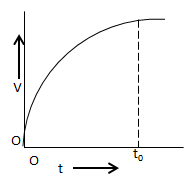
In the graph shown in option A, the velocity of the rocket increases rapidly until time \[{t_0}\] and after time \[{t_0}\] also the velocity of the rocket increases slowly.
Hence, the option A is incorrect.
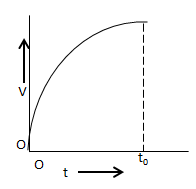
In the graph shown in option B, the velocity of the rocket increases until time \[{t_0}\] and then suddenly becomes zero.
Hence, option B is incorrect.
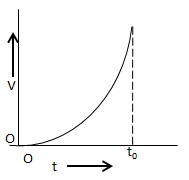
In the graph shown in option D, the velocity of the rocket increases until time \[{t_0}\] and then suddenly becomes zero.
Hence, the option D is incorrect.
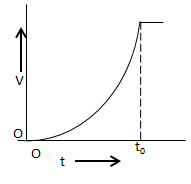
In the graph shown in option C, the velocity of the rocket increases until time \[{t_0}\] and then it becomes constant after time \[{t_0}\].
So, the correct answer is “Option C”.
Note:
According to Newton’s first law of motion, the rocket continues its speed of motion until a force (resulting from burning of fuel) is acting on it and after all the fuel is over, the velocity remains constant.
Complete step by step answer:
When the fuel is burnt, then the velocity of the rock increases.
Initially, as the mass of the fuel is substantial, the velocity of the rocket increases rapidly.
But after time \[{t_0}\], the fuel of the rocket is over. After this time \[{t_0}\], there is no fuel in the rocket to burn and to increase the velocity of the rocket.
Therefore, according to Newton’s first law of motion there is no force on the rocket to increase its velocity as all the fuel is burnt.
Hence, the velocity of the rocket in gravity free space after time \[{t_0}\] remains the same for all time.
In the graph shown in option A, the velocity of the rocket increases rapidly until time \[{t_0}\] and after time \[{t_0}\] also the velocity of the rocket increases slowly.
Hence, the option A is incorrect.
In the graph shown in option B, the velocity of the rocket increases until time \[{t_0}\] and then suddenly becomes zero.
Hence, option B is incorrect.
In the graph shown in option D, the velocity of the rocket increases until time \[{t_0}\] and then suddenly becomes zero.
Hence, the option D is incorrect.
In the graph shown in option C, the velocity of the rocket increases until time \[{t_0}\] and then it becomes constant after time \[{t_0}\].
So, the correct answer is “Option C”.
Note:
According to Newton’s first law of motion, the rocket continues its speed of motion until a force (resulting from burning of fuel) is acting on it and after all the fuel is over, the velocity remains constant.
Recently Updated Pages
The magnetic field in a plane electromagnetic wave class 11 physics CBSE

In a plane electromagnetic wave the electric field class 12 physics CBSE
A plane electromagnetic wave travels in vacuum along class 12 physics CBSE
Basicity of sulphurous acid and sulphuric acid are
Master Class 11 Business Studies: Engaging Questions & Answers for Success
Master Class 11 Computer Science: Engaging Questions & Answers for Success
Trending doubts
One Metric ton is equal to kg A 10000 B 1000 C 100 class 11 physics CBSE
What are the examples of C3 and C4 plants class 11 biology CBSE
State and prove Bernoullis theorem class 11 physics CBSE
10 examples of friction in our daily life
A body is said to be in dynamic equilibrium if A When class 11 physics CBSE
Difference Between Prokaryotic Cells and Eukaryotic Cells