




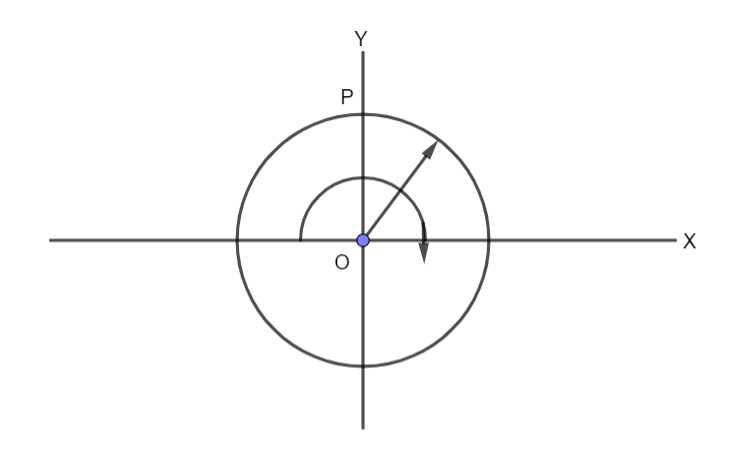
A ring rotates about the z axis as shown in the figure. The plane of rotation is x-y. At a certain instant, the acceleration of a particle P (shown in the figure) is $(6\hat i - 8\hat j)\,m\,{s^{ - 2}}$ . Find the angular acceleration of the ring and the angular velocity at that instant. Radius of the ring is $2\,m$ .
Answer
 Verified
561.3k+ views
Hint: In this question, we will break the given acceleration into its components- tangential and normal- and use their formulas. The tangential acceleration will be equal to the x component of the given acceleration and the normal acceleration is equal to the y component of the given acceleration. Given that the radius of the circular path is 2m, we can find out the value of angular velocity and angular acceleration by substituting the values.
Complete step by step answer:
Let the angular acceleration be $\alpha $ and the angular velocity be $\omega $ .
The acceleration of a particle moving in circular motion has two components.
(1) Tangential acceleration: The acceleration that acts along the tangent. This is generally denoted as ${a_t}$ . The magnitude is given by ${a_t} = R\alpha $ where R is the radius of the circular path.
(2) Normal or centripetal acceleration: The acceleration acting radially inwards towards the center of the circular path described by the body. This is generally denoted as ${a_n}$ . The magnitude is given by ${a_n} = R{\omega ^2}$ where R is the radius of the circular path.
At point P, the tangential acceleration will be equal to the x component of the given acceleration and the normal acceleration is equal to the y component of the given acceleration.
Hence, we can say that ${a_t} = R\alpha = 6\,rad\,{s^{ - 2}}$
Given that the radius of the circular path is 2m, we can find out the value of angular acceleration.
Substituting the values, we get,
$6 = 2\alpha $
$ \Rightarrow \alpha = 3\,rad\,{s^{ - 2}}$
Also, we can say that ${a_n} = R{\omega ^2} = 8\,rad\,{s^{ - 2}}$
Given that the radius of the circular path is 2m, we can find out the value of angular velocity.
Substituting the values, we get,
$8 = 2{\omega ^2}$
$ \Rightarrow {\omega ^2} = 4$
This gives us $\omega = 2\,rad\,{s^{ - 1}}$
Note:Here we did not take into account the vectorial notation of accelerations. Acceleration being a vector must be given some direction. However, in this question, the components were already given and hence the direction of the acceleration was also already specified. So, we directly calculated the magnitude of the angular acceleration and angular velocity from the formulas.
Complete step by step answer:
Let the angular acceleration be $\alpha $ and the angular velocity be $\omega $ .
The acceleration of a particle moving in circular motion has two components.
(1) Tangential acceleration: The acceleration that acts along the tangent. This is generally denoted as ${a_t}$ . The magnitude is given by ${a_t} = R\alpha $ where R is the radius of the circular path.
(2) Normal or centripetal acceleration: The acceleration acting radially inwards towards the center of the circular path described by the body. This is generally denoted as ${a_n}$ . The magnitude is given by ${a_n} = R{\omega ^2}$ where R is the radius of the circular path.
At point P, the tangential acceleration will be equal to the x component of the given acceleration and the normal acceleration is equal to the y component of the given acceleration.
Hence, we can say that ${a_t} = R\alpha = 6\,rad\,{s^{ - 2}}$
Given that the radius of the circular path is 2m, we can find out the value of angular acceleration.
Substituting the values, we get,
$6 = 2\alpha $
$ \Rightarrow \alpha = 3\,rad\,{s^{ - 2}}$
Also, we can say that ${a_n} = R{\omega ^2} = 8\,rad\,{s^{ - 2}}$
Given that the radius of the circular path is 2m, we can find out the value of angular velocity.
Substituting the values, we get,
$8 = 2{\omega ^2}$
$ \Rightarrow {\omega ^2} = 4$
This gives us $\omega = 2\,rad\,{s^{ - 1}}$
Note:Here we did not take into account the vectorial notation of accelerations. Acceleration being a vector must be given some direction. However, in this question, the components were already given and hence the direction of the acceleration was also already specified. So, we directly calculated the magnitude of the angular acceleration and angular velocity from the formulas.
Recently Updated Pages
If x a + bt + ct2 where x is in meters and t is in class 11 physics CBSE

A car covers the first half distance between two places class 11 physics CBSE
The resultant of two vectors overrightarrow P and overrightarrow class 11 physics CBSE
Find the value of cos 135 class 11 maths CBSE
A mass M is held in place by an applied force F and class 11 physics CBSE
A solution of glucose in water is labelled as 10 dfracwv class 11 chemistry CBSE
Trending doubts
One Metric ton is equal to kg A 10000 B 1000 C 100 class 11 physics CBSE
Find the value of the expression given below sin 30circ class 11 maths CBSE
Draw a diagram of nephron and explain its structur class 11 biology CBSE
10 examples of friction in our daily life
Proton was discovered by A Thomson B Rutherford C Chadwick class 11 chemistry CBSE
Bond order ofO2 O2+ O2 and O22 is in order A O2 langle class 11 chemistry CBSE