



What is a right angle, acute angle, and obtuse angle?
Answer
 Verified
564k+ views
Hint: In order to know about right, acute and obtuse angles we should know about an angle. An angle is the space made between two intersecting lines at a common vertex. It is measured in degrees using a protractor.
Complete step by step solution:
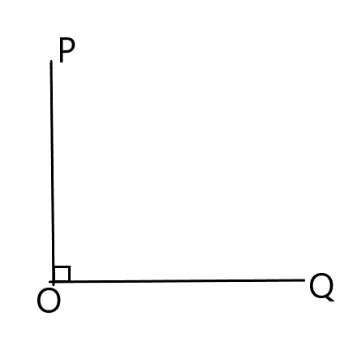
Right Angle: An angle which when measured is exactly ${90^ \circ }$. In this angle, the two intersecting lines at $O$ are perpendicular to each other. Let’s see an example of an angle $\angle POQ$ which is right angled, in which the square corner represents ${90^ \circ }$.
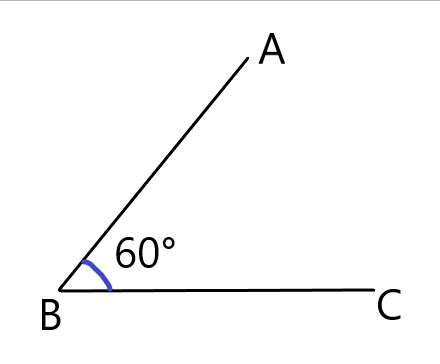
Acute Angle: An angle which when measured is less than ${90^ \circ }$. It can be any angle between ${0^ \circ }$ and ${90^ \circ }$. Let’s see an example of an angle $\angle ABC$ which is acute:
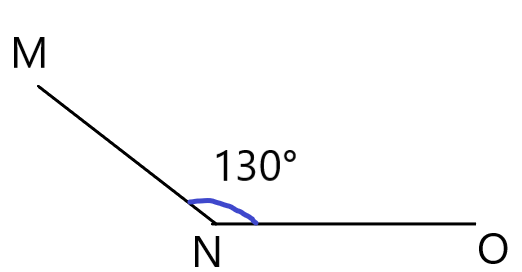
Obtuse angle: An angle which when measured is greater than ${90^ \circ }$. It can be any angle between ${90^ \circ }$ and ${180^ \circ }$. Let’s see an example of an angle $\angle MNO$ which is obtuse angled:
Note:
There are seven or more types of angles, in which the main angles are the right, acute and obtuse angles. Some of the other angles are:
1) Reflex angle: The angle which measures greater than ${180^ \circ }$ and less than ${360^ \circ }$ Or An angle between both of these degrees, is called Reflex angle.
2) Straight angle: An angle which is exactly ${180^ \circ }$.
3) Complete angle: An angle which covers total ${360^ \circ }$.
4) Complementary angles: When the sum of two acute angles give ${90^ \circ }$, or a right angle.
5) Supplementary angles: When the sum of two angles gives ${180^ \circ }$, or a straight angle.
Complete step by step solution:
Right Angle: An angle which when measured is exactly ${90^ \circ }$. In this angle, the two intersecting lines at $O$ are perpendicular to each other. Let’s see an example of an angle $\angle POQ$ which is right angled, in which the square corner represents ${90^ \circ }$.
Acute Angle: An angle which when measured is less than ${90^ \circ }$. It can be any angle between ${0^ \circ }$ and ${90^ \circ }$. Let’s see an example of an angle $\angle ABC$ which is acute:
Obtuse angle: An angle which when measured is greater than ${90^ \circ }$. It can be any angle between ${90^ \circ }$ and ${180^ \circ }$. Let’s see an example of an angle $\angle MNO$ which is obtuse angled:
Note:
There are seven or more types of angles, in which the main angles are the right, acute and obtuse angles. Some of the other angles are:
1) Reflex angle: The angle which measures greater than ${180^ \circ }$ and less than ${360^ \circ }$ Or An angle between both of these degrees, is called Reflex angle.
2) Straight angle: An angle which is exactly ${180^ \circ }$.
3) Complete angle: An angle which covers total ${360^ \circ }$.
4) Complementary angles: When the sum of two acute angles give ${90^ \circ }$, or a right angle.
5) Supplementary angles: When the sum of two angles gives ${180^ \circ }$, or a straight angle.

Recently Updated Pages
Master Class 11 English: Engaging Questions & Answers for Success

Master Class 11 Social Science: Engaging Questions & Answers for Success
Master Class 11 Maths: Engaging Questions & Answers for Success
Master Class 11 Biology: Engaging Questions & Answers for Success
Master Class 11 Physics: Engaging Questions & Answers for Success
Master Class 11 Chemistry: Engaging Questions & Answers for Success
Trending doubts
Full Form of IASDMIPSIFSIRSPOLICE class 7 social science CBSE
Write in numerals Ten lakh ninety thousand nine hundred class 7 maths CBSE
How many crores make 10 million class 7 maths CBSE
One lakh eight thousand how can we write it in num class 7 maths CBSE
One lakh eight thousand how can we write it in num class 7 maths CBSE
List of coprime numbers from 1 to 100 class 7 maths CBSE