




A rectangular sheet of acrylic is \[34cm\] by \[24cm\] . From it, \[64\] circular buttons, each of diameter \[3.5cm\] , have been cut out. Find the area of the remaining sheet.
Answer
 Verified
511.5k+ views
Hint: Here some circular buttons are cut out from a large rectangular acrylic sheet. To find the area of the rectangular sheet except for those circular buttons we have to subtract the area of the circular buttons from the area of the rectangular sheet.
Formula: The area of a rectangle with length \[l\] and breadth \[b\] is given by \[A = l \times b\] .
The area of a circle is \[A = \pi {r^2}\] where \[r\] is the radius.
Complete step by step answer:
It is given that the rectangular acrylic sheet is of length \[34cm\] and breadth \[24cm\] .
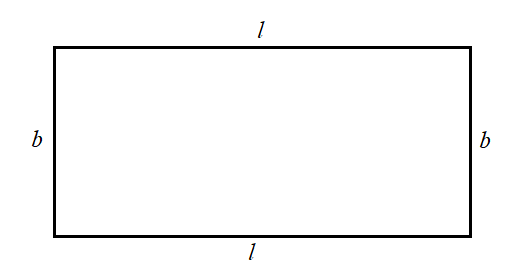
We know that the area of a rectangle is \[A = l \times b\] where \[l\] is the length and \[b\] is the breadth of the rectangle.
Thus, the area of the rectangular acrylic sheet is \[A = 34 \times 24 = 816c{m^2}\] .
It is given that \[64\] circular buttons are cut out from that acrylic sheet.
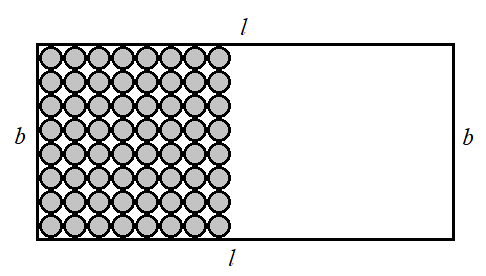
We know that the area of the circle is given by \[A = \pi {r^2}\] where \[r\] is the radius of the circle.
Thus, the area of one circular button is \[A = \pi {r^2} = \dfrac{{22}}{7} \times \dfrac{{3.5}}{2} \times \dfrac{{3.5}}{2}\]
Let us simplify this, \[A = \dfrac{{11}}{1} \times \dfrac{{0.5}}{1} \times \dfrac{{3.5}}{2}\]
Let us simplify it further.
\[A = \dfrac{{11 \times 0.5 \times 3.5}}{2} = \dfrac{{19.25}}{2}\]
On simplifying it again we get the area of one circular button.
\[A = 9.625\]
Thus, the area of one circular button is \[9.625c{m^2}\] .
It is given that \[64\] circular buttons are cut out from the sheet.
Thus, the area of \[64\] circular buttons is \[64 \times 9.625 = 57.75\] .
We aim to find the area of the remaining rectangular sheet after cutting out \[64\] circular buttons from that. For that, we need to subtract the area of the \[64\] circular buttons from the area of the rectangular sheet.
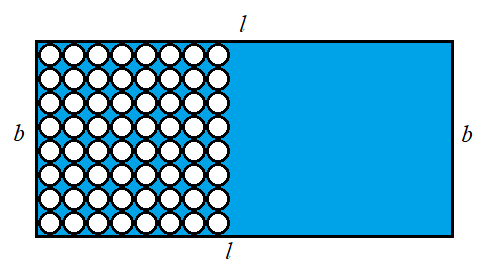
Thus, the area of the remaining acrylic sheet is \[816 - 9.625 = 806.375\] .
Therefore, the area of the remaining rectangular acrylic sheet is \[806.37c{m^2}\] .
Note:
The area of the remaining part can be found by subtracting the used part from the area of the whole part. Thus, we have subtracted the area of those circular buttons from the rectangular acrylic sheet, which will give us the area of the remaining part.
Formula: The area of a rectangle with length \[l\] and breadth \[b\] is given by \[A = l \times b\] .
The area of a circle is \[A = \pi {r^2}\] where \[r\] is the radius.
Complete step by step answer:
It is given that the rectangular acrylic sheet is of length \[34cm\] and breadth \[24cm\] .
We know that the area of a rectangle is \[A = l \times b\] where \[l\] is the length and \[b\] is the breadth of the rectangle.
Thus, the area of the rectangular acrylic sheet is \[A = 34 \times 24 = 816c{m^2}\] .
It is given that \[64\] circular buttons are cut out from that acrylic sheet.
We know that the area of the circle is given by \[A = \pi {r^2}\] where \[r\] is the radius of the circle.
Thus, the area of one circular button is \[A = \pi {r^2} = \dfrac{{22}}{7} \times \dfrac{{3.5}}{2} \times \dfrac{{3.5}}{2}\]
Let us simplify this, \[A = \dfrac{{11}}{1} \times \dfrac{{0.5}}{1} \times \dfrac{{3.5}}{2}\]
Let us simplify it further.
\[A = \dfrac{{11 \times 0.5 \times 3.5}}{2} = \dfrac{{19.25}}{2}\]
On simplifying it again we get the area of one circular button.
\[A = 9.625\]
Thus, the area of one circular button is \[9.625c{m^2}\] .
It is given that \[64\] circular buttons are cut out from the sheet.
Thus, the area of \[64\] circular buttons is \[64 \times 9.625 = 57.75\] .
We aim to find the area of the remaining rectangular sheet after cutting out \[64\] circular buttons from that. For that, we need to subtract the area of the \[64\] circular buttons from the area of the rectangular sheet.
Thus, the area of the remaining acrylic sheet is \[816 - 9.625 = 806.375\] .
Therefore, the area of the remaining rectangular acrylic sheet is \[806.37c{m^2}\] .
Note:
The area of the remaining part can be found by subtracting the used part from the area of the whole part. Thus, we have subtracted the area of those circular buttons from the rectangular acrylic sheet, which will give us the area of the remaining part.
Recently Updated Pages
Master Class 11 English: Engaging Questions & Answers for Success

Master Class 11 Social Science: Engaging Questions & Answers for Success
Master Class 11 Maths: Engaging Questions & Answers for Success
Master Class 11 Biology: Engaging Questions & Answers for Success
Master Class 11 Physics: Engaging Questions & Answers for Success
Master Class 11 Chemistry: Engaging Questions & Answers for Success
Trending doubts
Explain the Treaty of Vienna of 1815 class 10 social science CBSE
What is the full form of CNG A Complete Natural Gas class 10 social science CBSE
In cricket, what is a "Yorker" designed to do?
What is the full form of POSCO class 10 social science CBSE
Define Potential, Developed, Stock and Reserved resources
What were the majoritarian measures taken in Sri Lanka class 10 social science CBSE