




A rectangular parallelopiped is formed by drawing planes through the points (-1,2,5) and (1,-1,-1) and parallel to the coordinate planes. The length of the diagonal of the parallelopiped is:
(a) 2
(b) 3
(c) 6
(d) 7
Answer
 Verified
610.2k+ views
Hint: We know the diagonal of parallelopiped is the square root of the sum of squares of its edges. So, first we need their edge’s length. So, by that we can get the diagonal. First we have 2 points. All the planes pass through these points. So, the distance between these planes are edges. So the difference between corresponding coordinates, we get the edge lengths. Now the final sum of squares and then add them together.
Complete step-by-step solution -
Parallelopiped: In geometry, a parallelopiped or parallelopipedal is a three-dimensional figure by six parallelograms. By analogy it relates to a parallelogram just as a cube relates to a square.
Diagonal of Parallelopiped: As we know three sides a, b, c. The diagonal will be the square root of the sum of squares of these 3 edges of parallelopiped.
Diagonal= $\sqrt{{{a}^{2}}+{{b}^{2}}+{{c}^{2}}}...........(i)$
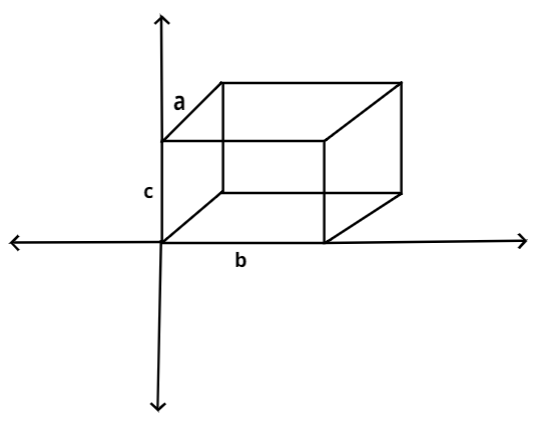
Given condition in the question, parallelopiped’s planes passes through (-1,2,5) (1,-1,-1).
So, all the planes pass through these points. Now the distance between planes through (a,0,0) (b,0,0) is b-a.
Similarly, we can generate 3 pairs of planes from each coordinate from these 2 points.
Let the first edge be assumed as a in the question.
We take ‘a’ as x-coordinates edge. So, by subtracting both x’s we get,
a=1-(-1)
By simplifying the above, we get value of a as:
a=2
by squaring on both sides, we get value of it as:
${{a}^{2}}=4......(ii)$
Let the second and third edges be b, c in this question we take “b” as distance between y- coordinates and “c” as distance between z- coordinates
So, by subtracting y-coordinate, we get the value of b as:
b= -1-2=-3
by subtracting z coordinates, we get the value of c as:
c=-1-5=-6
By squaring both the above equation we get their values as:
${{b}^{2}}=9........(iii);\,\,{{c}^{2}}=36.......(iv)$
By substituting equations (iii),(iv),(ii) in the equation (i), we get:
Diagonal = $\sqrt{4+9+36}$
by simplifying the root; we get its value as:
Diagonal =7
Therefore option (d) is correct for the given radius in the question.
Note: Be careful while stating analogy of planes, distance. So, when we find the plane's distance, the order of difference doesn’t matter because in the next step we square them. So, you may apply for an order. Don’t consider the negative root for diagonal because it’s a length it must always be greater than 0.
Complete step-by-step solution -
Parallelopiped: In geometry, a parallelopiped or parallelopipedal is a three-dimensional figure by six parallelograms. By analogy it relates to a parallelogram just as a cube relates to a square.
Diagonal of Parallelopiped: As we know three sides a, b, c. The diagonal will be the square root of the sum of squares of these 3 edges of parallelopiped.
Diagonal= $\sqrt{{{a}^{2}}+{{b}^{2}}+{{c}^{2}}}...........(i)$
Given condition in the question, parallelopiped’s planes passes through (-1,2,5) (1,-1,-1).
So, all the planes pass through these points. Now the distance between planes through (a,0,0) (b,0,0) is b-a.
Similarly, we can generate 3 pairs of planes from each coordinate from these 2 points.
Let the first edge be assumed as a in the question.
We take ‘a’ as x-coordinates edge. So, by subtracting both x’s we get,
a=1-(-1)
By simplifying the above, we get value of a as:
a=2
by squaring on both sides, we get value of it as:
${{a}^{2}}=4......(ii)$
Let the second and third edges be b, c in this question we take “b” as distance between y- coordinates and “c” as distance between z- coordinates
So, by subtracting y-coordinate, we get the value of b as:
b= -1-2=-3
by subtracting z coordinates, we get the value of c as:
c=-1-5=-6
By squaring both the above equation we get their values as:
${{b}^{2}}=9........(iii);\,\,{{c}^{2}}=36.......(iv)$
By substituting equations (iii),(iv),(ii) in the equation (i), we get:
Diagonal = $\sqrt{4+9+36}$
by simplifying the root; we get its value as:
Diagonal =7
Therefore option (d) is correct for the given radius in the question.
Note: Be careful while stating analogy of planes, distance. So, when we find the plane's distance, the order of difference doesn’t matter because in the next step we square them. So, you may apply for an order. Don’t consider the negative root for diagonal because it’s a length it must always be greater than 0.

Recently Updated Pages
Master Class 11 Business Studies: Engaging Questions & Answers for Success

Master Class 12 Business Studies: Engaging Questions & Answers for Success
Master Class 12 Biology: Engaging Questions & Answers for Success
Master Class 12 Chemistry: Engaging Questions & Answers for Success
Class 12 Question and Answer - Your Ultimate Solutions Guide
Master Class 11 Computer Science: Engaging Questions & Answers for Success
Trending doubts
Four bells toll together at 900am They toll after 7811 class 6 maths CBSE
What is the capital city of Australia? A) Sydney B) Melbourne C) Brisbane D) Canberra
Give 10 examples for herbs , shrubs , climbers , creepers
Write a formal letter on this topic Write a formal class 6 english CBSE
Two positive numbers have their HCF as 12 and their class 6 maths CBSE
There are 156 208 260 students in groups A B C respectively class 6 maths CBSE