




A ray of light strikes a glass slab of thickness $t$ . It emerges on the opposite face, parallel to the incident ray but laterally displaced. Find the lateral displacement.
A) $0$
B) $t\sin \left( {i - r} \right)\cos r$
C) $t\dfrac{{\sin i}}{{\cos r}}$
D) $t\dfrac{{\sin \left( {i - r} \right)}}{{\cos r}}$
Answer
 Verified
613.5k+ views
Hint:When a light ray enters from a rarer medium into a denser medium, the refracted ray will bend towards the normal. Here glass is denser than air. Sketching a ray diagram will provide a better understanding. The lateral displacement can be obtained by using simple rules of trigonometry for right-angled triangles formed by the refracted ray and the ray parallel to the incident ray.
Formulas used:
-The relation for the cosine of an angle in a right-angled triangle is given by, $\cos \theta = \dfrac{{{\text{Adjacent}}}}{{{\text{Hypotenuse}}}}$
-The relation for the sine of an angle in a right-angled triangle is given by, $\sin \theta = \dfrac{{{\text{Opposite}}}}{{{\text{Hypotenuse}}}}$
Complete step by step answer.
Step 1: Sketch a ray diagram depicting the incidence and emergence of light from the glass slab.
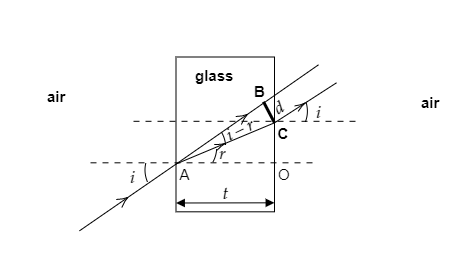
The above figure shows how the ray of light is incident on the glass slab of thickness $t$ and how it emerges from the slab to be parallel to the incident ray but suffering a lateral displacement $d$ .
The angle of incidence is marked as $i$ and the angle of refraction is marked as $r$ .
From the figure we also have $\angle BAC = i - r$ .
The side AO corresponds to the thickness of the slab.
i.e., $AO = t$
As seen from the figure the side BC will correspond to the lateral displacement of the emerging ray.
i.e., $BC = d$
Step 2: Obtain the sine and cosine of $\angle i - r$ and $\angle r$ in $\Delta ABC$ and $\Delta AOC$ to determine the lateral displacement $d$ .
Consider $\Delta AOC$ , we have $\cos r = \dfrac{{{\text{Adjacent}}}}{{{\text{Hypotenuse}}}}$
Here the adjacent side is $AO = t$ and the hypotenuse is ${\text{AC}}$ .
Then we have $\cos r = \dfrac{t}{{AC}}$
$ \Rightarrow AC = \dfrac{t}{{\cos r}}$ --------- (1)
Consider $\Delta ABC$ , we have $\sin \left( {i - r} \right) = \dfrac{{{\text{Opposite}}}}{{{\text{Hypotenuse}}}}$
Here the opposite side is $BC = d$ and the hypotenuse is ${\text{AC}}$ .
Then we have $\sin \left( {i - r} \right) = \dfrac{d}{{AC}}$--------- (2)
Substituting equation (1) in (2) we get, $\sin \left( {i - r} \right) = \dfrac{{d\cos r}}{t}$
$ \Rightarrow d = t\dfrac{{\sin \left( {i - r} \right)}}{{\cos r}}$
Thus the lateral displacement is obtained as $d = t\dfrac{{\sin \left( {i - r} \right)}}{{\cos r}}$
So the correct option is D.
Note:The trigonometric relations for the sine and cosine of an angle can only be applied when dealing with a right triangle. Here both triangles $\Delta ABC$ and $\Delta AOC$ are right triangles and so we can apply these relations to find the lateral displacement. In $\Delta AOC$ , $\angle OF = 90^\circ $ and in $\Delta ABC$ , $\angle B = 90^\circ $ .
Formulas used:
-The relation for the cosine of an angle in a right-angled triangle is given by, $\cos \theta = \dfrac{{{\text{Adjacent}}}}{{{\text{Hypotenuse}}}}$
-The relation for the sine of an angle in a right-angled triangle is given by, $\sin \theta = \dfrac{{{\text{Opposite}}}}{{{\text{Hypotenuse}}}}$
Complete step by step answer.
Step 1: Sketch a ray diagram depicting the incidence and emergence of light from the glass slab.
The above figure shows how the ray of light is incident on the glass slab of thickness $t$ and how it emerges from the slab to be parallel to the incident ray but suffering a lateral displacement $d$ .
The angle of incidence is marked as $i$ and the angle of refraction is marked as $r$ .
From the figure we also have $\angle BAC = i - r$ .
The side AO corresponds to the thickness of the slab.
i.e., $AO = t$
As seen from the figure the side BC will correspond to the lateral displacement of the emerging ray.
i.e., $BC = d$
Step 2: Obtain the sine and cosine of $\angle i - r$ and $\angle r$ in $\Delta ABC$ and $\Delta AOC$ to determine the lateral displacement $d$ .
Consider $\Delta AOC$ , we have $\cos r = \dfrac{{{\text{Adjacent}}}}{{{\text{Hypotenuse}}}}$
Here the adjacent side is $AO = t$ and the hypotenuse is ${\text{AC}}$ .
Then we have $\cos r = \dfrac{t}{{AC}}$
$ \Rightarrow AC = \dfrac{t}{{\cos r}}$ --------- (1)
Consider $\Delta ABC$ , we have $\sin \left( {i - r} \right) = \dfrac{{{\text{Opposite}}}}{{{\text{Hypotenuse}}}}$
Here the opposite side is $BC = d$ and the hypotenuse is ${\text{AC}}$ .
Then we have $\sin \left( {i - r} \right) = \dfrac{d}{{AC}}$--------- (2)
Substituting equation (1) in (2) we get, $\sin \left( {i - r} \right) = \dfrac{{d\cos r}}{t}$
$ \Rightarrow d = t\dfrac{{\sin \left( {i - r} \right)}}{{\cos r}}$
Thus the lateral displacement is obtained as $d = t\dfrac{{\sin \left( {i - r} \right)}}{{\cos r}}$
So the correct option is D.
Note:The trigonometric relations for the sine and cosine of an angle can only be applied when dealing with a right triangle. Here both triangles $\Delta ABC$ and $\Delta AOC$ are right triangles and so we can apply these relations to find the lateral displacement. In $\Delta AOC$ , $\angle OF = 90^\circ $ and in $\Delta ABC$ , $\angle B = 90^\circ $ .
Recently Updated Pages
Master Class 12 Economics: Engaging Questions & Answers for Success

Master Class 12 English: Engaging Questions & Answers for Success
Master Class 12 Social Science: Engaging Questions & Answers for Success
Master Class 12 Maths: Engaging Questions & Answers for Success
Master Class 12 Physics: Engaging Questions & Answers for Success
Master Class 9 General Knowledge: Engaging Questions & Answers for Success
Trending doubts
Which are the Top 10 Largest Countries of the World?
Draw a labelled sketch of the human eye class 12 physics CBSE
Differentiate between homogeneous and heterogeneous class 12 chemistry CBSE
Sulphuric acid is known as the king of acids State class 12 chemistry CBSE
Why is the cell called the structural and functional class 12 biology CBSE
A dentist uses a small mirror that gives a magnification class 12 physics CBSE