




A ray of light of pure single colour is incident on the face of a prism having angle of the prism 30° at an angle of incidence 45°. The refracted ray does not change its direction as it crosses the other face and emerges out of the prism. The refractive index of the material of the prism is
A. $\dfrac{2}{{\sqrt 3 }}$
B. 2
C. $\sqrt 2 $
D. $\sqrt 3 $
Answer
 Verified
607.8k+ views
Hint: Use ${r_2}$= 0° since the refracted ray emerges from the prism without changing its direction. Also remember to use formulav$A = {r_1} + {r_2}$ and find the correct option.
Formula used: ${\mu _{21}} = \dfrac{{\sin {i_1}}}{{\sin {r_1}}}$and $A = {r_1} + {r_2}$
Complete Step-by-Step solution:
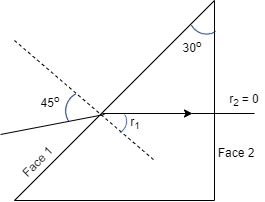
According to the given information A = 30° and ${i_1} = 45^\circ $
Since according to the given information the refracted ray does not change its direction
Also we know that for a prism of angle A, ${r_1}$ and ${r_2}$ are the refraction angle
Therefore $A = {r_1} + {r_2}$ (equation 1)
Since the refracted ray emerges out of the prism without change in direction .i.e. ${r_2}$= 0°
Substituting the values in the equation 1
$ \Rightarrow $\[{30^ \circ } = {r_1} + {0^ \circ }\]
$ \Rightarrow $\[{r_1} = {30^ \circ }\]
Therefore the relation ${\mu _{21}} = \dfrac{{\sin {i_1}}}{{\sin {r_1}}}$$ \Rightarrow $$\dfrac{{\sin {{45}^ \circ }}}{{\sin {{30}^ \circ }}}$
So, ${\mu _{21}} = \sqrt 2 $
Hence C is the correct option.
Note: Refraction is the bending of light when going from one medium to another, and as a light ray passes through a glass prism, light refraction happens both when it reaches the prism and when it leaves the prism. Furthermore, because the refracting surfaces are not parallel, the evolving radius and incident rays are not parallel to each other. In this case, on passing through the prism, the beam of light deviates.
Formula used: ${\mu _{21}} = \dfrac{{\sin {i_1}}}{{\sin {r_1}}}$and $A = {r_1} + {r_2}$
Complete Step-by-Step solution:
According to the given information A = 30° and ${i_1} = 45^\circ $
Since according to the given information the refracted ray does not change its direction
Also we know that for a prism of angle A, ${r_1}$ and ${r_2}$ are the refraction angle
Therefore $A = {r_1} + {r_2}$ (equation 1)
Since the refracted ray emerges out of the prism without change in direction .i.e. ${r_2}$= 0°
Substituting the values in the equation 1
$ \Rightarrow $\[{30^ \circ } = {r_1} + {0^ \circ }\]
$ \Rightarrow $\[{r_1} = {30^ \circ }\]
Therefore the relation ${\mu _{21}} = \dfrac{{\sin {i_1}}}{{\sin {r_1}}}$$ \Rightarrow $$\dfrac{{\sin {{45}^ \circ }}}{{\sin {{30}^ \circ }}}$
So, ${\mu _{21}} = \sqrt 2 $
Hence C is the correct option.
Note: Refraction is the bending of light when going from one medium to another, and as a light ray passes through a glass prism, light refraction happens both when it reaches the prism and when it leaves the prism. Furthermore, because the refracting surfaces are not parallel, the evolving radius and incident rays are not parallel to each other. In this case, on passing through the prism, the beam of light deviates.
Recently Updated Pages
Master Class 10 Computer Science: Engaging Questions & Answers for Success

Master Class 10 General Knowledge: Engaging Questions & Answers for Success
Master Class 10 English: Engaging Questions & Answers for Success
Master Class 10 Social Science: Engaging Questions & Answers for Success
Master Class 10 Maths: Engaging Questions & Answers for Success
Master Class 10 Science: Engaging Questions & Answers for Success
Trending doubts
What is the median of the first 10 natural numbers class 10 maths CBSE
Which women's tennis player has 24 Grand Slam singles titles?
Who is the Brand Ambassador of Incredible India?
Why is there a time difference of about 5 hours between class 10 social science CBSE
Write a letter to the principal requesting him to grant class 10 english CBSE
State and prove converse of BPT Basic Proportionality class 10 maths CBSE