




A ray of light, incident on an equilateral prism $({\mu _g} = \sqrt 3 )$ moves parallel to the baseline of the prism inside it. Find the angle of incidence for this ray.
Answer
 Verified
588.6k+ views
Hint: Use the concept of planar geometry and then find out the angle of reflection. After that use Snell’s law to find out the angle of incidence.
Complete step by step solution:
The above situation can be visualized as
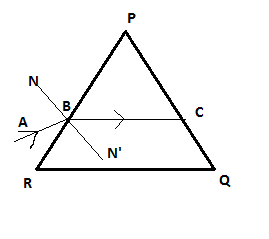
Here the $NN'$ is the normal. Since the prism is an equilateral prism, therefore each angle including the angle of prism $A$ is equal to ${60^ \circ }$
$\therefore A = {60^ \circ }$
Now we use some geometry here
$\angle BRQ = {60^ \circ }$ since it is an equilateral prism
$\therefore \angle RBC = {120^ \circ }$ Since $RQ||BC$ given in question
$\angle N'BR = {90^ \circ }$ Since $NN'$ is the normal
Using above data we get that
$\angle N'BC = \angle RBC - \angle N'BR$
Substituting the values in the above equation we get;
$\angle N'BC = {120^ \circ } - {90^ \circ }$
$\angle N'BC = {30^ \circ }$ Which is the angle of refraction.
Now using snell's law,
${\mu _1}\sin i = {\mu _2}\sin r$
Substituting the values in the above equation we get;
$ \Rightarrow 1 \times \sin i = \sqrt 3 \sin {30^ \circ }$
Calculating further we get;
$ \Rightarrow \sin i = \dfrac{{\sqrt 3 }}{2}$
$ \Rightarrow i = {\sin ^{ - 1}}\dfrac{{\sqrt 3 }}{2}$
$ \therefore = {60^ \circ }$
Therefore the angle of incidence $i = {60^ \circ }.$
Additional Information:
An optical prism is a transparent optical element with flat, polished surfaces that refract light. At least one surface must be angled—elements with two parallel surfaces are not prisms. The traditional geometrical shape of an optical prism is that of a triangular prism with a triangular base and rectangular sides, and in colloquial use "prism" usually refers to this type. Some types of optical prisms are not in fact in the shape of geometric prisms. Prisms can be made from any material that is transparent to the wavelengths for which they are designed. Typical materials include glass, plastic, and fluorite. Prism is generally used to split white light into its constituent colours.
Note: Use Snell’s law appropriately. Questions of these types require good knowledge of planar geometry. Hence one should be sound in knowledge of planar geometry. Read about all other terms and properties of prism.
Complete step by step solution:
The above situation can be visualized as
Here the $NN'$ is the normal. Since the prism is an equilateral prism, therefore each angle including the angle of prism $A$ is equal to ${60^ \circ }$
$\therefore A = {60^ \circ }$
Now we use some geometry here
$\angle BRQ = {60^ \circ }$ since it is an equilateral prism
$\therefore \angle RBC = {120^ \circ }$ Since $RQ||BC$ given in question
$\angle N'BR = {90^ \circ }$ Since $NN'$ is the normal
Using above data we get that
$\angle N'BC = \angle RBC - \angle N'BR$
Substituting the values in the above equation we get;
$\angle N'BC = {120^ \circ } - {90^ \circ }$
$\angle N'BC = {30^ \circ }$ Which is the angle of refraction.
Now using snell's law,
${\mu _1}\sin i = {\mu _2}\sin r$
Substituting the values in the above equation we get;
$ \Rightarrow 1 \times \sin i = \sqrt 3 \sin {30^ \circ }$
Calculating further we get;
$ \Rightarrow \sin i = \dfrac{{\sqrt 3 }}{2}$
$ \Rightarrow i = {\sin ^{ - 1}}\dfrac{{\sqrt 3 }}{2}$
$ \therefore = {60^ \circ }$
Therefore the angle of incidence $i = {60^ \circ }.$
Additional Information:
An optical prism is a transparent optical element with flat, polished surfaces that refract light. At least one surface must be angled—elements with two parallel surfaces are not prisms. The traditional geometrical shape of an optical prism is that of a triangular prism with a triangular base and rectangular sides, and in colloquial use "prism" usually refers to this type. Some types of optical prisms are not in fact in the shape of geometric prisms. Prisms can be made from any material that is transparent to the wavelengths for which they are designed. Typical materials include glass, plastic, and fluorite. Prism is generally used to split white light into its constituent colours.
Note: Use Snell’s law appropriately. Questions of these types require good knowledge of planar geometry. Hence one should be sound in knowledge of planar geometry. Read about all other terms and properties of prism.
Recently Updated Pages
Basicity of sulphurous acid and sulphuric acid are

Master Class 12 English: Engaging Questions & Answers for Success
Master Class 12 Social Science: Engaging Questions & Answers for Success
Master Class 12 Maths: Engaging Questions & Answers for Success
Master Class 12 Economics: Engaging Questions & Answers for Success
Master Class 12 Physics: Engaging Questions & Answers for Success
Trending doubts
Which are the Top 10 Largest Countries of the World?
Draw a labelled sketch of the human eye class 12 physics CBSE
Draw ray diagrams each showing i myopic eye and ii class 12 physics CBSE
Give 10 examples of unisexual and bisexual flowers
Give simple chemical tests to distinguish between the class 12 chemistry CBSE
Define Vant Hoff factor How is it related to the degree class 12 chemistry CBSE