




When a ray of light enters a water filled glass tank from a glass face making a non-zero angle to the normal, the emergent ray from the opposite face will follow a path which is
A. same
B. deflected to the right
C. deflected to the left
D. parallel but not the same
Answer
 Verified
537k+ views
Hint: The phenomenon of refraction of light occurs when light travels through two differing mediums with different refractive indices. The concept of refraction and the laws of refraction are applied in order to find out the path of the emergent ray. The path of the ray is traced with the help of a diagram to find out the direction of the emergent ray.
Complete step by step answer:
The above problem revolves around the concept of refraction of light. In order to find out the path of the emergent ray from the glass tank we first need to know the concept of refraction. When a light ray travels from one medium to another, that is, when the ray of light from one medium falls on the second medium, then a part of the light is said to be refracted inside the second medium with a change in its direction or path.
Refraction is defined as the phenomenon wherein there is a change in the path of light or more specifically the bending of the light rays due to the difference in the medium it is travelling in. Refraction of light occurs due to its differing speeds in both the mediums, that is, the speed of light changes causing a change in path.
Each medium will have a particular nature. One medium may be denser or rarer than the other and the speed in which light was travelling would certainly differ because of the need to pass through many atoms or molecules present in the material which would obviously slow down the speed of light in the case of dense materials like glass. Hence there is a change in its direction which is observed.
The ray of light which is incident of the glass tank is called the incident ray of light while the light ray coming out of the glass tank through air once again is known as the emergent ray. Emergent ray is the ray leaving the medium which it had entered. We are asked to compare the incident ray and the path of the emergent ray which will have a slightly differing path after being refracted in the glass medium.
It is given in the question that the incident ray makes a non-zero angle of incidence with the normal and hence there will be refraction and a change in its path either towards or away from the normal. As per the laws of refraction, it is said that when a ray which travels from an optically rarer medium to an optically denser medium it tends to suffer a change in its direction and it tends to bend towards the normal.
Here, as per the question we have considered an air-glass medium which means that comparatively air is the rarer medium while glass is the denser medium and hence when it is first incident on the glass tank there is a refraction inside the glass medium and the ray bends towards the normal.
Inside the glass medium it travels through the refracted path and then when emerging out of the glass tank back into air it again suffers a deviation in its path and gets refracted in a direction away from the normal as it is travelling from an optically denser medium to a rarer medium; as per the laws of refraction. This path of the emergent ray is to be found out.
The diagram below illustrates the incident ray, the refraction of light in the medium and the emergent ray as well:
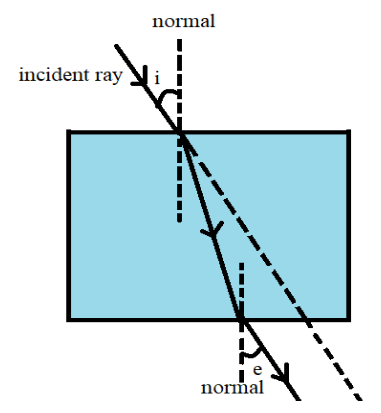
The above diagram shows the incident ray hitting the glass tank and then undergoing refraction and then again suffering deviation when emerging out of the tank. The dotted lines signify the path the incident light ray should have taken.
When we compare the path of this dotted line, that is, the incident ray with the emergent ray it can be clearly seen that the emergent ray appears to be parallel to the incident ray. But this emergent ray is not the same as the incident ray since it suffers a change in its path and direction due to refraction.Hence, the emergent ray from the opposite phase will be parallel but not the same as the incident ray.
Therefore, the correct option is option D.
Note: A common error in this problem can be the choosing of the wrong option because there is a chance to consider the deflection of the light and in which direction it is taking place which is wrong. A comparison is required to be made between the incident and emergent ray in order to find the solution. When the incident ray coincides with the normal, that is, the angle between the incident ray and the normal is zero then there occurs no refraction of light and hence no change in its path.
Complete step by step answer:
The above problem revolves around the concept of refraction of light. In order to find out the path of the emergent ray from the glass tank we first need to know the concept of refraction. When a light ray travels from one medium to another, that is, when the ray of light from one medium falls on the second medium, then a part of the light is said to be refracted inside the second medium with a change in its direction or path.
Refraction is defined as the phenomenon wherein there is a change in the path of light or more specifically the bending of the light rays due to the difference in the medium it is travelling in. Refraction of light occurs due to its differing speeds in both the mediums, that is, the speed of light changes causing a change in path.
Each medium will have a particular nature. One medium may be denser or rarer than the other and the speed in which light was travelling would certainly differ because of the need to pass through many atoms or molecules present in the material which would obviously slow down the speed of light in the case of dense materials like glass. Hence there is a change in its direction which is observed.
The ray of light which is incident of the glass tank is called the incident ray of light while the light ray coming out of the glass tank through air once again is known as the emergent ray. Emergent ray is the ray leaving the medium which it had entered. We are asked to compare the incident ray and the path of the emergent ray which will have a slightly differing path after being refracted in the glass medium.
It is given in the question that the incident ray makes a non-zero angle of incidence with the normal and hence there will be refraction and a change in its path either towards or away from the normal. As per the laws of refraction, it is said that when a ray which travels from an optically rarer medium to an optically denser medium it tends to suffer a change in its direction and it tends to bend towards the normal.
Here, as per the question we have considered an air-glass medium which means that comparatively air is the rarer medium while glass is the denser medium and hence when it is first incident on the glass tank there is a refraction inside the glass medium and the ray bends towards the normal.
Inside the glass medium it travels through the refracted path and then when emerging out of the glass tank back into air it again suffers a deviation in its path and gets refracted in a direction away from the normal as it is travelling from an optically denser medium to a rarer medium; as per the laws of refraction. This path of the emergent ray is to be found out.
The diagram below illustrates the incident ray, the refraction of light in the medium and the emergent ray as well:
The above diagram shows the incident ray hitting the glass tank and then undergoing refraction and then again suffering deviation when emerging out of the tank. The dotted lines signify the path the incident light ray should have taken.
When we compare the path of this dotted line, that is, the incident ray with the emergent ray it can be clearly seen that the emergent ray appears to be parallel to the incident ray. But this emergent ray is not the same as the incident ray since it suffers a change in its path and direction due to refraction.Hence, the emergent ray from the opposite phase will be parallel but not the same as the incident ray.
Therefore, the correct option is option D.
Note: A common error in this problem can be the choosing of the wrong option because there is a chance to consider the deflection of the light and in which direction it is taking place which is wrong. A comparison is required to be made between the incident and emergent ray in order to find the solution. When the incident ray coincides with the normal, that is, the angle between the incident ray and the normal is zero then there occurs no refraction of light and hence no change in its path.
Recently Updated Pages
Master Class 12 Economics: Engaging Questions & Answers for Success

Master Class 12 English: Engaging Questions & Answers for Success
Master Class 12 Social Science: Engaging Questions & Answers for Success
Master Class 12 Maths: Engaging Questions & Answers for Success
Master Class 12 Physics: Engaging Questions & Answers for Success
Master Class 9 General Knowledge: Engaging Questions & Answers for Success
Trending doubts
Explain the Treaty of Vienna of 1815 class 10 social science CBSE
Who Won 36 Oscar Awards? Record Holder Revealed
Why is it 530 pm in india when it is 1200 afternoon class 10 social science CBSE
Make a sketch of the human nerve cell What function class 10 biology CBSE
What is the full form of POSCO class 10 social science CBSE
Define Potential, Developed, Stock and Reserved resources