




A quadrilateral which has exactly one pair of parallel sides is called as?
A. a parallelogram
B. a rectangle
C. a trapezium
D a kite
Answer
 Verified
629.1k+ views
Hint: In a trapezium, two sides are parallel, where as other two sides are intersecting. A parallelogram and a rectangle are quadrilaterals having two pairs of the parallel sides. A kite is the quadrilateral having no parallel sides.
Complete step by step answer:
A parallelogram is the quadrilateral having two pairs of the parallel sides. The opposite sides of the parallelogram are equal.
A rectangle is the quadrilateral having two pairs of the parallel sides. The opposite sides of the rectangle are equal. Each angle of the rectangle is right-angle.
A kite is the quadrilateral having no pairs of the parallel sides. The adjacent sides of the kites are equal.
A trapezium is the quadrilateral having only one pair of the parallel sides, whereas, in rectangle and parallelogram there are two pair of the parallel sides. A kite is the quadrilateral having no parallel sides. Consider a trapezium ABCD as shown below.
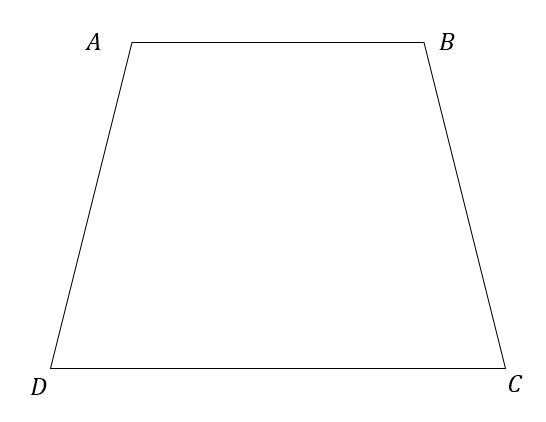
The above figure shows a trapezium. The side AB is parallel to DC. The sides AD and BC are intersecting.
So, the correct answer is “Option C”.
Note: Trapezium is the quadrilateral having one pair of parallel sides and other two sides are intersecting. The rectangle and parallelogram consist of two pairs of the parallel sides. The adjacent sides of the kites are equal.
Complete step by step answer:
A parallelogram is the quadrilateral having two pairs of the parallel sides. The opposite sides of the parallelogram are equal.
A rectangle is the quadrilateral having two pairs of the parallel sides. The opposite sides of the rectangle are equal. Each angle of the rectangle is right-angle.
A kite is the quadrilateral having no pairs of the parallel sides. The adjacent sides of the kites are equal.
A trapezium is the quadrilateral having only one pair of the parallel sides, whereas, in rectangle and parallelogram there are two pair of the parallel sides. A kite is the quadrilateral having no parallel sides. Consider a trapezium ABCD as shown below.
The above figure shows a trapezium. The side AB is parallel to DC. The sides AD and BC are intersecting.
So, the correct answer is “Option C”.
Note: Trapezium is the quadrilateral having one pair of parallel sides and other two sides are intersecting. The rectangle and parallelogram consist of two pairs of the parallel sides. The adjacent sides of the kites are equal.
Recently Updated Pages
Master Class 11 English: Engaging Questions & Answers for Success

Master Class 11 Social Science: Engaging Questions & Answers for Success
Master Class 11 Maths: Engaging Questions & Answers for Success
Master Class 11 Biology: Engaging Questions & Answers for Success
Master Class 11 Physics: Engaging Questions & Answers for Success
Master Class 11 Chemistry: Engaging Questions & Answers for Success
Trending doubts
In which year voting age was reduced from 21 to 18?
What planets have no moons Which one has only one moon class 10 physics CBSE
In football, what is a hat-trick?
In football, which nation is called "La Roja"?
Draw a labelled diagram of the excretory system of class 10 biology CBSE
Identify the feminine form of the word Duke a Dukes class 10 english CBSE