




How is a pulse width modulation signal generated?
Answer
 Verified
504.9k+ views
Hint:Pulse width modulation signal is used to control analog devices with a digital output. In other words, we can drive an analog device by using an output of a modulating signal from a digital device such as a microcontroller. Pulse Width Modulation or PWM is a fancy word that can describe a type of digital signal. In much simpler words PWM generates analog signals by using a digital source.
Complete answer:
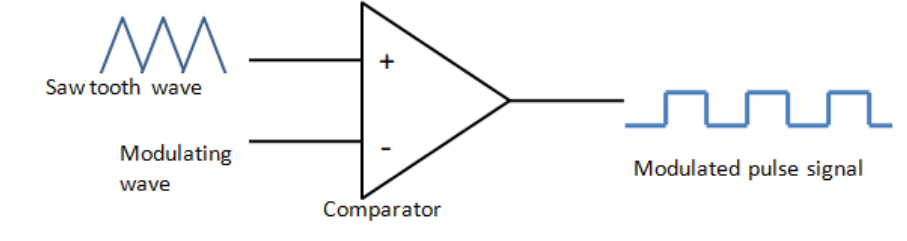
PWM signal can be generated using a comparator. One input of the comparator is connected to a modulating signal and the other input is fed with a non-sinusoidal wave or saw-tooth wave. The comparator compares the two input signals and generates a PWM signal. It depends on the value of the saw-tooth signal, if the saw-tooth signal is more than the modulation signal then the output of the PWM wave will be high and if the value of the saw-tooth signal is less than the modulation signal then the output of the PWM signal will be low.
Additional Information: The advantages of the PWM signal include preventing overheating of LEDs while maintaining their brightness. PWM signal provides quick response time. Its initial cost is low. Its disadvantages include high switching losses because PWM frequency is quite high. Also, it induces radio frequency interference.
Note:There are numerous applications for PWM technology. The applications of PWM signals include controlling the speed of the motor, driving a buzzer with different loudness, controlling the direction of the servo, providing an analog output, and generating an audio signal. The behavior of the PWM signal is determined by the duty cycle and frequency of a PWM signal.
Complete answer:
PWM signal can be generated using a comparator. One input of the comparator is connected to a modulating signal and the other input is fed with a non-sinusoidal wave or saw-tooth wave. The comparator compares the two input signals and generates a PWM signal. It depends on the value of the saw-tooth signal, if the saw-tooth signal is more than the modulation signal then the output of the PWM wave will be high and if the value of the saw-tooth signal is less than the modulation signal then the output of the PWM signal will be low.
Additional Information: The advantages of the PWM signal include preventing overheating of LEDs while maintaining their brightness. PWM signal provides quick response time. Its initial cost is low. Its disadvantages include high switching losses because PWM frequency is quite high. Also, it induces radio frequency interference.
Note:There are numerous applications for PWM technology. The applications of PWM signals include controlling the speed of the motor, driving a buzzer with different loudness, controlling the direction of the servo, providing an analog output, and generating an audio signal. The behavior of the PWM signal is determined by the duty cycle and frequency of a PWM signal.
Recently Updated Pages
Master Class 12 Business Studies: Engaging Questions & Answers for Success

Master Class 12 Chemistry: Engaging Questions & Answers for Success
Master Class 12 Biology: Engaging Questions & Answers for Success
Class 12 Question and Answer - Your Ultimate Solutions Guide
Master Class 11 Social Science: Engaging Questions & Answers for Success
Master Class 11 Chemistry: Engaging Questions & Answers for Success
Trending doubts
Which are the Top 10 Largest Countries of the World?
Draw a labelled sketch of the human eye class 12 physics CBSE
Name the crygenes that control cotton bollworm and class 12 biology CBSE
Differentiate between homogeneous and heterogeneous class 12 chemistry CBSE
Ribosomal RNA is actively synthesised in A Nucleoplasm class 12 biology CBSE
How many molecules of ATP and NADPH are required information class 12 biology CBSE