




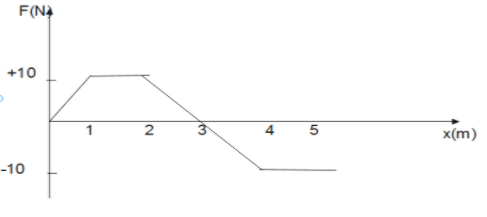
A position dependent force F acting on a particle and its force-position curve is shown in figure. Work done on the particle when its displacement 0 to 5 m is:
1) 35 J
2) 25 J
3) 45 J
4) 5 J
Answer
 Verified
635.4k+ views
Hint: Work done on an object depends on the amount of force F causing the work, the displacement d experienced by the object. Also, work done is given by the area under the F-x curve. S.I unit of work is Joule (J).
Total area under the given curve can be calculated by dividing the curve in small areas and adding them.
Formula used:
Work done= area under F-x curve.
Area of triangle${A_T} = \dfrac{1}{2} \times base \times height$
Area of rectangle${A_R} = length \times breadth$
Complete answer:
We know that, Work done on an object depends on the amount of force F causing the work, the displacement d experienced by the object.
Work done = area under F-x curve.
Or, W= Area
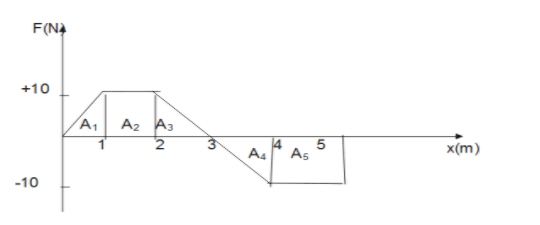
From above figure:
$\eqalign{
& W = {A_1} + {A_2} + {A_3} - ({A_4} + {A_5}) \cr
& \Rightarrow W = \left[ {\dfrac{1}{2} \times 1 \times 10} \right] + [1 \times 10] + \left[ {\dfrac{1}{2} \times 1 \times 10} \right] - \left[ {\dfrac{1}{2} \times 1 \times 10 + 10 \times 1} \right] \cr
& \Rightarrow W = 5 + 10 + 5 - (5 + 10) \cr
& \therefore W = 5J \cr} $
Therefore, option 4) is correct i.e., work done on the particle, when the displacement is 0 to 5 m is 5 Joule.
Additional information:
Work done can also be given by $W = Fd\cos \theta $, here $\theta $ is the angle between the force vector F and the displacement vector d.
If the angle between the force vector and the displacement d is zero, then the work done is maximum.
If the angle between the force vector and displacement d is ${90^ \circ }$, the work done is zero.
Force is push or pull upon an object’s interaction with another object. From Newton’s second law force F is given by the product of mass m and acceleration a. Acceleration is the rate of change of the velocity of an object with respect to time. Acceleration is a vector quantity.
Deceleration is when the speed or velocity decreases. It can also be defined as the acceleration which is opposite to the velocity.
Note:
Work done on an object depends on the amount of force F causing the work, the displacement d experienced by the object. So, if there is no displacement then the work done upon the object is zero. Also, in work when the force and the displacement are perpendicular to each other we do not have to do any work.
Total area under the given curve can be calculated by dividing the curve in small areas and adding them.
Formula used:
Work done= area under F-x curve.
Area of triangle${A_T} = \dfrac{1}{2} \times base \times height$
Area of rectangle${A_R} = length \times breadth$
Complete answer:
We know that, Work done on an object depends on the amount of force F causing the work, the displacement d experienced by the object.
Work done = area under F-x curve.
Or, W= Area
From above figure:
$\eqalign{
& W = {A_1} + {A_2} + {A_3} - ({A_4} + {A_5}) \cr
& \Rightarrow W = \left[ {\dfrac{1}{2} \times 1 \times 10} \right] + [1 \times 10] + \left[ {\dfrac{1}{2} \times 1 \times 10} \right] - \left[ {\dfrac{1}{2} \times 1 \times 10 + 10 \times 1} \right] \cr
& \Rightarrow W = 5 + 10 + 5 - (5 + 10) \cr
& \therefore W = 5J \cr} $
Therefore, option 4) is correct i.e., work done on the particle, when the displacement is 0 to 5 m is 5 Joule.
Additional information:
Work done can also be given by $W = Fd\cos \theta $, here $\theta $ is the angle between the force vector F and the displacement vector d.
If the angle between the force vector and the displacement d is zero, then the work done is maximum.
If the angle between the force vector and displacement d is ${90^ \circ }$, the work done is zero.
Force is push or pull upon an object’s interaction with another object. From Newton’s second law force F is given by the product of mass m and acceleration a. Acceleration is the rate of change of the velocity of an object with respect to time. Acceleration is a vector quantity.
Deceleration is when the speed or velocity decreases. It can also be defined as the acceleration which is opposite to the velocity.
Note:
Work done on an object depends on the amount of force F causing the work, the displacement d experienced by the object. So, if there is no displacement then the work done upon the object is zero. Also, in work when the force and the displacement are perpendicular to each other we do not have to do any work.
Recently Updated Pages
Master Class 11 Social Science: Engaging Questions & Answers for Success

Master Class 11 English: Engaging Questions & Answers for Success
Master Class 11 Accountancy: Engaging Questions & Answers for Success
Master Class 11 Physics: Engaging Questions & Answers for Success
Master Class 11 Computer Science: Engaging Questions & Answers for Success
Master Class 11 Business Studies: Engaging Questions & Answers for Success
Trending doubts
Find the value of the expression given below sin 30circ class 11 maths CBSE
One Metric ton is equal to kg A 10000 B 1000 C 100 class 11 physics CBSE
Draw a diagram of nephron and explain its structur class 11 biology CBSE
10 examples of friction in our daily life
Proton was discovered by A Thomson B Rutherford C Chadwick class 11 chemistry CBSE
The teeth used for biting and cutting food are called class 11 biology CBSE