




A point R with x-coordinate 4 lies on the line segment joining the points P(2, -3, 4) and Q(8, 0, 10). Find the coordinates of the point R.
Answer
 Verified
591.6k+ views
Hint: Assume that the point ‘R’ is dividing the length of the line segment joining the coordinates P(2,-3,4) and Q(8,0,10) in ratio K:1. Now, use the section formula to find the other coordinates (y and z) of point R.
Complete step-by-step solution:
Let us suppose coordinates of point R be $\left( {{x}_{1}},{{y}_{1}},{{z}_{1}} \right)$.
We know the x-coordinate of ‘R’ is ‘4’ from the question. Hence,
${{x}_{1}}=4.............\left( i \right)$
Now, we have another two points P and Q given as P(2,-3,4) and Q(8,0,10), such that point R is lying on the line joining PQ.
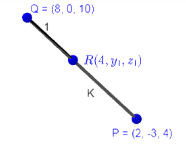
Let us suppose point R is dividing the length PQ in the ratio K:1 as shown in the diagram.
Now, we can use the section formula to get coordinates of ‘R’ in terms of points P and Q and the given ratio K:1.
Section formula can be given as:
If any point C is dividing length AB in the ratio m:n with coordinates of A and B as \[\left( {{x}_{1}},{{y}_{1}},{{z}_{1}} \right)\] and \[\left( {{x}_{2}},{{y}_{2}},{{z}_{2}} \right)\], then coordinates of C can be given by relation,
$C=\left( \dfrac{m{{x}_{2}}+n{{x}_{1}}}{m+n},\dfrac{m{{y}_{2}}+n{{y}_{1}}}{m+n},\dfrac{m{{z}_{2}}+n{{z}_{1}}}{m+n} \right)$
Hence, point R from the figure (2) can be given as,
$\begin{align}
& R\left( 4,{{y}_{1}},{{z}_{1}} \right)=\left( \dfrac{8k+2}{k+1},\dfrac{0.k-1\times 3}{k+1},\dfrac{10k+4}{k+1} \right) \\
& R\left( 4,{{y}_{1}},{{z}_{1}} \right)=\left( \dfrac{8k+2}{k+1},\dfrac{-3}{k+1},\dfrac{10k+4}{k+1} \right)..............\left( ii \right) \\
\end{align}$
Since, coordinates from the above relation should be equal. Hence, on equating x-coordinate, we get
$4=\dfrac{8k+2}{k+1}$
On cross multiplication, we get
$\begin{align}
& 4k\text{ }+\text{ }4\text{ }=\text{ }8K\text{ }+\text{ }2 \\
& 2\text{ }=\text{ }4k \\
& k=\dfrac{1}{2} \\
\end{align}$
Hence, from the equation (ii), we can get values of $\left( {{y}_{1}} \right)$ and $\left( {{z}_{1}} \right)$ as,
${{y}_{1}}=\dfrac{-3}{k+1}=\dfrac{-3}{\left( \dfrac{1}{2}+1 \right)}=\dfrac{-3\times 2}{3}=-2$
And ${{z}_{1}}$ can be given as,
${{z}_{1}}=\dfrac{10k+}{k+1}=\dfrac{10\times \dfrac{1}{2}+4}{\dfrac{1}{2}+1}=\dfrac{5+4}{\left( \dfrac{3}{2} \right)}=\dfrac{9\times 2}{3}=6$
Hence, the coordinates of point R can be given as R(4,-2,6).
Note: We can get equation of line PQ by relation $\dfrac{x-{{x}_{1}}}{{{x}_{2}}-{{x}_{1}}}=\dfrac{y-{{y}_{1}}}{{{y}_{2}}-{{y}_{1}}}=\dfrac{z-{{z}_{1}}}{{{z}_{2}}-{{z}_{1}}}$, where $\left( {{x}_{1}},{{y}_{1}},{{z}_{1}} \right)$ and $\left( {{x}_{2}},{{y}_{2}},{{z}_{2}} \right)$ are points on line.
Find the equation of the line and put x = 4 in that equation to get other coordinates of point R.
One can go wrong with the sectional formula. He or she may write the formula as
$\left( \dfrac{m{{x}_{1}}+n{{x}_{2}}}{m+n},\dfrac{m{{y}_{1}}+n{{y}_{2}}}{m+n},\dfrac{m{{z}_{1}}+n{{z}_{2}}}{m+n} \right)$
This is wrong. So, be careful with the place of terms to get the correct answer.
Complete step-by-step solution:
Let us suppose coordinates of point R be $\left( {{x}_{1}},{{y}_{1}},{{z}_{1}} \right)$.
We know the x-coordinate of ‘R’ is ‘4’ from the question. Hence,
${{x}_{1}}=4.............\left( i \right)$
Now, we have another two points P and Q given as P(2,-3,4) and Q(8,0,10), such that point R is lying on the line joining PQ.
Let us suppose point R is dividing the length PQ in the ratio K:1 as shown in the diagram.
Now, we can use the section formula to get coordinates of ‘R’ in terms of points P and Q and the given ratio K:1.
Section formula can be given as:
If any point C is dividing length AB in the ratio m:n with coordinates of A and B as \[\left( {{x}_{1}},{{y}_{1}},{{z}_{1}} \right)\] and \[\left( {{x}_{2}},{{y}_{2}},{{z}_{2}} \right)\], then coordinates of C can be given by relation,
$C=\left( \dfrac{m{{x}_{2}}+n{{x}_{1}}}{m+n},\dfrac{m{{y}_{2}}+n{{y}_{1}}}{m+n},\dfrac{m{{z}_{2}}+n{{z}_{1}}}{m+n} \right)$
Hence, point R from the figure (2) can be given as,
$\begin{align}
& R\left( 4,{{y}_{1}},{{z}_{1}} \right)=\left( \dfrac{8k+2}{k+1},\dfrac{0.k-1\times 3}{k+1},\dfrac{10k+4}{k+1} \right) \\
& R\left( 4,{{y}_{1}},{{z}_{1}} \right)=\left( \dfrac{8k+2}{k+1},\dfrac{-3}{k+1},\dfrac{10k+4}{k+1} \right)..............\left( ii \right) \\
\end{align}$
Since, coordinates from the above relation should be equal. Hence, on equating x-coordinate, we get
$4=\dfrac{8k+2}{k+1}$
On cross multiplication, we get
$\begin{align}
& 4k\text{ }+\text{ }4\text{ }=\text{ }8K\text{ }+\text{ }2 \\
& 2\text{ }=\text{ }4k \\
& k=\dfrac{1}{2} \\
\end{align}$
Hence, from the equation (ii), we can get values of $\left( {{y}_{1}} \right)$ and $\left( {{z}_{1}} \right)$ as,
${{y}_{1}}=\dfrac{-3}{k+1}=\dfrac{-3}{\left( \dfrac{1}{2}+1 \right)}=\dfrac{-3\times 2}{3}=-2$
And ${{z}_{1}}$ can be given as,
${{z}_{1}}=\dfrac{10k+}{k+1}=\dfrac{10\times \dfrac{1}{2}+4}{\dfrac{1}{2}+1}=\dfrac{5+4}{\left( \dfrac{3}{2} \right)}=\dfrac{9\times 2}{3}=6$
Hence, the coordinates of point R can be given as R(4,-2,6).
Note: We can get equation of line PQ by relation $\dfrac{x-{{x}_{1}}}{{{x}_{2}}-{{x}_{1}}}=\dfrac{y-{{y}_{1}}}{{{y}_{2}}-{{y}_{1}}}=\dfrac{z-{{z}_{1}}}{{{z}_{2}}-{{z}_{1}}}$, where $\left( {{x}_{1}},{{y}_{1}},{{z}_{1}} \right)$ and $\left( {{x}_{2}},{{y}_{2}},{{z}_{2}} \right)$ are points on line.
Find the equation of the line and put x = 4 in that equation to get other coordinates of point R.
One can go wrong with the sectional formula. He or she may write the formula as
$\left( \dfrac{m{{x}_{1}}+n{{x}_{2}}}{m+n},\dfrac{m{{y}_{1}}+n{{y}_{2}}}{m+n},\dfrac{m{{z}_{1}}+n{{z}_{2}}}{m+n} \right)$
This is wrong. So, be careful with the place of terms to get the correct answer.
Recently Updated Pages
Master Class 10 Computer Science: Engaging Questions & Answers for Success

Master Class 10 General Knowledge: Engaging Questions & Answers for Success
Master Class 10 English: Engaging Questions & Answers for Success
Master Class 10 Social Science: Engaging Questions & Answers for Success
Master Class 10 Maths: Engaging Questions & Answers for Success
Master Class 10 Science: Engaging Questions & Answers for Success
Trending doubts
Explain the Treaty of Vienna of 1815 class 10 social science CBSE
Who Won 36 Oscar Awards? Record Holder Revealed
What is the median of the first 10 natural numbers class 10 maths CBSE
What is the name of Japan Parliament?
Why is it 530 pm in india when it is 1200 afternoon class 10 social science CBSE
Select the word that is correctly spelled a Twelveth class 10 english CBSE