




A p-n photodiode is made of a material with a bandgap of \[2.0eV\]. The minimum frequency of the radiation that can be absorbed by the material is near:
A) \[10 \times {10^{14}}Hz\;\]
B) \[5 \times {10^{14}}Hz\]
C) \[1 \times {10^{14}}Hz\]
D) \[20 \times {10^{14}}Hz\]
Answer
 Verified
571.8k+ views
Hint: When the photodiode starts working such that the photodiode is illuminated with a certain frequency of radiation, it produces a significant current.
Use the condition for absorbing the minimum frequency of radiation given,
Band-gap energy = Energy of radiation.
The formula of the energy of radiation consists of the minimum frequency.
Formula used:
The energy of radiation, $E = h\upsilon $ where, $h$ is the plank constant and $\upsilon $ the minimum frequency.
The band-gap energy ${E_g} = E$
Complete step by step answer:
A photodiode is a special type of semiconductor diode that is connected to the reverse bias; if a light is an incident on its p-n connection the saturation current increases.
Hence, when the photodiode is illuminated with a certain frequency of radiation, it produces a significant current.
The condition for the absorbing of the minimum frequency of radiation given,
Band-gap energy = Energy of radiation.
The energy of radiation, $E = h\upsilon $ where, $h$ is the Planck's constant and $\upsilon $ the minimum frequency.
The band-gap energy ${E_g} = E$
$ \Rightarrow {E_g} = h\upsilon $
Given that, ${E_g} = 2.0eV = 2 \times 1.6 \times {10^{ - 19}}J$
and we know, $h = 6.625 \times {10^{ - 34}}J.s$
$\therefore 2 \times 1.6 \times {10^{ - 19}} = 6.625 \times {10^{ - 34}} \times \upsilon $
$ \Rightarrow \upsilon = \dfrac{{2 \times 1.6 \times {{10}^{ - 19}}}}{{6.625 \times {{10}^{ - 34}}}}$
$ \Rightarrow \upsilon = 4.84 \times {10^{14}}Hz$
$ \Rightarrow \upsilon \approx 5 \times {10^{14}}Hz$
Hence, the minimum frequency which is absorbed by the original material is, $5 \times {10^{14}}Hz$
Hence the correct answer is in option, $(B)$.
Additional information:
The volt-ampere characteristics curve are shown below,
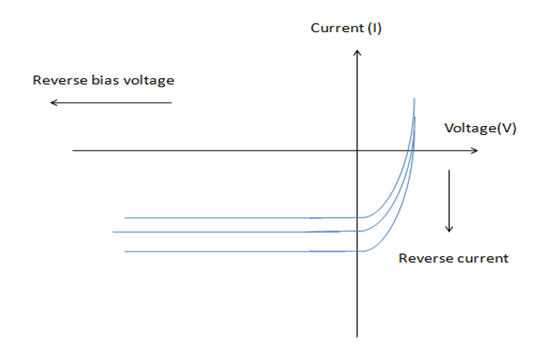
The photo-diode is used in Compact Disk, Smoke detector, Remote control machine. This photo-diode is also used to measure the intensity of light.
Note: When light is incident externally on the p-n connection the value of saturation current increases. But if no light is incident from outside then like a normal diode a very small amount of current flows in reverse bias – this is called the dark current.
Now when light is focused on the p-n connection through a lens, the new electron-hole pair is created by the energy exchange of the incident photon, and thus current flow increases.
It is shown that the value of the reverse current is directly proportional to the brightness of the light. But if the energy of the incident photon is not enough to free the electron-hole pair, the photodiode does not work.
Use the condition for absorbing the minimum frequency of radiation given,
Band-gap energy = Energy of radiation.
The formula of the energy of radiation consists of the minimum frequency.
Formula used:
The energy of radiation, $E = h\upsilon $ where, $h$ is the plank constant and $\upsilon $ the minimum frequency.
The band-gap energy ${E_g} = E$
Complete step by step answer:
A photodiode is a special type of semiconductor diode that is connected to the reverse bias; if a light is an incident on its p-n connection the saturation current increases.
Hence, when the photodiode is illuminated with a certain frequency of radiation, it produces a significant current.
The condition for the absorbing of the minimum frequency of radiation given,
Band-gap energy = Energy of radiation.
The energy of radiation, $E = h\upsilon $ where, $h$ is the Planck's constant and $\upsilon $ the minimum frequency.
The band-gap energy ${E_g} = E$
$ \Rightarrow {E_g} = h\upsilon $
Given that, ${E_g} = 2.0eV = 2 \times 1.6 \times {10^{ - 19}}J$
and we know, $h = 6.625 \times {10^{ - 34}}J.s$
$\therefore 2 \times 1.6 \times {10^{ - 19}} = 6.625 \times {10^{ - 34}} \times \upsilon $
$ \Rightarrow \upsilon = \dfrac{{2 \times 1.6 \times {{10}^{ - 19}}}}{{6.625 \times {{10}^{ - 34}}}}$
$ \Rightarrow \upsilon = 4.84 \times {10^{14}}Hz$
$ \Rightarrow \upsilon \approx 5 \times {10^{14}}Hz$
Hence, the minimum frequency which is absorbed by the original material is, $5 \times {10^{14}}Hz$
Hence the correct answer is in option, $(B)$.
Additional information:
The volt-ampere characteristics curve are shown below,
The photo-diode is used in Compact Disk, Smoke detector, Remote control machine. This photo-diode is also used to measure the intensity of light.
Note: When light is incident externally on the p-n connection the value of saturation current increases. But if no light is incident from outside then like a normal diode a very small amount of current flows in reverse bias – this is called the dark current.
Now when light is focused on the p-n connection through a lens, the new electron-hole pair is created by the energy exchange of the incident photon, and thus current flow increases.
It is shown that the value of the reverse current is directly proportional to the brightness of the light. But if the energy of the incident photon is not enough to free the electron-hole pair, the photodiode does not work.
Recently Updated Pages
Basicity of sulphurous acid and sulphuric acid are

Master Class 12 English: Engaging Questions & Answers for Success
Master Class 12 Social Science: Engaging Questions & Answers for Success
Master Class 12 Maths: Engaging Questions & Answers for Success
Master Class 12 Economics: Engaging Questions & Answers for Success
Master Class 12 Physics: Engaging Questions & Answers for Success
Trending doubts
Draw a labelled sketch of the human eye class 12 physics CBSE
Which are the Top 10 Largest Countries of the World?
Draw ray diagrams each showing i myopic eye and ii class 12 physics CBSE
Giving reasons state the signs positive or negative class 12 physics CBSE
Explain esterification reaction with the help of a class 12 chemistry CBSE
What is defined as a solenoid Depict a diagram with class 12 physics CBSE