




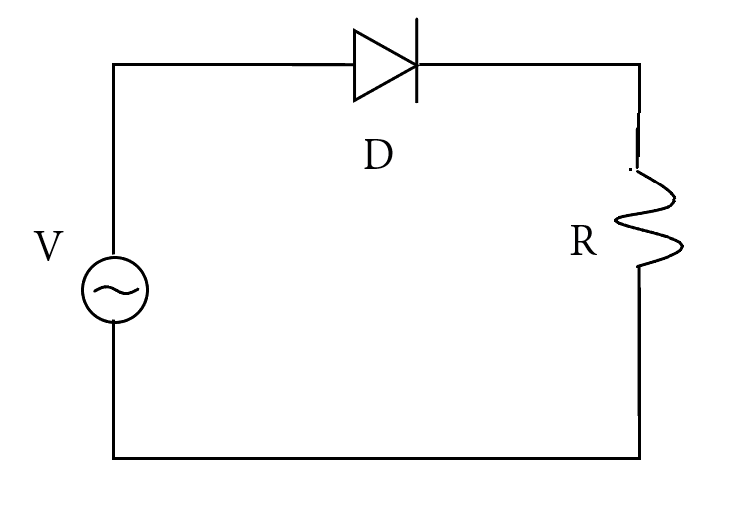
A p-n junction diode shown in the figure can act as a rectifier. An alternating current source (V) is connected in the circuit. The current (I) in the resistor (R) can be shown by:
A.
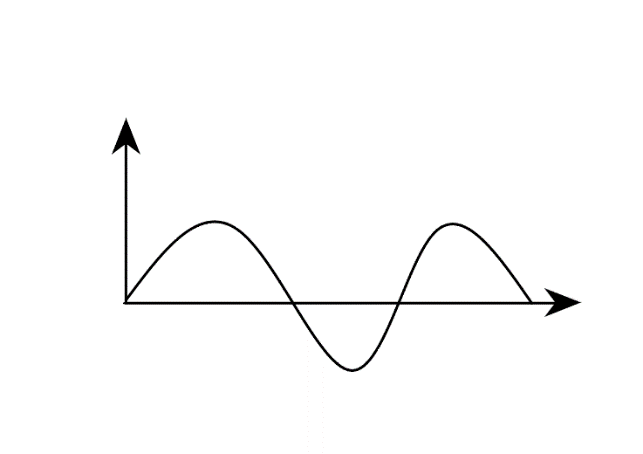
B.
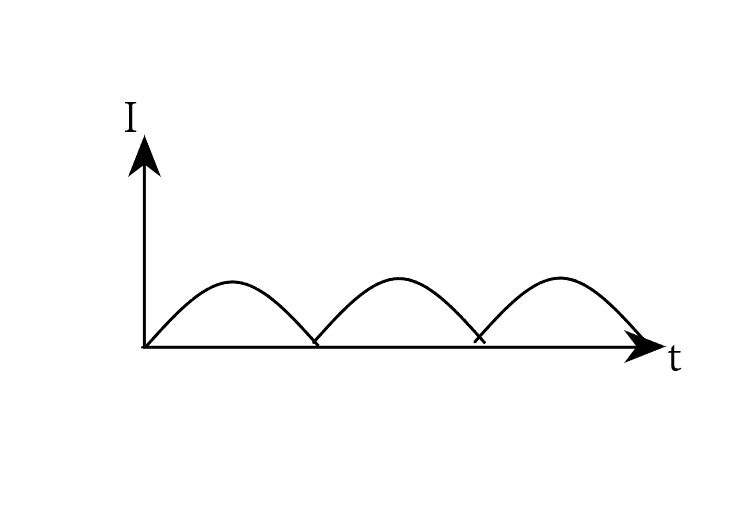
C.
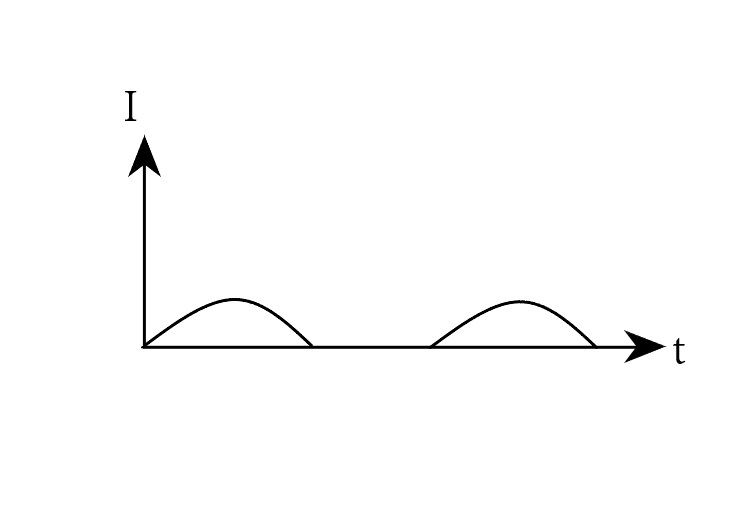
D.
Answer
 Verified
607.5k+ views
Hint: The diode is a device that allows current to flow in one direction. During one-half cycle, the diode acts as a closed key, while during the second half cycle, it acts as an open key.
Complete answer: We see a diagram in which one diode is connected in series to a resistor. The voltage input is an alternating source and we are asked for the current flowing through the resistor as a function of time.
Generally, a diode is a device that allows current to flow through it in one direction. Hence when a current is allowed to enter a diode from a particular direction, it allows the current to flow, but when the current is reversed it blocks the current. A diode allows current to flow from the anode (represented by an arrowed triangle in its schematic diagram) to the cathode (represented by a bar in its schematic diagram).
In the case of an ac current, during the first half cycle when the current is positive, the diode allows the current to flow without much interruption, however, during the second half cycle, the diode acts as an open key, and hence, the current is cut off, and no current is allowed to flow in the circuit. The process repeats continuously.
Hence, by observation the correct option is C.
Note: In actuality, the current flowing through the circuit would not be as smooth as represented. This is for a number of reasons. First, the diode has a junction voltage that must be overcome even in forward bias before the current starts to flow. However, the junction voltage is usually low and often negligible for most ac voltages. Also, the current is not exactly directly proportional to voltage as in ohm’s law, hence will not follow the same line as the ac voltage.
Complete answer: We see a diagram in which one diode is connected in series to a resistor. The voltage input is an alternating source and we are asked for the current flowing through the resistor as a function of time.
Generally, a diode is a device that allows current to flow through it in one direction. Hence when a current is allowed to enter a diode from a particular direction, it allows the current to flow, but when the current is reversed it blocks the current. A diode allows current to flow from the anode (represented by an arrowed triangle in its schematic diagram) to the cathode (represented by a bar in its schematic diagram).
In the case of an ac current, during the first half cycle when the current is positive, the diode allows the current to flow without much interruption, however, during the second half cycle, the diode acts as an open key, and hence, the current is cut off, and no current is allowed to flow in the circuit. The process repeats continuously.
Hence, by observation the correct option is C.
Note: In actuality, the current flowing through the circuit would not be as smooth as represented. This is for a number of reasons. First, the diode has a junction voltage that must be overcome even in forward bias before the current starts to flow. However, the junction voltage is usually low and often negligible for most ac voltages. Also, the current is not exactly directly proportional to voltage as in ohm’s law, hence will not follow the same line as the ac voltage.
Recently Updated Pages
Master Class 5 English: Engaging Questions & Answers for Success

Master Class 5 Maths: Engaging Questions & Answers for Success
Master Class 5 Social Science: Engaging Questions & Answers for Success
Master Class 5 Science: Engaging Questions & Answers for Success
Class 5 Question and Answer - Your Ultimate Solutions Guide
Master Class 9 General Knowledge: Engaging Questions & Answers for Success
Trending doubts
One Metric ton is equal to kg A 10000 B 1000 C 100 class 11 physics CBSE
What is cell theory Who formulated it class 11 biology CBSE
Phyllotaxy is the arrangement of ALeaflets BLeaves class 11 biology CBSE
Difference Between Prokaryotic Cells and Eukaryotic Cells
The symbiotic association of fungi and algae is called class 11 biology CBSE
Cell theory was formulated by A Schleiden and Schwann class 11 biology CBSE