




A plumb line suspended from the roof of a carriage moving with acceleration ‘a’ incline at an angle $\theta $ with the vertical, then
A. $a = g\tan \theta $
B. $a = \dfrac{F}{m}$
C. $a = \dfrac{{dV}}{{dt}}$
D. $a = \dfrac{{{d^2}x}}{{d{t^2}}}$
Answer
 Verified
618.9k+ views
Hint: The plumb line is attached to the roof of the moving carriage so the acceleration of both will be the same (a). There exists one more acceleration i.e. acceleration due to gravity (g). Find a relation relating a, g and $\theta $, you will get the final answer.
Complete step by step answer:
The above situation is depicted below.
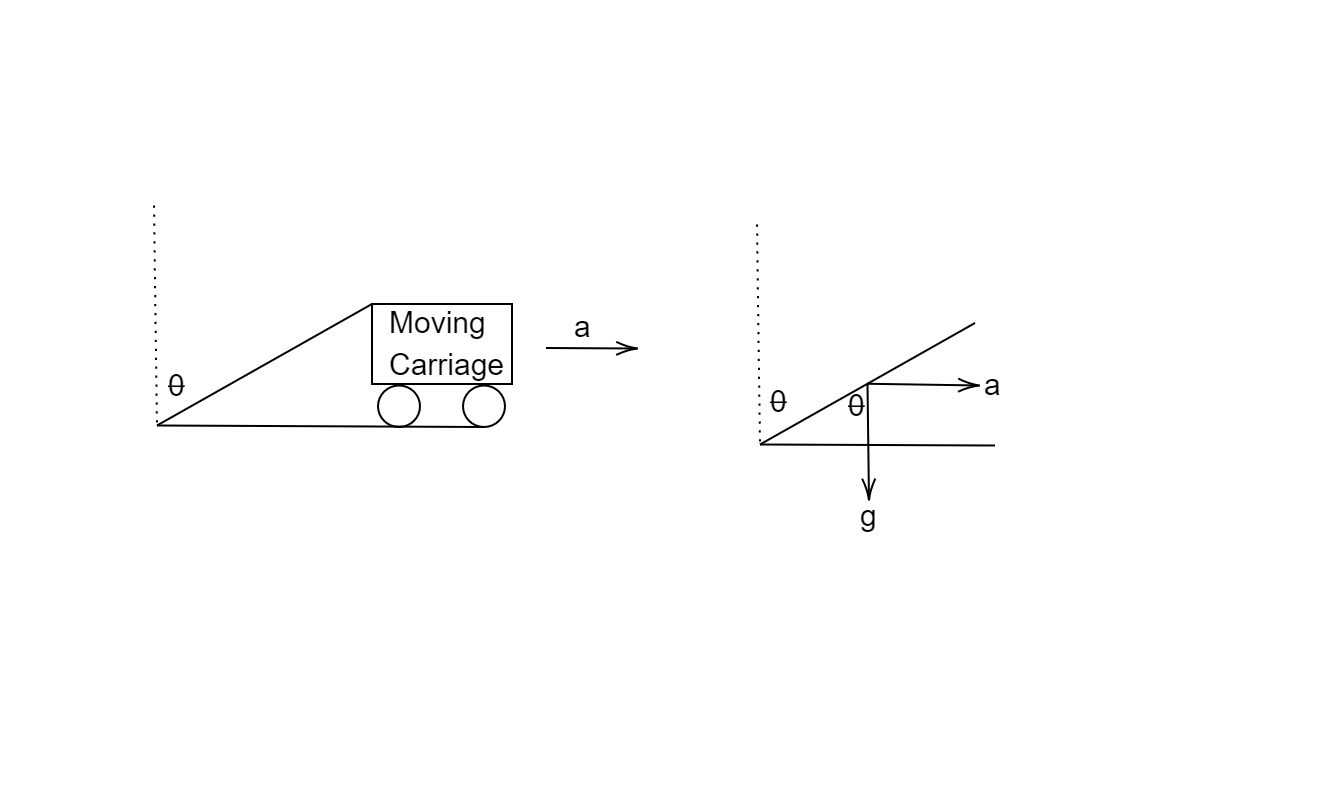
The plumb line is attached to the roof of the moving carriage so the acceleration of both will be the same (a). There exists one more acceleration i.e. acceleration due to gravity (g). By resolving the two acceleration in x and y direction we get the above picture.
The acceleration due to gravity is in negative y direction while acceleration of carriage is in positive x direction. By simple geometry, we get that the angle between acceleration due to gravity and plumb line is also $\theta $. Depicted in the figure in the right, we see from the triangle formed that,
\[
\tan \theta = \dfrac{{perpendicular}}{{base}} \\
\tan \theta = \dfrac{a}{g} \\
\]
Therefore, we can express the value of given parameter a with the angle of plumb line makes with vertical:
\[a = g\tan \theta \]
The correct answer is option A.
Additional information: The question can also be given as, ‘Given a and g, find the angle made by the plumb line with the ground’. In this case, the same approach should be taken. Now,
\[\theta = {\tan ^{ - 1}}\dfrac{a}{g}\]
But this is the angle with the vertical. For angle with ground,
$\theta ' = \,{90^ \circ } - \theta $
Note:The acceleration of plumb line is along the same direction as the carriage i.e. along positive x-direction. Sometimes students make this mistake in that they assign the direction of acceleration of the plumb line along the plumb line i.e. along the direction at an angle $\theta $ with vertical. This is wrong and the correct concept should be clear.
Complete step by step answer:
The above situation is depicted below.
The plumb line is attached to the roof of the moving carriage so the acceleration of both will be the same (a). There exists one more acceleration i.e. acceleration due to gravity (g). By resolving the two acceleration in x and y direction we get the above picture.
The acceleration due to gravity is in negative y direction while acceleration of carriage is in positive x direction. By simple geometry, we get that the angle between acceleration due to gravity and plumb line is also $\theta $. Depicted in the figure in the right, we see from the triangle formed that,
\[
\tan \theta = \dfrac{{perpendicular}}{{base}} \\
\tan \theta = \dfrac{a}{g} \\
\]
Therefore, we can express the value of given parameter a with the angle of plumb line makes with vertical:
\[a = g\tan \theta \]
The correct answer is option A.
Additional information: The question can also be given as, ‘Given a and g, find the angle made by the plumb line with the ground’. In this case, the same approach should be taken. Now,
\[\theta = {\tan ^{ - 1}}\dfrac{a}{g}\]
But this is the angle with the vertical. For angle with ground,
$\theta ' = \,{90^ \circ } - \theta $
Note:The acceleration of plumb line is along the same direction as the carriage i.e. along positive x-direction. Sometimes students make this mistake in that they assign the direction of acceleration of the plumb line along the plumb line i.e. along the direction at an angle $\theta $ with vertical. This is wrong and the correct concept should be clear.
Recently Updated Pages
Master Class 11 Social Science: Engaging Questions & Answers for Success

Master Class 11 English: Engaging Questions & Answers for Success
Master Class 11 Maths: Engaging Questions & Answers for Success
Master Class 11 Chemistry: Engaging Questions & Answers for Success
Master Class 11 Biology: Engaging Questions & Answers for Success
Class 11 Question and Answer - Your Ultimate Solutions Guide
Trending doubts
One Metric ton is equal to kg A 10000 B 1000 C 100 class 11 physics CBSE
Difference Between Prokaryotic Cells and Eukaryotic Cells
Find the value of the expression given below sin 30circ class 11 maths CBSE
1 ton equals to A 100 kg B 1000 kg C 10 kg D 10000 class 11 physics CBSE
Two of the body parts which do not appear in MRI are class 11 biology CBSE
Draw a diagram of nephron and explain its structur class 11 biology CBSE