




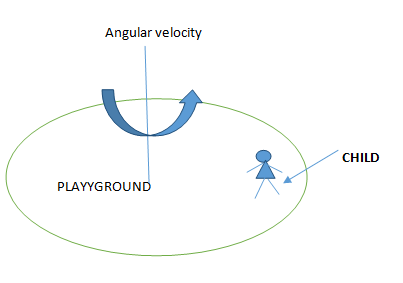
A playground merry-go-round is at rest, pivoted about a friend's axis. A child of mass m runs on the ground along the path tangential to the rim with speed v and jumps on-to-merry go round. If R is the Radius of a merry-go-round and I is the moment of inertia, then the angular velocity of the merry-go-round and the child is:
Answer
 Verified
598.2k+ views
Hint: As the direction of motion of the girl sitting on the merry-go-round is constantly varying, even though the speed is being constant, the velocity at each instant is found to be varying. This vector quantity varying due to the change in direction of motion makes the body have acceleration. Therefore the girl sitting in a merry-go-round is found to be moving with acceleration.
Complete step by step answer:
A playground merry-go-round is at rest, upon a frictionless axis that is there is no external torque acting on the system, angular momentum is conserved.
\[ \Rightarrow \;{{\rm{L}}_i}\; = \;{{\rm{L}}_f}\;\]
$ \Rightarrow \;{\rm{mvR}}\; + \,0 = \left( {{\rm{I + m}}{{\rm{R}}^2}} \right)\;\omega $
Here ${\rm{mvR}}$ is the angular momentum.
If an object is with a massive moment of inertia ${\rm{I}}$, such as Earth, it has a very large angular momentum. An object with large angular velocity $\omega $, such as a centrifuge, also has a rather large angular momentum.
The child's momentum to the center of the merry-go-round and angular momentum of the merry-go-round is zero initially since it is at rest.
$ \Rightarrow \omega \,{\rm{ = }}\dfrac{{{\rm{mvR}}}}{{\left( {{\rm{I + m}}{{\rm{R}}^{\rm{2}}}} \right)}}$
Where,
M= Mass
V= Velocity
R= Radius
I= moment of inertia
Note: Angular momentum- A rigid object's angular momentum is defined as the product of both the moment of inertia and angular velocity.
Angular Momentum = (moment of inertia) (angular velocity)
i) Angular momentum of the merry-go-round is zero initially since it is at rest.
ii) If R is the Radius of the merry-go-round and I is its moment of inertia, then the angular velocity of the merry-go-round and child is zero (pivoted).
Complete step by step answer:
A playground merry-go-round is at rest, upon a frictionless axis that is there is no external torque acting on the system, angular momentum is conserved.
\[ \Rightarrow \;{{\rm{L}}_i}\; = \;{{\rm{L}}_f}\;\]
$ \Rightarrow \;{\rm{mvR}}\; + \,0 = \left( {{\rm{I + m}}{{\rm{R}}^2}} \right)\;\omega $
Here ${\rm{mvR}}$ is the angular momentum.
If an object is with a massive moment of inertia ${\rm{I}}$, such as Earth, it has a very large angular momentum. An object with large angular velocity $\omega $, such as a centrifuge, also has a rather large angular momentum.
The child's momentum to the center of the merry-go-round and angular momentum of the merry-go-round is zero initially since it is at rest.
$ \Rightarrow \omega \,{\rm{ = }}\dfrac{{{\rm{mvR}}}}{{\left( {{\rm{I + m}}{{\rm{R}}^{\rm{2}}}} \right)}}$
Where,
M= Mass
V= Velocity
R= Radius
I= moment of inertia
Note: Angular momentum- A rigid object's angular momentum is defined as the product of both the moment of inertia and angular velocity.
Angular Momentum = (moment of inertia) (angular velocity)
i) Angular momentum of the merry-go-round is zero initially since it is at rest.
ii) If R is the Radius of the merry-go-round and I is its moment of inertia, then the angular velocity of the merry-go-round and child is zero (pivoted).
Recently Updated Pages
Three beakers labelled as A B and C each containing 25 mL of water were taken A small amount of NaOH anhydrous CuSO4 and NaCl were added to the beakers A B and C respectively It was observed that there was an increase in the temperature of the solutions contained in beakers A and B whereas in case of beaker C the temperature of the solution falls Which one of the following statements isarecorrect i In beakers A and B exothermic process has occurred ii In beakers A and B endothermic process has occurred iii In beaker C exothermic process has occurred iv In beaker C endothermic process has occurred

Master Class 12 Social Science: Engaging Questions & Answers for Success
Master Class 12 Physics: Engaging Questions & Answers for Success
Master Class 12 Maths: Engaging Questions & Answers for Success
Master Class 12 Economics: Engaging Questions & Answers for Success
Master Class 12 Chemistry: Engaging Questions & Answers for Success
Three beakers labelled as A B and C each containing 25 mL of water were taken A small amount of NaOH anhydrous CuSO4 and NaCl were added to the beakers A B and C respectively It was observed that there was an increase in the temperature of the solutions contained in beakers A and B whereas in case of beaker C the temperature of the solution falls Which one of the following statements isarecorrect i In beakers A and B exothermic process has occurred ii In beakers A and B endothermic process has occurred iii In beaker C exothermic process has occurred iv In beaker C endothermic process has occurred
Master Class 12 Social Science: Engaging Questions & Answers for Success
Master Class 12 Physics: Engaging Questions & Answers for Success
Trending doubts
Which are the Top 10 Largest Countries of the World?
Draw a labelled sketch of the human eye class 12 physics CBSE
Explain the structure of megasporangium class 12 biology CBSE
What are the major means of transport Explain each class 12 social science CBSE
Differentiate between homogeneous and heterogeneous class 12 chemistry CBSE
Sulphuric acid is known as the king of acids State class 12 chemistry CBSE