




A Plano convex lens of refractive index 1.5 and radius of curvature 30cm is silvered at the curved surface. Now this lens has been used to form the image of an object. At what distance from this lens an object be placed in order to have a real image of the size of the object:
(A) 20cm
(B) 30cm
(C) 60cm
(D) 80cm
Answer
 Verified
600.3k+ views
Hint: Concept of image formation by Plano convex lens and the focal length of the plane conveys lens is to be used.
for Plano-convex \[F = \dfrac{R}{{2\mu }}\]
Complete step by step answer:
Plano-convex lens:
Plano-convex lenses are positive focal-length elements that have one spherical surface and one flat surface.
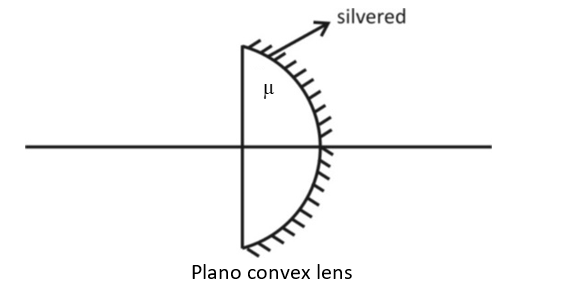
The optic lenses are ideal for all purpose focusing elements.
If the curved surface of a Plano-concave lens is silvered, the focal length of the lens is given by \[\dfrac{1}{F} = \dfrac{{2\mu }}{R}\]
When \[F = \,\,Focal\,\,length\]
\[R = \,\,Radius\]
\[\mu \,\, = \,\,refractive\,\,index\]
\[R\,\, = \,\,30\,\,cm\]
\[\mu = 1.5\]
\[F = \dfrac{{30 \times 10}}{{2 \times 1.5}}\]
\[F = \dfrac{{30 \times 10}}{{30}}\]
\[F = 10cm\]
The value of focal length is 10cm
The real image will be equal to the size of the object if the object distance u.
As distance of the object u is twice of the focal length then
Mathematically we define the above statement as
\[u = 3F\]
\[u = 2 \times 10 = 20cm\]
\[u = 20cm\]
\[20cm\]is the distance from this plane-convex lens an object bi placed in order to have a real image of the size of the object.
So, the correct answer is “Option A”.
Note:
The silvered side of the plano convex lens will act as a mirror. So for image formation the ray of light will suffer two time refraction from the plane surface of the lens and one reflection from curved portion and thus a real image is formed.
for Plano-convex \[F = \dfrac{R}{{2\mu }}\]
Complete step by step answer:
Plano-convex lens:
Plano-convex lenses are positive focal-length elements that have one spherical surface and one flat surface.
The optic lenses are ideal for all purpose focusing elements.
If the curved surface of a Plano-concave lens is silvered, the focal length of the lens is given by \[\dfrac{1}{F} = \dfrac{{2\mu }}{R}\]
When \[F = \,\,Focal\,\,length\]
\[R = \,\,Radius\]
\[\mu \,\, = \,\,refractive\,\,index\]
\[R\,\, = \,\,30\,\,cm\]
\[\mu = 1.5\]
\[F = \dfrac{{30 \times 10}}{{2 \times 1.5}}\]
\[F = \dfrac{{30 \times 10}}{{30}}\]
\[F = 10cm\]
The value of focal length is 10cm
The real image will be equal to the size of the object if the object distance u.
As distance of the object u is twice of the focal length then
Mathematically we define the above statement as
\[u = 3F\]
\[u = 2 \times 10 = 20cm\]
\[u = 20cm\]
\[20cm\]is the distance from this plane-convex lens an object bi placed in order to have a real image of the size of the object.
So, the correct answer is “Option A”.
Note:
The silvered side of the plano convex lens will act as a mirror. So for image formation the ray of light will suffer two time refraction from the plane surface of the lens and one reflection from curved portion and thus a real image is formed.
Recently Updated Pages
Master Class 12 Social Science: Engaging Questions & Answers for Success

Master Class 12 Physics: Engaging Questions & Answers for Success
Master Class 12 Maths: Engaging Questions & Answers for Success
Master Class 12 Economics: Engaging Questions & Answers for Success
Master Class 12 Chemistry: Engaging Questions & Answers for Success
Master Class 12 Business Studies: Engaging Questions & Answers for Success
Trending doubts
Which are the Top 10 Largest Countries of the World?
Draw a labelled sketch of the human eye class 12 physics CBSE
Explain the structure of megasporangium class 12 biology CBSE
What are the major means of transport Explain each class 12 social science CBSE
How many chromosomes are found in human ovum a 46 b class 12 biology CBSE
The diagram of the section of a maize grain is given class 12 biology CBSE