




A plank of mass $m$ and length $L$ is placed on a table such that $\dfrac{L}{3}$ length is out of the table. A person of mass $2m$ is standing on the plank such that his position is at the edge of the table. Find the distance on plank which the person can move such that the plank does not fall (figure)
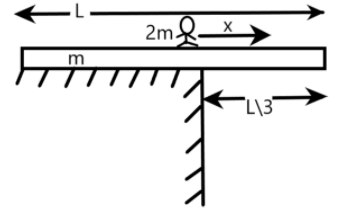
$\begin{align}
& A)X=\dfrac{L}{6} \\
& B)X=\dfrac{L}{12} \\
& C)X=\dfrac{L}{18} \\
\end{align}$
$D)$None of these
Answer
 Verified
611.7k+ views
Hint: The net torque acting at a point is equal to zero, when two masses are balanced on either side of the point. Edge of the table is considered as the balancing point of the plank. For the plank to balance at this point, torque on the left side of the plank about the edge of the table is equal to the torque on the right side of the plank about the edge of the table.
Formula used:
$1){{\tau }_{edge}}=0\Rightarrow {{\tau }_{left}}={{\tau }_{right}}$
$2){{\tau }_{left}}=m\times \left( L-\dfrac{L}{3} \right)$
$3){{\tau }_{right}}=2mx$
Complete answer:
We are given a plank of mass $m$ and length $L$, placed on a table such that $\dfrac{L}{3}$ of its length is out of the table, as shown in the following figure. A person of mass $2m$ is standing on the plank such that his position is at the edge of the table. We are required to find the distance on the plank which the person can move such that the plank does not fall.
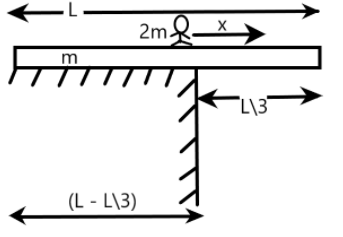
According to the principle of moments, we know that for a system to be balanced at a point, the net torque acting on that point needs to be equal to zero. This suggests that torque on the right ride about a balancing point is equal to the torque on the left side about the balancing point.
Now, let us apply this principle in our case. Let us take the balancing point to be the edge of the table, on which the plank is kept. When the man over the plank starts walking towards the right from the edge of the table, it is obvious that the plank will tend to fall. But before this happens, the man could walk a certain distance and get balanced with the weight of the plank on its left. Clearly, we are required to find this distance. Applying the principle of moments on the plank about the edge of the table, we have
${{\tau }_{edge}}=0\Rightarrow {{\tau }_{left}}={{\tau }_{right}}$
where
${{\tau }_{edge}}$ is the net torque at the balancing point of the plank, on the edge of the table
${{\tau }_{left}}$ is the torque on the left side of the balancing point of the plank
${{\tau }_{right}}$ is the torque on the right side of the balancing point of the plank
Let this be equation 1.
We know that torque at a point is equal to the product of weight on the given point and the distance between the given point and the point about which the mass tends to rotate.
Therefore, torque on the left side of the balancing point of the plank, ${{\tau }_{left}}$ is given by
${{\tau }_{left}}=m\times \left( L-\dfrac{L}{3} \right)=\dfrac{2Lm}{3}$
where
${{\tau }_{left}}$ is the torque on the left side of the balancing point of the plank
$m$ is the mass of the plank which balances the plank on its left side
$L-\dfrac{L}{3}$ is the length of the plank on the left side of the balancing point of the plank, as shown in the figure
Let this be equation 2.
Similarly, torque on the right side of the balancing point of the plank, ${{\tau }_{right}}$ is given by
${{\tau }_{right}}=2m\times \left( x \right)=2mx$
where
${{\tau }_{right}}$ is the torque on the right side of the balancing point of the plank
$2m$ is the mass of the person standing on the right side of the plank when the plank is balanced
$x$ is the assumed length of the plank on the right side of the balancing point of the plank, where the person can balance the plank without falling
Let this be equation 3.
Substituting equation 2 and equation 3 in equation 1, we have
${{\tau }_{left}}={{\tau }_{right}}\Rightarrow \dfrac{2Lm}{3}=2mx\Rightarrow x=\dfrac{2Lm}{6m}=\dfrac{L}{3}$
Therefore, the distance the person can walk on the plank from the edge of the table towards the right, without causing the plank to fall is equal to $\dfrac{L}{3}$. This suggests that the person can walk till the right end of the plank, without causing any rotation to the plank.
Hence, the correct answer is option $D$.
Note:
Students can relate this situation to that of a seesaw. Clearly, for a seesaw to be balanced, product of weight of the child and his/her distance from the center of the seesaw on each side should be equal to the product of weight of another child and his/her distance from the center of the seesaw, on the other side of the seesaw. This is nothing but an application of principle of moments.
Formula used:
$1){{\tau }_{edge}}=0\Rightarrow {{\tau }_{left}}={{\tau }_{right}}$
$2){{\tau }_{left}}=m\times \left( L-\dfrac{L}{3} \right)$
$3){{\tau }_{right}}=2mx$
Complete answer:
We are given a plank of mass $m$ and length $L$, placed on a table such that $\dfrac{L}{3}$ of its length is out of the table, as shown in the following figure. A person of mass $2m$ is standing on the plank such that his position is at the edge of the table. We are required to find the distance on the plank which the person can move such that the plank does not fall.
According to the principle of moments, we know that for a system to be balanced at a point, the net torque acting on that point needs to be equal to zero. This suggests that torque on the right ride about a balancing point is equal to the torque on the left side about the balancing point.
Now, let us apply this principle in our case. Let us take the balancing point to be the edge of the table, on which the plank is kept. When the man over the plank starts walking towards the right from the edge of the table, it is obvious that the plank will tend to fall. But before this happens, the man could walk a certain distance and get balanced with the weight of the plank on its left. Clearly, we are required to find this distance. Applying the principle of moments on the plank about the edge of the table, we have
${{\tau }_{edge}}=0\Rightarrow {{\tau }_{left}}={{\tau }_{right}}$
where
${{\tau }_{edge}}$ is the net torque at the balancing point of the plank, on the edge of the table
${{\tau }_{left}}$ is the torque on the left side of the balancing point of the plank
${{\tau }_{right}}$ is the torque on the right side of the balancing point of the plank
Let this be equation 1.
We know that torque at a point is equal to the product of weight on the given point and the distance between the given point and the point about which the mass tends to rotate.
Therefore, torque on the left side of the balancing point of the plank, ${{\tau }_{left}}$ is given by
${{\tau }_{left}}=m\times \left( L-\dfrac{L}{3} \right)=\dfrac{2Lm}{3}$
where
${{\tau }_{left}}$ is the torque on the left side of the balancing point of the plank
$m$ is the mass of the plank which balances the plank on its left side
$L-\dfrac{L}{3}$ is the length of the plank on the left side of the balancing point of the plank, as shown in the figure
Let this be equation 2.
Similarly, torque on the right side of the balancing point of the plank, ${{\tau }_{right}}$ is given by
${{\tau }_{right}}=2m\times \left( x \right)=2mx$
where
${{\tau }_{right}}$ is the torque on the right side of the balancing point of the plank
$2m$ is the mass of the person standing on the right side of the plank when the plank is balanced
$x$ is the assumed length of the plank on the right side of the balancing point of the plank, where the person can balance the plank without falling
Let this be equation 3.
Substituting equation 2 and equation 3 in equation 1, we have
${{\tau }_{left}}={{\tau }_{right}}\Rightarrow \dfrac{2Lm}{3}=2mx\Rightarrow x=\dfrac{2Lm}{6m}=\dfrac{L}{3}$
Therefore, the distance the person can walk on the plank from the edge of the table towards the right, without causing the plank to fall is equal to $\dfrac{L}{3}$. This suggests that the person can walk till the right end of the plank, without causing any rotation to the plank.
Hence, the correct answer is option $D$.
Note:
Students can relate this situation to that of a seesaw. Clearly, for a seesaw to be balanced, product of weight of the child and his/her distance from the center of the seesaw on each side should be equal to the product of weight of another child and his/her distance from the center of the seesaw, on the other side of the seesaw. This is nothing but an application of principle of moments.
Recently Updated Pages
Master Class 12 Economics: Engaging Questions & Answers for Success

Master Class 12 English: Engaging Questions & Answers for Success
Master Class 12 Social Science: Engaging Questions & Answers for Success
Master Class 12 Maths: Engaging Questions & Answers for Success
Master Class 12 Physics: Engaging Questions & Answers for Success
Master Class 9 General Knowledge: Engaging Questions & Answers for Success
Trending doubts
One Metric ton is equal to kg A 10000 B 1000 C 100 class 11 physics CBSE
Difference Between Prokaryotic Cells and Eukaryotic Cells
Two of the body parts which do not appear in MRI are class 11 biology CBSE
Find the value of the expression given below sin 30circ class 11 maths CBSE
1 ton equals to A 100 kg B 1000 kg C 10 kg D 10000 class 11 physics CBSE
Draw a diagram of nephron and explain its structur class 11 biology CBSE