




A planet of mass $M$ has two natural satellites with masses ${m_1}$ and ${m_2}$. The radii of their circular orbits are ${R_1}$ and ${R_2}$ respectively. Ignore the gravitational force between the satellites. Define ${v_1}$, ${L_1}$, ${K_1}$and ${T_1}$ to be respectively, the orbital speed, angular momentum, kinetic energy and time period of revolution of satellite 1; and ${v_2}$, ${L_2}$, ${K_2}$and ${T_2}$ to be the corresponding quantities of satellite 2. Given $\dfrac{{{m_1}}}{{{m_2}}} = 2$ and $\dfrac{{{R_1}}}{{{R_2}}} = \dfrac{1}{4}$. Match the ratios in list 1 to the numbers in list 2.
List 1 List 2 P. $\dfrac{{{v_1}}}{{{v_2}}}$ 1) $\dfrac{1}{8}$ Q. $\dfrac{{{L_1}}}{{{L_2}}}$ 2) $1$ R. $\dfrac{{{K_1}}}{{{K_2}}}$ 3) $2$ S. $\dfrac{{{T_1}}}{{{T_2}}}$ 4) $8$
A) $P \to 4$ ; $Q \to 2$ ; $R \to 1$ ; $S \to 3$
B) $P \to 3$ ; $Q \to 2$ ; $R \to 4$ ; $S \to 1$
C) $P \to 2$ ; $Q \to 3$ ; $R \to 1$ ; $S \to 4$
D) $P \to 2$ ; $Q \to 3$ ; $R \to 4$ ; $S \to 1$
| List 1 | List 2 |
| P. $\dfrac{{{v_1}}}{{{v_2}}}$ | 1) $\dfrac{1}{8}$ |
| Q. $\dfrac{{{L_1}}}{{{L_2}}}$ | 2) $1$ |
| R. $\dfrac{{{K_1}}}{{{K_2}}}$ | 3) $2$ |
| S. $\dfrac{{{T_1}}}{{{T_2}}}$ | 4) $8$ |
Answer
 Verified
609.9k+ views
Hint: There exists a gravitational force of attraction between the planet and the individual satellites. This gravitational force of attraction between the planet and the satellite (1 or 2) will be equal to the centripetal force of the respective satellite.
Formulas used:
The gravitational force of attraction between the planet and the satellite is given by, ${F_G} = \dfrac{{GMm}}{{{r^2}}}$ where $G$ is the gravitational constant, $M$ is the mass of the planet and $m$ is the mass of the satellite and $r$ is the distance of separation between the planet and the mass.
The centripetal force of a body executing circular motion is given by, ${F_c} = \dfrac{{m{v^2}}}{r}$ where $m$ is the mass of the body, $v$ is the linear velocity of the body and $r$ is the radius of the circular path.
The angular momentum of a body is given by, $L = mvr$ where $m$ is the mass of the body, $v$ is the linear velocity of the body and $r$ is the radius of the circular path.
The kinetic energy of a body is given by, $K = \dfrac{1}{2}m{v^2}$ where $m$ is the mass of the body and $v$ is the velocity of the body.
The time period of revolution of a body in a circular orbit is given by, $T = \dfrac{{2\pi r}}{v}$ where $v$ is the linear velocity of the body and $r$ is the radius of the circular orbit.
Complete step by step answer:
Step 1: Sketch a rough figure describing the revolution of the two satellites around the planet and list the key features of the planet-satellite system.
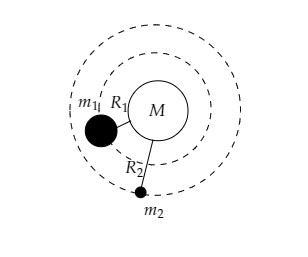
The above figure depicts the circular orbits of the two satellites.
The mass of the planet is $M$.
The mass of the satellite 1 is given to be ${m_1}$ and the mass of the satellite 2 is given to be ${m_2}$.
Also, the radii of the circular orbits of satellites 1 and 2 are ${R_1}$ and ${R_2}$ respectively.
The ratio of the mass of satellite 1 to the satellite 2 is given to be $\dfrac{{{m_1}}}{{{m_2}}} = 2$ and the ratio of the radius of the circular orbit of satellite 1 to that of satellite 2 is given to be $\dfrac{{{R_1}}}{{{R_2}}} = \dfrac{1}{4}$.
Step 2: Use the fact that the gravitational force of attraction between the planet and the satellite equals the centripetal force of the satellite to obtain the ratio for the velocities of the satellites.
The gravitational force of attraction between the planet and the satellite 1 is given by,
${F_{G1}} = \dfrac{{GM{m_1}}}{{{R_1}^2}}$
The gravitational force of attraction between the planet and the satellite 2 is given by,
${F_{G2}} = \dfrac{{GM{m_2}}}{{{R_2}^2}}$
Now, the centripetal force of satellite 1 is given by, ${F_{c1}} = \dfrac{{{m_1}{v_1}^2}}{{{R_1}}}$ and that of satellite 2 is given by, ${F_{c2}} = \dfrac{{{m_2}{v_2}^2}}{{{R_2}}}$
The gravitational force and the centripetal force are equal.
i.e., ${F_{G1}} = {F_{c1}}$ and ${F_{G2}} = {F_{c2}}$
$ \Rightarrow \dfrac{{GM{m_1}}}{{{R_1}^2}} = \dfrac{{{m_1}{v_1}^2}}{{{R_1}}}$ and $ \Rightarrow \dfrac{{GM{m_2}}}{{{R_2}^2}} = \dfrac{{{m_2}{v_2}^2}}{{{R_2}}}$
Taking the ratio of the above two equalities we have
$\Rightarrow \dfrac{{\left( {\dfrac{{GM{m_1}}}{{{R_1}^2}}} \right)}}{{\left( {\dfrac{{GM{m_2}}}{{{R_2}^2}}} \right)}} = \dfrac{{\left( {\dfrac{{{m_1}{v_1}^2}}{{{R_1}}}} \right)}}{{\left( {\dfrac{{{m_2}{v_2}^2}}{{{R_2}}}} \right)}}$
Cancelling the similar terms on both sides and in the numerator and denominator of the above equation we have
$\Rightarrow \dfrac{{{R_2}}}{{{R_1}}} = \dfrac{{{v_1}^2}}{{{v_2}^2}}$
Substituting for $\dfrac{{{R_2}}}{{{R_1}}} = 4$ in the above relation we get,
$\Rightarrow \dfrac{{{v_1}^2}}{{{v_2}^2}} = 4$
$ \Rightarrow \dfrac{{{v_1}}}{{{v_2}}} = 2$
So the correct match for P in list 1 is option 3 in list 2 i.e., $P \to 3$.
Step 3: Express the relation for the angular momentum of the two satellites to obtain the ratio $\dfrac{{{L_1}}}{{{L_2}}}$.
The angular momentum of satellite 1 is given by, ${L_1} = {m_1}{v_1}{R_1}$ and the angular momentum of the satellite 2 is given by, ${L_2} = {m_2}{v_2}{R_2}$.
Then the ratio of the angular momentum of the two satellites will be $\dfrac{{{L_1}}}{{{L_2}}} = \dfrac{{{m_1}{v_1}{R_1}}}{{{m_2}{v_2}{R_2}}}$
Substituting for $\dfrac{{{m_1}}}{{{m_2}}} = 2$, $\dfrac{{{R_1}}}{{{R_2}}} = \dfrac{1}{4}$ and $\dfrac{{{v_1}}}{{{v_2}}} = 2$ in the above relation we get,
$\Rightarrow \dfrac{{{L_1}}}{{{L_2}}} = 2 \times 2 \times \dfrac{1}{4} = 1$
So the correct match for Q in list 1 is option 2 in list 2 i.e., $Q \to 2$.
Step 4: Express the relation for the kinetic energy of the two satellites to obtain the ratio $\dfrac{{{K_1}}}{{{K_2}}}$.
The kinetic energy of satellite 1 is given by, ${K_1} = \dfrac{1}{2}{m_1}{v_1}^2$ and the kinetic energy of the satellite 2 is given by, ${K_2} = \dfrac{1}{2}{m_2}{v_2}^2$.
Then the ratio of the kinetic energies of the two satellites will be
$\Rightarrow \dfrac{{{K_1}}}{{{K_2}}} = \dfrac{{2{m_1}{v_1}^2}}{{2{m_1}{v_2}^2}}$
Substituting for $\dfrac{{{m_1}}}{{{m_2}}} = 2$ and $\dfrac{{{v_1}}}{{{v_2}}} = 2$ in the above relation we get,
$\Rightarrow \dfrac{{{K_1}}}{{{K_2}}} = 2 \times {2^2} = 8$
So the correct match for R in list 1 is option 4 in list 2 i.e., $R \to 4$.
Step 5: Express the relation for the period of revolution of the two satellites to obtain the ratio of $\dfrac{{{T_1}}}{{{T_2}}}$.
The period of revolution of satellite 1 is given by,
${T_1} = \dfrac{{2\pi {R_1}}}{{{v_1}}}$ and the period of revolution of the satellite 2 is given by, ${T_2} = \dfrac{{2\pi {R_2}}}{{{v_2}}}$.
Then the ratio of the period of revolution of the two satellites will be
$\Rightarrow \dfrac{{{T_1}}}{{{T_2}}} = \dfrac{{2\pi {v_2}{R_1}}}{{2\pi {v_1}{R_2}}}$
Substituting for $\dfrac{{{R_1}}}{{{R_2}}} = \dfrac{1}{4}$ and $\dfrac{{{v_2}}}{{{v_1}}} = \dfrac{1}{2}$ in the above relation we get,
$\Rightarrow \dfrac{{{T_1}}}{{{T_2}}} = \dfrac{1}{4} \times \dfrac{1}{2} = \dfrac{1}{8}$
So the correct match for S in list 1 is option 1 in list 2 i.e., $S \to 1$.
So we have finally, $P \to 3$ ; $Q \to 2$ ; $R \to 4$ ; $S \to 1$ and hence the correct option is (B).
Note:
All bodies moving in circular orbits possess centripetal force. Here, the satellites have circular orbits and thus have centripetal force. It is this centripetal force that keeps the satellites revolving in their respective circular orbits. But note that the centripetal force is provided by the gravitational force of attraction between the planet and the satellite. If we were to consider the gravitational force of attraction between the two satellites then the ratios will have different values.
Formulas used:
The gravitational force of attraction between the planet and the satellite is given by, ${F_G} = \dfrac{{GMm}}{{{r^2}}}$ where $G$ is the gravitational constant, $M$ is the mass of the planet and $m$ is the mass of the satellite and $r$ is the distance of separation between the planet and the mass.
The centripetal force of a body executing circular motion is given by, ${F_c} = \dfrac{{m{v^2}}}{r}$ where $m$ is the mass of the body, $v$ is the linear velocity of the body and $r$ is the radius of the circular path.
The angular momentum of a body is given by, $L = mvr$ where $m$ is the mass of the body, $v$ is the linear velocity of the body and $r$ is the radius of the circular path.
The kinetic energy of a body is given by, $K = \dfrac{1}{2}m{v^2}$ where $m$ is the mass of the body and $v$ is the velocity of the body.
The time period of revolution of a body in a circular orbit is given by, $T = \dfrac{{2\pi r}}{v}$ where $v$ is the linear velocity of the body and $r$ is the radius of the circular orbit.
Complete step by step answer:
Step 1: Sketch a rough figure describing the revolution of the two satellites around the planet and list the key features of the planet-satellite system.
The above figure depicts the circular orbits of the two satellites.
The mass of the planet is $M$.
The mass of the satellite 1 is given to be ${m_1}$ and the mass of the satellite 2 is given to be ${m_2}$.
Also, the radii of the circular orbits of satellites 1 and 2 are ${R_1}$ and ${R_2}$ respectively.
The ratio of the mass of satellite 1 to the satellite 2 is given to be $\dfrac{{{m_1}}}{{{m_2}}} = 2$ and the ratio of the radius of the circular orbit of satellite 1 to that of satellite 2 is given to be $\dfrac{{{R_1}}}{{{R_2}}} = \dfrac{1}{4}$.
Step 2: Use the fact that the gravitational force of attraction between the planet and the satellite equals the centripetal force of the satellite to obtain the ratio for the velocities of the satellites.
The gravitational force of attraction between the planet and the satellite 1 is given by,
${F_{G1}} = \dfrac{{GM{m_1}}}{{{R_1}^2}}$
The gravitational force of attraction between the planet and the satellite 2 is given by,
${F_{G2}} = \dfrac{{GM{m_2}}}{{{R_2}^2}}$
Now, the centripetal force of satellite 1 is given by, ${F_{c1}} = \dfrac{{{m_1}{v_1}^2}}{{{R_1}}}$ and that of satellite 2 is given by, ${F_{c2}} = \dfrac{{{m_2}{v_2}^2}}{{{R_2}}}$
The gravitational force and the centripetal force are equal.
i.e., ${F_{G1}} = {F_{c1}}$ and ${F_{G2}} = {F_{c2}}$
$ \Rightarrow \dfrac{{GM{m_1}}}{{{R_1}^2}} = \dfrac{{{m_1}{v_1}^2}}{{{R_1}}}$ and $ \Rightarrow \dfrac{{GM{m_2}}}{{{R_2}^2}} = \dfrac{{{m_2}{v_2}^2}}{{{R_2}}}$
Taking the ratio of the above two equalities we have
$\Rightarrow \dfrac{{\left( {\dfrac{{GM{m_1}}}{{{R_1}^2}}} \right)}}{{\left( {\dfrac{{GM{m_2}}}{{{R_2}^2}}} \right)}} = \dfrac{{\left( {\dfrac{{{m_1}{v_1}^2}}{{{R_1}}}} \right)}}{{\left( {\dfrac{{{m_2}{v_2}^2}}{{{R_2}}}} \right)}}$
Cancelling the similar terms on both sides and in the numerator and denominator of the above equation we have
$\Rightarrow \dfrac{{{R_2}}}{{{R_1}}} = \dfrac{{{v_1}^2}}{{{v_2}^2}}$
Substituting for $\dfrac{{{R_2}}}{{{R_1}}} = 4$ in the above relation we get,
$\Rightarrow \dfrac{{{v_1}^2}}{{{v_2}^2}} = 4$
$ \Rightarrow \dfrac{{{v_1}}}{{{v_2}}} = 2$
So the correct match for P in list 1 is option 3 in list 2 i.e., $P \to 3$.
Step 3: Express the relation for the angular momentum of the two satellites to obtain the ratio $\dfrac{{{L_1}}}{{{L_2}}}$.
The angular momentum of satellite 1 is given by, ${L_1} = {m_1}{v_1}{R_1}$ and the angular momentum of the satellite 2 is given by, ${L_2} = {m_2}{v_2}{R_2}$.
Then the ratio of the angular momentum of the two satellites will be $\dfrac{{{L_1}}}{{{L_2}}} = \dfrac{{{m_1}{v_1}{R_1}}}{{{m_2}{v_2}{R_2}}}$
Substituting for $\dfrac{{{m_1}}}{{{m_2}}} = 2$, $\dfrac{{{R_1}}}{{{R_2}}} = \dfrac{1}{4}$ and $\dfrac{{{v_1}}}{{{v_2}}} = 2$ in the above relation we get,
$\Rightarrow \dfrac{{{L_1}}}{{{L_2}}} = 2 \times 2 \times \dfrac{1}{4} = 1$
So the correct match for Q in list 1 is option 2 in list 2 i.e., $Q \to 2$.
Step 4: Express the relation for the kinetic energy of the two satellites to obtain the ratio $\dfrac{{{K_1}}}{{{K_2}}}$.
The kinetic energy of satellite 1 is given by, ${K_1} = \dfrac{1}{2}{m_1}{v_1}^2$ and the kinetic energy of the satellite 2 is given by, ${K_2} = \dfrac{1}{2}{m_2}{v_2}^2$.
Then the ratio of the kinetic energies of the two satellites will be
$\Rightarrow \dfrac{{{K_1}}}{{{K_2}}} = \dfrac{{2{m_1}{v_1}^2}}{{2{m_1}{v_2}^2}}$
Substituting for $\dfrac{{{m_1}}}{{{m_2}}} = 2$ and $\dfrac{{{v_1}}}{{{v_2}}} = 2$ in the above relation we get,
$\Rightarrow \dfrac{{{K_1}}}{{{K_2}}} = 2 \times {2^2} = 8$
So the correct match for R in list 1 is option 4 in list 2 i.e., $R \to 4$.
Step 5: Express the relation for the period of revolution of the two satellites to obtain the ratio of $\dfrac{{{T_1}}}{{{T_2}}}$.
The period of revolution of satellite 1 is given by,
${T_1} = \dfrac{{2\pi {R_1}}}{{{v_1}}}$ and the period of revolution of the satellite 2 is given by, ${T_2} = \dfrac{{2\pi {R_2}}}{{{v_2}}}$.
Then the ratio of the period of revolution of the two satellites will be
$\Rightarrow \dfrac{{{T_1}}}{{{T_2}}} = \dfrac{{2\pi {v_2}{R_1}}}{{2\pi {v_1}{R_2}}}$
Substituting for $\dfrac{{{R_1}}}{{{R_2}}} = \dfrac{1}{4}$ and $\dfrac{{{v_2}}}{{{v_1}}} = \dfrac{1}{2}$ in the above relation we get,
$\Rightarrow \dfrac{{{T_1}}}{{{T_2}}} = \dfrac{1}{4} \times \dfrac{1}{2} = \dfrac{1}{8}$
So the correct match for S in list 1 is option 1 in list 2 i.e., $S \to 1$.
So we have finally, $P \to 3$ ; $Q \to 2$ ; $R \to 4$ ; $S \to 1$ and hence the correct option is (B).
Note:
All bodies moving in circular orbits possess centripetal force. Here, the satellites have circular orbits and thus have centripetal force. It is this centripetal force that keeps the satellites revolving in their respective circular orbits. But note that the centripetal force is provided by the gravitational force of attraction between the planet and the satellite. If we were to consider the gravitational force of attraction between the two satellites then the ratios will have different values.
Recently Updated Pages
Master Class 12 Economics: Engaging Questions & Answers for Success

Master Class 12 English: Engaging Questions & Answers for Success
Master Class 12 Social Science: Engaging Questions & Answers for Success
Master Class 12 Maths: Engaging Questions & Answers for Success
Master Class 12 Physics: Engaging Questions & Answers for Success
Master Class 9 General Knowledge: Engaging Questions & Answers for Success
Trending doubts
One Metric ton is equal to kg A 10000 B 1000 C 100 class 11 physics CBSE
Difference Between Prokaryotic Cells and Eukaryotic Cells
Two of the body parts which do not appear in MRI are class 11 biology CBSE
1 ton equals to A 100 kg B 1000 kg C 10 kg D 10000 class 11 physics CBSE
10 examples of friction in our daily life
DNA is not present in A Nucleus B Mitochondria C Chloroplast class 11 biology CBSE