




A plane mirror moves with velocity of 1$\hat i$m/s is placed from origin parallel to Y axis, facing the positive X-axis. An object starts from (2m, 0, 0) with velocity of $2\hat i + 2\hat j$, the relative velocity of image with respect to object is:
Answer
 Verified
568.5k+ views
Hint: In this question, we will use the relation between the velocity of image and velocity of object. Now by substituting the given values we get the required result. Further, we will discuss the basics of mirror, lens and types of lens, for better understanding.
Formula used:
${\vec V_{{I_0}}} = {\vec V_I} - {\vec V_0}$
Complete answer:
Here, we know that velocity of image is given as:
${\vec V_I} = 2{\vec V_m} + {\vec V_0}$
Also, velocity of image with respect to object, we get:
${\vec V_{{I_0}}} = {\vec V_I} - {\vec V_0}$
Now, substituting the given values of velocity of image in the above equation, we get:
${\vec V_{{I_0}}} = 2{\vec V_m} + {\vec V_0} - {\vec V_0}$
$\eqalign{& {{\vec V}_{{I_0}}} = 2{{\vec V}_m} \cr
& \therefore {{\vec V}_{{I_0}}} = + 2\hat i \cr} $
Therefore, we get the required answer of the relative velocity of the image with respect to the object.
Additional information:
As we know a mirror is defined as a device that contains a surface, which is mainly used to reflect light. As mirrors do not usually absorb much light, most of the light is redirected. The mirror and the object's overall quality is generally preserved in the new image.
In the given figure, the shaded portion is not used to reflect light.
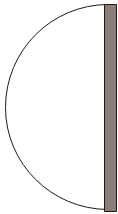
Convex mirror
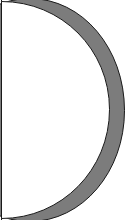
Concave mirror
Now, when we define a lens, we know that a lens is a transmissive optical device that focuses or disperses light beams by the means of refraction. For example- a lens can focus light to form an image, unlike a prism, which refracts light without focusing.
Here, there are two types of lenses, a simple lens and a compound lens. A simple lens consists of a single piece of transparent material. Compound lens consist of several simple lenses arranged along with a common axis
As we know that lenses are of two types.
This classification of lenses depends on how the light rays bend when they pass through the lens:
1.Convex Lens also called Converging lens:
Convex lenses are thick in the middle and thinner at the edges. . A convex lens is also known as the converging lens as the light rays bend inwards and converge at a point which is known as focal length.
2.Concave Lens also called Diverging lens:
Here, we define a concave lens which is flat in the middle and thicker at the edges. Also, a concave lens is known as a diverging lens as it bends the parallel light rays outward and diverges the light rays at the focal point.
Note:
We should remember that a mirror will have only one focal point, which is in front of the mirror. Also, a lens has two focal points each on either side. We should note that compound lenses are constructed from a combination of different simple lenses. The lens which is used to build a compound lens may have different refractive indices and other properties.
Formula used:
${\vec V_{{I_0}}} = {\vec V_I} - {\vec V_0}$
Complete answer:
Here, we know that velocity of image is given as:
${\vec V_I} = 2{\vec V_m} + {\vec V_0}$
Also, velocity of image with respect to object, we get:
${\vec V_{{I_0}}} = {\vec V_I} - {\vec V_0}$
Now, substituting the given values of velocity of image in the above equation, we get:
${\vec V_{{I_0}}} = 2{\vec V_m} + {\vec V_0} - {\vec V_0}$
$\eqalign{& {{\vec V}_{{I_0}}} = 2{{\vec V}_m} \cr
& \therefore {{\vec V}_{{I_0}}} = + 2\hat i \cr} $
Therefore, we get the required answer of the relative velocity of the image with respect to the object.
Additional information:
As we know a mirror is defined as a device that contains a surface, which is mainly used to reflect light. As mirrors do not usually absorb much light, most of the light is redirected. The mirror and the object's overall quality is generally preserved in the new image.
In the given figure, the shaded portion is not used to reflect light.
Convex mirror
Concave mirror
Now, when we define a lens, we know that a lens is a transmissive optical device that focuses or disperses light beams by the means of refraction. For example- a lens can focus light to form an image, unlike a prism, which refracts light without focusing.
Here, there are two types of lenses, a simple lens and a compound lens. A simple lens consists of a single piece of transparent material. Compound lens consist of several simple lenses arranged along with a common axis
As we know that lenses are of two types.
This classification of lenses depends on how the light rays bend when they pass through the lens:
1.Convex Lens also called Converging lens:
Convex lenses are thick in the middle and thinner at the edges. . A convex lens is also known as the converging lens as the light rays bend inwards and converge at a point which is known as focal length.
2.Concave Lens also called Diverging lens:
Here, we define a concave lens which is flat in the middle and thicker at the edges. Also, a concave lens is known as a diverging lens as it bends the parallel light rays outward and diverges the light rays at the focal point.
Note:
We should remember that a mirror will have only one focal point, which is in front of the mirror. Also, a lens has two focal points each on either side. We should note that compound lenses are constructed from a combination of different simple lenses. The lens which is used to build a compound lens may have different refractive indices and other properties.
Recently Updated Pages
Basicity of sulphurous acid and sulphuric acid are

Master Class 12 English: Engaging Questions & Answers for Success
Master Class 12 Social Science: Engaging Questions & Answers for Success
Master Class 12 Maths: Engaging Questions & Answers for Success
Master Class 12 Economics: Engaging Questions & Answers for Success
Master Class 12 Physics: Engaging Questions & Answers for Success
Trending doubts
Draw a labelled sketch of the human eye class 12 physics CBSE
Which are the Top 10 Largest Countries of the World?
Draw ray diagrams each showing i myopic eye and ii class 12 physics CBSE
Giving reasons state the signs positive or negative class 12 physics CBSE
Explain esterification reaction with the help of a class 12 chemistry CBSE
What is defined as a solenoid Depict a diagram with class 12 physics CBSE