




A piece of liver tissue is homogenized in a laboratory and the homogenate is subjected to sequential centrifugation at increasing speeds ( expressed in xg ). Centrifugation is used to separate subcellular components based on size and density. The steps carried out in the experiment are shown. Sediments 1, 2 and 3 would most likely contain.
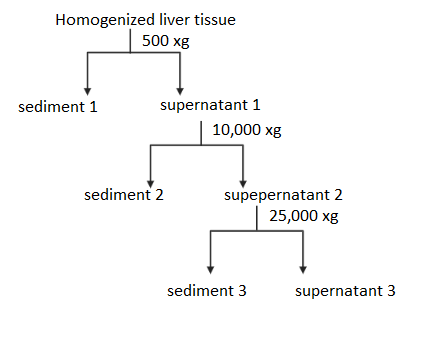
A) 1: Nuclei, 2: Ribosomes, 3: Mitochondria
B) 1: Nuclei, 2: Mitochondria, 3: Lysosomes
C) 1: Lysosomes, 2: Mitochondria, 3: Nuclei
D) 1: Ribosomes, 2: Nuclei, 3: Mitochondria
Answer
 Verified
578.1k+ views
Hint: Centrifugation is a mechanical method involving the use of centrifugal force according to its scale, shape, density, medium viscosity and rotor speed to remove particles from a solution. The liver homogenate is a tissue of the liver in which its cells, releasing organelles and cytoplasm, have been mechanically disrupted. Each cell is composed of cell organelles such as nuclei, mitochondria, ER, lysosomes and many more.
Complete answer:
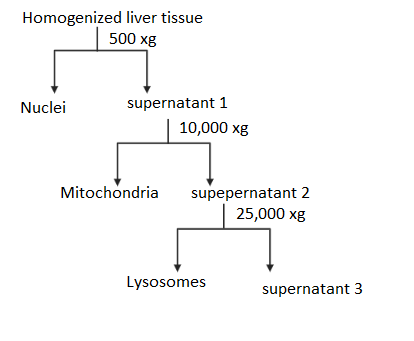
A centrifuge operates by using the sedimentation principle; substances separate according to their density under the influence of gravitational force (g-force). Various forms of separation, including isopycnic, ultrafiltration, the gradient of density, phase separation and pelleting, are known. Based on size and density, centrifugation is used to isolate subcellular components. The larger the density, the more quickly it moves. In order to separate various subcellular components from the homogenate, differential centrifugation uses different velocities. The heaviest subcellular elements, i.e. nuclei, would settle first when homogenized liver tissue is centrifuged at 500 xg. The second heavier sub-cellular component, which is mitochondria, will settle when the supernatant is again centrifuged at 10000 xg. The lightest sub-cellular part, that is, lysosomes, will settle when the supernatant is centrifuged at a very high speed of 25000 xg. Therefore, option B is the correct answer.
So, option B is the correct answer.
Note: The order of sedimentation is usually (from most to least dense) with regard to the major components found in cells: nuclei, mitochondria, lysosomes, plasma membrane, endoplasmic reticulum and contractile vacuoles. Animal tissue is homogenized more readily than plant tissue since there are no cell walls, and soft and reasonably homogeneous tissue is the liver in particular.
Complete answer:
A centrifuge operates by using the sedimentation principle; substances separate according to their density under the influence of gravitational force (g-force). Various forms of separation, including isopycnic, ultrafiltration, the gradient of density, phase separation and pelleting, are known. Based on size and density, centrifugation is used to isolate subcellular components. The larger the density, the more quickly it moves. In order to separate various subcellular components from the homogenate, differential centrifugation uses different velocities. The heaviest subcellular elements, i.e. nuclei, would settle first when homogenized liver tissue is centrifuged at 500 xg. The second heavier sub-cellular component, which is mitochondria, will settle when the supernatant is again centrifuged at 10000 xg. The lightest sub-cellular part, that is, lysosomes, will settle when the supernatant is centrifuged at a very high speed of 25000 xg. Therefore, option B is the correct answer.
So, option B is the correct answer.
Note: The order of sedimentation is usually (from most to least dense) with regard to the major components found in cells: nuclei, mitochondria, lysosomes, plasma membrane, endoplasmic reticulum and contractile vacuoles. Animal tissue is homogenized more readily than plant tissue since there are no cell walls, and soft and reasonably homogeneous tissue is the liver in particular.
Recently Updated Pages
Master Class 11 Social Science: Engaging Questions & Answers for Success

Master Class 11 Physics: Engaging Questions & Answers for Success
Master Class 11 Maths: Engaging Questions & Answers for Success
Master Class 11 Economics: Engaging Questions & Answers for Success
Master Class 11 Computer Science: Engaging Questions & Answers for Success
Master Class 11 Chemistry: Engaging Questions & Answers for Success
Trending doubts
One Metric ton is equal to kg A 10000 B 1000 C 100 class 11 physics CBSE
There are 720 permutations of the digits 1 2 3 4 5 class 11 maths CBSE
1 Quintal is equal to a 110 kg b 10 kg c 100kg d 1000 class 11 physics CBSE
State and prove Bernoullis theorem class 11 physics CBSE
Difference Between Prokaryotic Cells and Eukaryotic Cells
Which among the following are examples of coming together class 11 social science CBSE