




A person standing in a stationary lift drops a coin from a certain height h. It takes time to reach the floor of the lift. If the lift is rising up with a uniform acceleration a, the time taken by the coin (dropped from the same height h) to reach the floor will be
A. t
B. $t\sqrt{\dfrac{a}{g}}$
C. $t{{\left( 1+\dfrac{a}{g} \right)}^{-\dfrac{1}{2}}}$
D. $t{{\left( 1-\sqrt{\dfrac{a}{g}} \right)}^{\dfrac{1}{2}}}$
Answer
 Verified
514.2k+ views
Hint: As a very first step, one could read the question well and hence note down the given points from it. Then, you could consider the two cases given, one where the lift is at rest and the other where the lift is accelerating upwards and hence find the answer using the equation of motion to both cases.
Formula used:
Equation of motion,
$s=ut+\dfrac{1}{2}g{{t}^{2}}$
Complete step by step solution:
In the question, we are told that a person is standing in a lift that is stationary and drops a coin from height h and this coin takes time to reach the floor. Now, we are supposed to find the time taken by the coin to cover the same height h if the lift had been accelerating at an acceleration.
When the coin is dropped, the initial velocity for both cases would be,
$u=0$
Now we have the equation of motion to be,
$s=ut+\dfrac{1}{2}g{{t}^{2}}$………………………………………. (1)
$\Rightarrow h=\dfrac{1}{2}g{{t}^{2}}$………………………………………… (2)
For lift rising up with constant acceleration a, the effective acceleration would be,
$a'=g+a$
Now, equation (1) here would be,
$h=\dfrac{1}{2}\left( g+a \right)t{{'}^{2}}$……………………………………… (3)
On equating the RHS of (2) and (3), we have,
$\dfrac{1}{2}g{{t}^{2}}=\dfrac{1}{2}\left( g+a \right)t{{'}^{2}}$
$\Rightarrow t'=\sqrt{\dfrac{g}{g+a}}t$
$\therefore t'=t{{\left( 1+\dfrac{a}{g} \right)}^{-\dfrac{1}{2}}}$
Therefore, we found the time taken by the coin to reach the floor in the accelerating lift to be,
$t'=t{{\left( 1+\dfrac{a}{g} \right)}^{-\dfrac{1}{2}}}$
Hence, option C is the correct answer.
Note: In case if you are wondering how we found the effective acceleration; consider the lift moving upwards and the coin falling downwards,
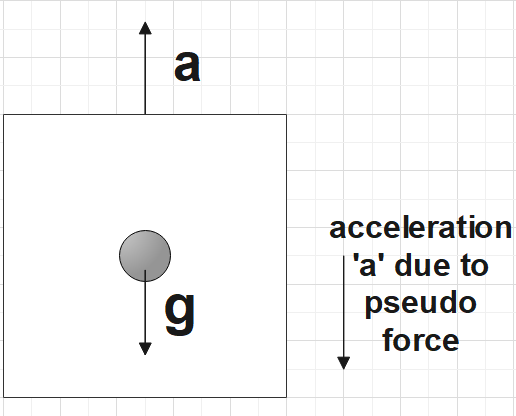
Now, we get the effective acceleration to be the sum of g and a.
Formula used:
Equation of motion,
$s=ut+\dfrac{1}{2}g{{t}^{2}}$
Complete step by step solution:
In the question, we are told that a person is standing in a lift that is stationary and drops a coin from height h and this coin takes time to reach the floor. Now, we are supposed to find the time taken by the coin to cover the same height h if the lift had been accelerating at an acceleration.
When the coin is dropped, the initial velocity for both cases would be,
$u=0$
Now we have the equation of motion to be,
$s=ut+\dfrac{1}{2}g{{t}^{2}}$………………………………………. (1)
$\Rightarrow h=\dfrac{1}{2}g{{t}^{2}}$………………………………………… (2)
For lift rising up with constant acceleration a, the effective acceleration would be,
$a'=g+a$
Now, equation (1) here would be,
$h=\dfrac{1}{2}\left( g+a \right)t{{'}^{2}}$……………………………………… (3)
On equating the RHS of (2) and (3), we have,
$\dfrac{1}{2}g{{t}^{2}}=\dfrac{1}{2}\left( g+a \right)t{{'}^{2}}$
$\Rightarrow t'=\sqrt{\dfrac{g}{g+a}}t$
$\therefore t'=t{{\left( 1+\dfrac{a}{g} \right)}^{-\dfrac{1}{2}}}$
Therefore, we found the time taken by the coin to reach the floor in the accelerating lift to be,
$t'=t{{\left( 1+\dfrac{a}{g} \right)}^{-\dfrac{1}{2}}}$
Hence, option C is the correct answer.
Note: In case if you are wondering how we found the effective acceleration; consider the lift moving upwards and the coin falling downwards,
Now, we get the effective acceleration to be the sum of g and a.
Recently Updated Pages
Master Class 11 Computer Science: Engaging Questions & Answers for Success

Master Class 11 Business Studies: Engaging Questions & Answers for Success
Master Class 11 Economics: Engaging Questions & Answers for Success
Master Class 11 English: Engaging Questions & Answers for Success
Master Class 11 Maths: Engaging Questions & Answers for Success
Master Class 11 Biology: Engaging Questions & Answers for Success
Trending doubts
One Metric ton is equal to kg A 10000 B 1000 C 100 class 11 physics CBSE
There are 720 permutations of the digits 1 2 3 4 5 class 11 maths CBSE
Discuss the various forms of bacteria class 11 biology CBSE
Draw a diagram of a plant cell and label at least eight class 11 biology CBSE
State the laws of reflection of light
Explain zero factorial class 11 maths CBSE