




A person invites a party of 10 friends at dinner and placed of them are
(i) 5 at one round table, 5 at the other round table.
(ii) 4 at one round table, 6 at the other round table.
Then the ratio of number of circular permutations of case (i) and case (ii) is
(A) \[\dfrac{24}{13}\]
(B) \[\dfrac{25}{24}\]
(C) \[\dfrac{24}{25}\]
(D) \[\dfrac{13}{24}\]
Answer
 Verified
612.6k+ views
Hint: In the \[{{1}^{st}}\] case, it is given that 5 persons are at one round table and the remaining 5 persons are at the other round table. Calculate the number of ways to select 5 persons for the first table by using the formula, \[^{n}{{C}_{m}}\] . Now, calculate the number of possible circular rearrangements of 5 persons sitting at the first table using the formula \[\left( n-1 \right)!\] . Similarly, calculate the number of possible circular rearrangements of the remaining 5 persons sitting at the second table. Now, get the
total number of circular permutations in the \[{{1}^{st}}\] case. In the \[{{2}^{nd}}\] case, it is given that 6 persons are at one round table and the remaining 4 persons are at the other round table. Calculate the number of ways to select 6 persons for the first table by using the formula, \[^{n}{{C}_{m}}\] . Now, calculate the number of possible circular rearrangements of 6 persons sitting at the first table using the formula \[\left( n-1 \right)!\] . Similarly, calculate the number of possible circular rearrangements of the remaining 4 persons sitting at the second table. Now, get the total number of circular permutations in the \[{{2}^{nd}}\] case. Finally, calculate the ratio of the circular permutations in the \[{{1}^{st}}\] case and \[{{2}^{nd}}\] case.
Complete step-by-step answer:
According to the question, it is given that a person invites a party of 10 friends at dinner. Here, we have two cases.
In the \[{{1}^{st}}\] case, it is given that
5 persons are at one round table and the remaining 5 persons are at the other round table.
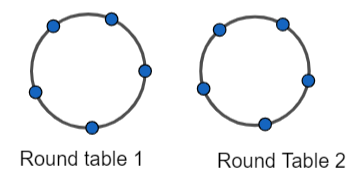
We know the formula to select m items out of n items, \[^{n}{{C}_{m}}\] .
Here, we have to select 5 persons for the first table out of 10 persons.
The number of ways to select 5 persons for the first table = \[^{10}{{C}_{5}}\] ……………………………..(1)
We know that the possible number of circular rearrangements for n items is \[\left( n-1 \right)!\] .
The number of possible rearrangements of 5 persons sitting on the round table = \[\left( 5-1 \right)!=4!\] ………………………………..(2)
Now, we have the remaining 5 persons for the second round table.
The number of possible rearrangements of the remaining 5 persons sitting on the round table = 4! ………………………………..(3)
The total number of circular permutations in the \[{{1}^{st}}\] case = \[^{10}{{C}_{5}}\times 4!\times 4!\] …………………………(4)
In the \[{{2}^{nd}}\] case, it is given that
6 persons are at one round table and the remaining 4 persons are at the other round table.
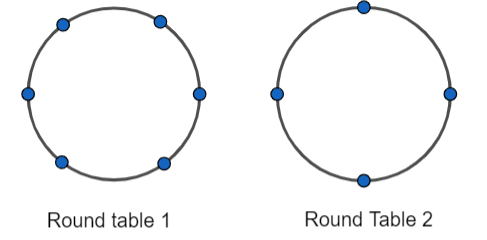
We know the formula to select m items out of n items, \[^{n}{{C}_{m}}\] .
Here, we have to select 6 persons for the first table out of 10 persons.
The number of ways to select 6 persons for the first table = \[^{10}{{C}_{6}}\] ……………………………..(5)
We know that the possible number of circular rearrangements for n items is \[\left( n-1 \right)!\] .
The number of possible rearrangements of 6 persons sitting on the round table = \[\left( 6-1 \right)!=5!\] ………………………………..(6)
Now, we have the remaining 4 people for the second round table.
The number of possible rearrangements of the remaining 4 persons sitting on the round table = \[\left( 4-1 \right)!=3!\] ………………………………..(7)
The total number of circular permutations in the \[{{2}^{nd}}\] case = \[^{10}{{C}_{6}}\times 5!\times 3!\] …………………………(8)
From equation(4) and equation (8), we have the total number of permutations for \[{{1}^{st}}\] case and \[{{2}^{nd}}\] case.
The ratio of the circular permutation in \[{{1}^{st}}\] case and \[{{2}^{nd}}\] case = \[\dfrac{^{10}{{C}_{5}}4!\times 4!}{^{10}{{C}_{6}}5!\times 3!}\] = \[\dfrac{\dfrac{10\times 9\times 8\times 7\times 6}{1\times 2\times 3\times 4\times 5}\times 4!\times 3!\times 4}{\dfrac{10\times 9\times 8\times 7\times 6\times 5}{1\times 2\times 3\times 4\times 5\times 6}\times 5\times 4!\times 3!}=\dfrac{6\times 4}{5\times 5}=\dfrac{24}{25}\] .
Hence, the correct option is (C).
Note: In this question, one might calculate the number of possible rearrangements using the formula \[n!\] . We cannot apply this formula here because here the persons are sitting on the round table. So, the number of possible rearrangements can be calculated using the formula for circular rearrangements, \[\left( n-1 \right)!\] where n is the total number of elements for the rearrangements.
total number of circular permutations in the \[{{1}^{st}}\] case. In the \[{{2}^{nd}}\] case, it is given that 6 persons are at one round table and the remaining 4 persons are at the other round table. Calculate the number of ways to select 6 persons for the first table by using the formula, \[^{n}{{C}_{m}}\] . Now, calculate the number of possible circular rearrangements of 6 persons sitting at the first table using the formula \[\left( n-1 \right)!\] . Similarly, calculate the number of possible circular rearrangements of the remaining 4 persons sitting at the second table. Now, get the total number of circular permutations in the \[{{2}^{nd}}\] case. Finally, calculate the ratio of the circular permutations in the \[{{1}^{st}}\] case and \[{{2}^{nd}}\] case.
Complete step-by-step answer:
According to the question, it is given that a person invites a party of 10 friends at dinner. Here, we have two cases.
In the \[{{1}^{st}}\] case, it is given that
5 persons are at one round table and the remaining 5 persons are at the other round table.
We know the formula to select m items out of n items, \[^{n}{{C}_{m}}\] .
Here, we have to select 5 persons for the first table out of 10 persons.
The number of ways to select 5 persons for the first table = \[^{10}{{C}_{5}}\] ……………………………..(1)
We know that the possible number of circular rearrangements for n items is \[\left( n-1 \right)!\] .
The number of possible rearrangements of 5 persons sitting on the round table = \[\left( 5-1 \right)!=4!\] ………………………………..(2)
Now, we have the remaining 5 persons for the second round table.
The number of possible rearrangements of the remaining 5 persons sitting on the round table = 4! ………………………………..(3)
The total number of circular permutations in the \[{{1}^{st}}\] case = \[^{10}{{C}_{5}}\times 4!\times 4!\] …………………………(4)
In the \[{{2}^{nd}}\] case, it is given that
6 persons are at one round table and the remaining 4 persons are at the other round table.
We know the formula to select m items out of n items, \[^{n}{{C}_{m}}\] .
Here, we have to select 6 persons for the first table out of 10 persons.
The number of ways to select 6 persons for the first table = \[^{10}{{C}_{6}}\] ……………………………..(5)
We know that the possible number of circular rearrangements for n items is \[\left( n-1 \right)!\] .
The number of possible rearrangements of 6 persons sitting on the round table = \[\left( 6-1 \right)!=5!\] ………………………………..(6)
Now, we have the remaining 4 people for the second round table.
The number of possible rearrangements of the remaining 4 persons sitting on the round table = \[\left( 4-1 \right)!=3!\] ………………………………..(7)
The total number of circular permutations in the \[{{2}^{nd}}\] case = \[^{10}{{C}_{6}}\times 5!\times 3!\] …………………………(8)
From equation(4) and equation (8), we have the total number of permutations for \[{{1}^{st}}\] case and \[{{2}^{nd}}\] case.
The ratio of the circular permutation in \[{{1}^{st}}\] case and \[{{2}^{nd}}\] case = \[\dfrac{^{10}{{C}_{5}}4!\times 4!}{^{10}{{C}_{6}}5!\times 3!}\] = \[\dfrac{\dfrac{10\times 9\times 8\times 7\times 6}{1\times 2\times 3\times 4\times 5}\times 4!\times 3!\times 4}{\dfrac{10\times 9\times 8\times 7\times 6\times 5}{1\times 2\times 3\times 4\times 5\times 6}\times 5\times 4!\times 3!}=\dfrac{6\times 4}{5\times 5}=\dfrac{24}{25}\] .
Hence, the correct option is (C).
Note: In this question, one might calculate the number of possible rearrangements using the formula \[n!\] . We cannot apply this formula here because here the persons are sitting on the round table. So, the number of possible rearrangements can be calculated using the formula for circular rearrangements, \[\left( n-1 \right)!\] where n is the total number of elements for the rearrangements.
Recently Updated Pages
Master Class 10 Social Science: Engaging Questions & Answers for Success

Master Class 10 Science: Engaging Questions & Answers for Success
Master Class 10 Maths: Engaging Questions & Answers for Success
Master Class 10 General Knowledge: Engaging Questions & Answers for Success
Master Class 10 Computer Science: Engaging Questions & Answers for Success
Class 10 Question and Answer - Your Ultimate Solutions Guide
Trending doubts
What is the full form of PNG A Petrol Natural Gas B class 10 chemistry CBSE
Explain the Treaty of Vienna of 1815 class 10 social science CBSE
Why is there a time difference of about 5 hours between class 10 social science CBSE
Who Won 36 Oscar Awards? Record Holder Revealed
What is the median of the first 10 natural numbers class 10 maths CBSE
The power of the lens is 2D What is its focal length class 10 physics CBSE