




A partition wall is made of two layers of different materials, A and B, in contact with each other. Both A and B have the same thickness but, the thermal conductivity of layer A is twice that of layer B. At steady state, if the temperature difference across the layer B is 50K, then find the corresponding difference across the layer A.
A) 50K
B) 12.5K
C) 25K
D) 60K
E) 6025K
Answer
 Verified
619.8k+ views
Hint: At steady state, the rate of heat flow (also known as heat current) $\dfrac{{dQ}}{{dt}}$ for both the layers A and B will be the same, i.e., $\dfrac{{d{Q_A}}}{{dt}} = \dfrac{{d{Q_B}}}{{dt}}$ and it depends on the thermal conductivity of the layer, is proportional to the temperature difference between the junction and layer and is inversely proportional to the distance between then (thickness of the layer).
Formula used:
The rate of heat flow is given by, $\dfrac{{dQ}}{{dt}} = \kappa A\dfrac{{dT}}{d}$, where $\kappa $ is the thermal conductivity of the layer, $A$ is the area of the layer, $dT$ is the temperature difference between two endpoints, $d$ is the thickness of the layer.
Complete step by step solution:
Step 1: Sketch a rough diagram of the problem.
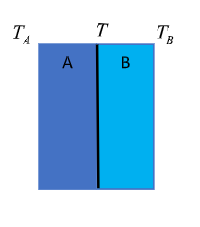
Step 2: List the information given in the question.
Let the temperature at the junction be $T$.
Let the temperature difference across layer A be $dT = {T_A} - T$ and it is unknown.
Let the temperature difference across layer B be $dT = T - {T_B} = 50{\text{K}}$ .
Let thermal conductivity of B be ${\kappa _B} = \kappa $ , then that of A will be ${\kappa _A} = 2{\kappa _B} = 2\kappa $ .
Given, A and B have the same thickness, i.e., ${d_A} = {d_B} = d$.
Also, A and B have the same area, i.e., ${A_A} = {A_B} = A$.
Step 3: Express the heat flow equation for A and B at a steady-state to find ${T_A} - T$.
When a steady state has reached the rate of heat flow will be constant across the layers.
Thus, we have $\dfrac{{d{Q_A}}}{{dt}} = \dfrac{{d{Q_B}}}{{dt}}$ where $\dfrac{{d{Q_A}}}{{dt}}$ represent rate of heat flow through A and $\dfrac{{d{Q_B}}}{{dt}}$ represents rate of heat flow through B.
Rate of heat flow through A is given as, $\dfrac{{d{Q_A}}}{{dt}} = 2\kappa \left( {\dfrac{{{T_A} - T}}{d}} \right)A$ .
Rate of heat flow through A is given as, $\dfrac{{d{Q_B}}}{{dt}} = \kappa \left( {\dfrac{{T - {T_B}}}{d}} \right)A$ .
At steady state, $2\kappa \left( {\dfrac{{{T_A} - T}}{d}} \right)A = \kappa \left( {\dfrac{{T - {T_B}}}{d}} \right)A$ .
Cancel out similar terms to obtain a simplified form of the above equation.
Now, $2\left( {{T_A} - T} \right) = T - {T_B}$ .
Substitute value for $T - {T_B} = 50{\text{K}}$ in the above equation to get required temperature difference, ${T_A} - T$ .
i.e., $2\left( {{T_A} - T} \right) = 50{\text{K}}$ or ${T_A} - T = 25{\text{K}}$ .
Hence, at a steady-state, the temperature difference across layer A is 25K.
Therefore, the correct option is (C) 25K.
Note:
The junction of the two layers is the endpoint of heat flow for layer A while, it is the start of heat flow for layer B. The temperature difference across each layer must be expressed accordingly.
Formula used:
The rate of heat flow is given by, $\dfrac{{dQ}}{{dt}} = \kappa A\dfrac{{dT}}{d}$, where $\kappa $ is the thermal conductivity of the layer, $A$ is the area of the layer, $dT$ is the temperature difference between two endpoints, $d$ is the thickness of the layer.
Complete step by step solution:
Step 1: Sketch a rough diagram of the problem.
Step 2: List the information given in the question.
Let the temperature at the junction be $T$.
Let the temperature difference across layer A be $dT = {T_A} - T$ and it is unknown.
Let the temperature difference across layer B be $dT = T - {T_B} = 50{\text{K}}$ .
Let thermal conductivity of B be ${\kappa _B} = \kappa $ , then that of A will be ${\kappa _A} = 2{\kappa _B} = 2\kappa $ .
Given, A and B have the same thickness, i.e., ${d_A} = {d_B} = d$.
Also, A and B have the same area, i.e., ${A_A} = {A_B} = A$.
Step 3: Express the heat flow equation for A and B at a steady-state to find ${T_A} - T$.
When a steady state has reached the rate of heat flow will be constant across the layers.
Thus, we have $\dfrac{{d{Q_A}}}{{dt}} = \dfrac{{d{Q_B}}}{{dt}}$ where $\dfrac{{d{Q_A}}}{{dt}}$ represent rate of heat flow through A and $\dfrac{{d{Q_B}}}{{dt}}$ represents rate of heat flow through B.
Rate of heat flow through A is given as, $\dfrac{{d{Q_A}}}{{dt}} = 2\kappa \left( {\dfrac{{{T_A} - T}}{d}} \right)A$ .
Rate of heat flow through A is given as, $\dfrac{{d{Q_B}}}{{dt}} = \kappa \left( {\dfrac{{T - {T_B}}}{d}} \right)A$ .
At steady state, $2\kappa \left( {\dfrac{{{T_A} - T}}{d}} \right)A = \kappa \left( {\dfrac{{T - {T_B}}}{d}} \right)A$ .
Cancel out similar terms to obtain a simplified form of the above equation.
Now, $2\left( {{T_A} - T} \right) = T - {T_B}$ .
Substitute value for $T - {T_B} = 50{\text{K}}$ in the above equation to get required temperature difference, ${T_A} - T$ .
i.e., $2\left( {{T_A} - T} \right) = 50{\text{K}}$ or ${T_A} - T = 25{\text{K}}$ .
Hence, at a steady-state, the temperature difference across layer A is 25K.
Therefore, the correct option is (C) 25K.
Note:
The junction of the two layers is the endpoint of heat flow for layer A while, it is the start of heat flow for layer B. The temperature difference across each layer must be expressed accordingly.
Recently Updated Pages
Master Class 12 Economics: Engaging Questions & Answers for Success

Master Class 12 English: Engaging Questions & Answers for Success
Master Class 12 Social Science: Engaging Questions & Answers for Success
Master Class 12 Maths: Engaging Questions & Answers for Success
Master Class 12 Physics: Engaging Questions & Answers for Success
Master Class 9 General Knowledge: Engaging Questions & Answers for Success
Trending doubts
One Metric ton is equal to kg A 10000 B 1000 C 100 class 11 physics CBSE
Difference Between Prokaryotic Cells and Eukaryotic Cells
Two of the body parts which do not appear in MRI are class 11 biology CBSE
1 ton equals to A 100 kg B 1000 kg C 10 kg D 10000 class 11 physics CBSE
Draw a diagram of nephron and explain its structur class 11 biology CBSE
10 examples of friction in our daily life