




A particle moves towards the east with velocity $ 5m/s $ . After $ 10 $ seconds its direction changes towards north with the same velocity. The average acceleration of the particle is
(A) $ Zero $
(B) $ \dfrac{1}{{\sqrt 2 }}m/{s^2}N - W $
(C) $ \dfrac{1}{{\sqrt 2 }}m/{s^2}N - E $
(D) $ \dfrac{1}{{\sqrt 2 }}m/{s^2}S - W $
Answer
 Verified
604.2k+ views
Hint To solve this question, we need to apply the basic formula of the average acceleration. As the directions are involved, we have to draw the vectors with their directions. Applying the formula for the magnitude of the resultant will give the magnitude of the average acceleration. Its direction can be obtained by using the parallelogram law.
Formula Used: The formula used for solving this question is given by
$\Rightarrow \vec a = \dfrac{{\Delta \vec v}}{{\Delta t}} $ , here $ \vec a $ is the average acceleration of a particle in a time interval of $ \Delta t $ , and $ \Delta \vec v $ is the change in the velocity.
Complete step by step answer
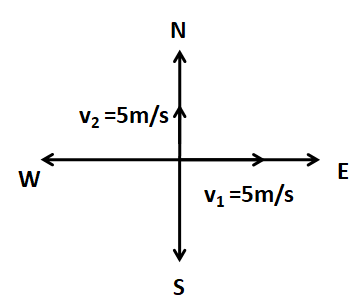
The initial and the final velocities of the particle are shown in the figure below.
We know that the average acceleration is given by
$\Rightarrow \vec a = \dfrac{{\Delta \vec v}}{{\Delta t}} $
$\Rightarrow \vec a = \dfrac{{{{\vec v}_2} - {{\vec v}_1}}}{{\Delta t}} $ …………………..(1)
So, we need to obtain the difference $ {\vec v_2} - {\vec v_1} $ of the velocity vectors.
Or we can say that we need to add the vectors $ {\vec v_2} $ and $ - {\vec v_1} $ .
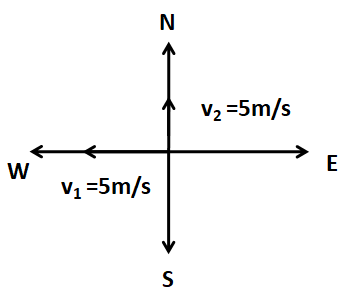
So, reversing the direction of the vector $ {\vec v_1} $ of the above figure, we obtain
Now, by the diagonal law of the vector addition, the resultant of these two vectors is represented by the diagonal of the parallelogram formed by these vectors.
The parallelogram and the diagonal are shown in the figure below.
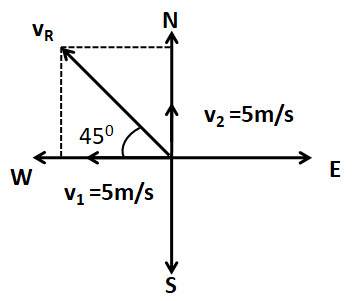
As we can see in the figure, the diagonal is in the direction of the north-west.
Now the magnitude of the resultant is given by
$\Rightarrow \left| {{{\vec v}_R}} \right| = \sqrt {{v_1}^2 + {v_2}^2} $
$\Rightarrow \left| {{{\vec v}_R}} \right| = \sqrt {{5^2} + {5^2}} = 5\sqrt 2 m/s $ ……………...(2)
From (1) we have
$\Rightarrow \vec a = \dfrac{{{{\vec v}_2} - {{\vec v}_1}}}{{\Delta t}} $
$\Rightarrow \vec a = \dfrac{{{{\vec v}_R}}}{{\Delta t}} $
Writing in terms of magnitude, we have
$\Rightarrow \left| {\vec a} \right| = \dfrac{{\left| {{{\vec v}_R}} \right|}}{{\Delta t}} $
According to the question $ \Delta t = 10s $ . So we have
$\Rightarrow \left| {\vec a} \right| = \dfrac{{\left| {{{\vec v}_R}} \right|}}{{10}} $
Substituting (2) we get
$\Rightarrow \left| {\vec a} \right| = \dfrac{{5\sqrt 2 }}{{10}} = \dfrac{1}{{\sqrt 2 }}m/{s^2} $
As the acceleration vector is parallel to the resultant vector $ {\vec v_R} $ , whose direction is north west as seen above, so the direction of acceleration is also $ N - W $ .
Hence, the correct answer is option B.
Note
Do not blindly conclude that the acceleration of the particle should be zero just because the initial and final magnitudes of the velocities are equal. Always remember that velocity is a vector quantity, so its initial and final magnitudes cannot be directly subtracted to obtain the acceleration.
Formula Used: The formula used for solving this question is given by
$\Rightarrow \vec a = \dfrac{{\Delta \vec v}}{{\Delta t}} $ , here $ \vec a $ is the average acceleration of a particle in a time interval of $ \Delta t $ , and $ \Delta \vec v $ is the change in the velocity.
Complete step by step answer
The initial and the final velocities of the particle are shown in the figure below.
We know that the average acceleration is given by
$\Rightarrow \vec a = \dfrac{{\Delta \vec v}}{{\Delta t}} $
$\Rightarrow \vec a = \dfrac{{{{\vec v}_2} - {{\vec v}_1}}}{{\Delta t}} $ …………………..(1)
So, we need to obtain the difference $ {\vec v_2} - {\vec v_1} $ of the velocity vectors.
Or we can say that we need to add the vectors $ {\vec v_2} $ and $ - {\vec v_1} $ .
So, reversing the direction of the vector $ {\vec v_1} $ of the above figure, we obtain
Now, by the diagonal law of the vector addition, the resultant of these two vectors is represented by the diagonal of the parallelogram formed by these vectors.
The parallelogram and the diagonal are shown in the figure below.
As we can see in the figure, the diagonal is in the direction of the north-west.
Now the magnitude of the resultant is given by
$\Rightarrow \left| {{{\vec v}_R}} \right| = \sqrt {{v_1}^2 + {v_2}^2} $
$\Rightarrow \left| {{{\vec v}_R}} \right| = \sqrt {{5^2} + {5^2}} = 5\sqrt 2 m/s $ ……………...(2)
From (1) we have
$\Rightarrow \vec a = \dfrac{{{{\vec v}_2} - {{\vec v}_1}}}{{\Delta t}} $
$\Rightarrow \vec a = \dfrac{{{{\vec v}_R}}}{{\Delta t}} $
Writing in terms of magnitude, we have
$\Rightarrow \left| {\vec a} \right| = \dfrac{{\left| {{{\vec v}_R}} \right|}}{{\Delta t}} $
According to the question $ \Delta t = 10s $ . So we have
$\Rightarrow \left| {\vec a} \right| = \dfrac{{\left| {{{\vec v}_R}} \right|}}{{10}} $
Substituting (2) we get
$\Rightarrow \left| {\vec a} \right| = \dfrac{{5\sqrt 2 }}{{10}} = \dfrac{1}{{\sqrt 2 }}m/{s^2} $
As the acceleration vector is parallel to the resultant vector $ {\vec v_R} $ , whose direction is north west as seen above, so the direction of acceleration is also $ N - W $ .
Hence, the correct answer is option B.
Note
Do not blindly conclude that the acceleration of the particle should be zero just because the initial and final magnitudes of the velocities are equal. Always remember that velocity is a vector quantity, so its initial and final magnitudes cannot be directly subtracted to obtain the acceleration.
Recently Updated Pages
Master Class 12 Economics: Engaging Questions & Answers for Success

Master Class 12 English: Engaging Questions & Answers for Success
Master Class 12 Social Science: Engaging Questions & Answers for Success
Master Class 12 Maths: Engaging Questions & Answers for Success
Master Class 12 Physics: Engaging Questions & Answers for Success
Master Class 11 Social Science: Engaging Questions & Answers for Success
Trending doubts
One Metric ton is equal to kg A 10000 B 1000 C 100 class 11 physics CBSE
Difference Between Prokaryotic Cells and Eukaryotic Cells
Two of the body parts which do not appear in MRI are class 11 biology CBSE
1 ton equals to A 100 kg B 1000 kg C 10 kg D 10000 class 11 physics CBSE
Draw a diagram of nephron and explain its structur class 11 biology CBSE
10 examples of friction in our daily life