




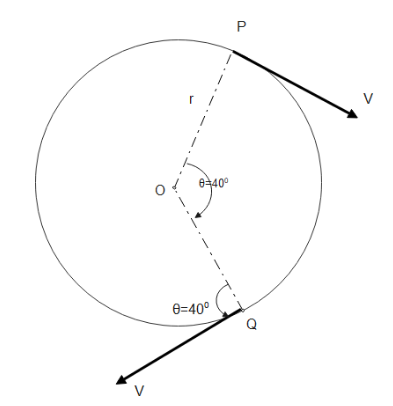
A particle is moving on a circular path of radius R with uniform speed we. The magnitude of change in velocity when the particle moves from P to Q is:- ($\angle PPOQ = 40^\circ $)
A. $2v\cos {\text{ }}40^\circ $
B. $2v{\text{ }}sin{\text{ }}40^\circ $
C. $2v{\text{ }}sin{\text{ 2}}0^\circ $
D. $2v\cos {\text{ 2}}0^\circ $
Answer
 Verified
513.6k+ views
Hint: Read the question carefully and observe that here speed is given as constant, and it asks for the magnitude of the change in velocity, hence we must know the difference between speed and velocity as scalar and vectors. Also remember that speed remaining constant doesn’t mean there’s no acceleration.
Complete step by step answer:
Let us assume the velocity at the point P be $V_1$. Now let us assume this point as the starting point and the other points are relative to it. We can consider the P point as either the Y axis or X axis. Let us consider it as the X axis here. Thus ${V_1} = V\widehat i$.
Now let the velocity at Q be ${V_2}$ , it is at an angle $40^\circ $ with the starting point P, thus it will have two components, one horizontal = $V\cos 40^\circ \widehat i$ and one vertical component = $V\sin 40^\circ \widehat j$.
Now the change in velocity = $\Delta V = {V_2} - {V_1} = (V\cos 40^\circ \widehat i - V\sin 40^\circ \widehat j) - V\widehat i$
Thus the magnitude of this change is :
$\sqrt {{{(V\cos 40^\circ - V)}^2} - {{(V\sin 40^\circ )}^2}} $
On solving the above expression we get the change of velocity = $2V\sin 20^\circ $.
Hence the answer is option B.
Note: It is very important to know the concept of vector units and scalar units to solve the problem. For instance, if the change in speed was asked, it would be zero as it is already that speed remains constant. Here velocity is always changing as there is change in direction continuously with the motion of the particle. Remember that this particle is able to change its direction continuously due to an acceleration towards the center of the circle, which is also varying the velocity.
Complete step by step answer:
Let us assume the velocity at the point P be $V_1$. Now let us assume this point as the starting point and the other points are relative to it. We can consider the P point as either the Y axis or X axis. Let us consider it as the X axis here. Thus ${V_1} = V\widehat i$.
Now let the velocity at Q be ${V_2}$ , it is at an angle $40^\circ $ with the starting point P, thus it will have two components, one horizontal = $V\cos 40^\circ \widehat i$ and one vertical component = $V\sin 40^\circ \widehat j$.
Now the change in velocity = $\Delta V = {V_2} - {V_1} = (V\cos 40^\circ \widehat i - V\sin 40^\circ \widehat j) - V\widehat i$
Thus the magnitude of this change is :
$\sqrt {{{(V\cos 40^\circ - V)}^2} - {{(V\sin 40^\circ )}^2}} $
On solving the above expression we get the change of velocity = $2V\sin 20^\circ $.
Hence the answer is option B.
Note: It is very important to know the concept of vector units and scalar units to solve the problem. For instance, if the change in speed was asked, it would be zero as it is already that speed remains constant. Here velocity is always changing as there is change in direction continuously with the motion of the particle. Remember that this particle is able to change its direction continuously due to an acceleration towards the center of the circle, which is also varying the velocity.
Recently Updated Pages
Basicity of sulphurous acid and sulphuric acid are

Master Class 11 Business Studies: Engaging Questions & Answers for Success
Master Class 11 Computer Science: Engaging Questions & Answers for Success
Master Class 11 Economics: Engaging Questions & Answers for Success
Master Class 11 Social Science: Engaging Questions & Answers for Success
Master Class 11 English: Engaging Questions & Answers for Success
Trending doubts
One Metric ton is equal to kg A 10000 B 1000 C 100 class 11 physics CBSE
The largest wind power cluster is located in the state class 11 social science CBSE
Explain zero factorial class 11 maths CBSE
What steps did the French revolutionaries take to create class 11 social science CBSE
Which among the following are examples of coming together class 11 social science CBSE
Why was the Vernacular Press Act passed by British class 11 social science CBSE