




A particle begins at the origin and moves 1 unit to the right and reaches ${{p}_{1}}$,$\dfrac{1}{2}$ unit up and reaches ${{p}_{2}}$ , $\dfrac{1}{4}$ unit to the right and reaches ${{p}_{3}}$, $\dfrac{1}{8}$ unit down and reaches ${{p}_{4}}$. $\dfrac{1}{16}$ unit to the right and reaches ${{p}_{5}}$ and so on. If the co-ordinates of ${{p}_{n}}$ are $\left( {{x}_{n}},{{y}_{n}} \right)$ find $\underset{n\to \infty }{\mathop{\lim }}\,{{p}_{n}}$. \[\]
A. $\left( 2,3 \right)$\[\]
B. $\left( \dfrac{4}{3},\dfrac{2}{5} \right)$\[\]
C. $\left( \dfrac{2}{5},1 \right)$\[\]
D. $\left( \dfrac{4}{3},\dfrac{5}{2} \right)$\[\]
Answer
 Verified
584.4k+ views
Hint: We firs find the coordinates of the points ${{p}_{1}},{{p}_{2}},{{p}_{3}},{{p}_{4}},{{p}_{5}},...$. We find that the $x-$coordinate ${{x}_{n}}$and $y-$coordinate ${{y}_{n}}$of the point ${{p}_{n}}$ are the sum of first $n$ terms of infinite GP sequences . We use the fact that the sum ${{x}_{1}}+{{x}_{2}}+{{x}_{3}}...$ is equal to $\underset{n\to \infty }{\mathop{\lim }}\,{{x}_{n}}$ and the limit will sum of the infinite GP series. We find $\underset{n\to \infty }{\mathop{\lim }}\,{{x}_{n}},\underset{n\to \infty }{\mathop{\lim }}\,{{y}_{n}}$ and then $\underset{n\to \infty }{\mathop{\lim }}\,{{p}_{n}}$. \[\]
Complete step by step answer:
We know that ${{x}_{1}}+{{x}_{2}}+{{x}_{3}}...=\underset{n\to \infty }{\mathop{\lim }}\,{{x}_{n}}$ provided the sequence $\left( {{x}_{n}} \right)$ is convergent. We also know that a geometric progression (GP ) series is the sum of terms in a geometric sequence $a,ar,a{{r}^{2}},...$ where $a$ is the first term and $r$ is the common ratio between two consecutive terms . The sum of first $n$ terms is given by
\[S=a+ar+a{{r}^{2}}+...+a{{r}^{n-1}}=\dfrac{a\left( {{r}^{n}}-1 \right)}{r-1}\]
The sum of a GP series with infinite terms and condition $\left| r \right|<1$ is given by,
\[S=\dfrac{a}{1-r}\]
We are given in the question that the particle begin from the origin whose co-ordinate is $O\left( 0,0 \right)$. It moves 1 unit to the right and reaches ${{p}_{1}}$. Now the distance of ${{p}_{1}}$ from $y-$axis is 1 unit which is the abscissa of its co-ordinate and it has not moved above $x-$axis . So the co-ordinate is ${{p}_{1}}\left( 1,0 \right)$. Similarly we move to the points ${{p}_{2}},{{p}_{3}},{{p}_{4}},{{p}_{5}},...$ and find their co-ordinates as shown in the following figure. \[\]
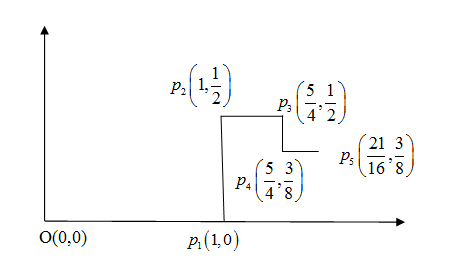
We can see from the figure when we move from ${{p}_{1}}$ to ${{p}_{2}}$ as given in the question by a distance of $\dfrac{1}{2}$ units up means above $x-$axis and then we have the co-ordinates ${{p}_{2}}$ as ${{p}_{2}}\left( 1,\dfrac{1}{2} \right)$. Similarly we move from ${{p}_{2}}$ to ${{p}_{3}}$ away from $y-axis$ by $\dfrac{1}{4}$ units and we have the co-ordinates of ${{p}_{3}}$ as ${{p}_{3}}\left( 1+\dfrac{1}{4},\dfrac{1}{2} \right)={{p}_{3}}\left( \dfrac{5}{4},\dfrac{1}{2} \right)$. We move from ${{p}_{3}}$ to ${{p}_{4}}$ down by $\dfrac{1}{8}$ units. So we have to subtract the ordinate of ${{p}_{3}}$ by $\dfrac{1}{8}$ and have the co-ordinates ${{p}_{4}}\left( \dfrac{5}{4},\dfrac{1}{2}-\dfrac{1}{8} \right)={{p}_{4}}\left( \dfrac{5}{4},\dfrac{3}{8} \right)$. We move we move from ${{p}_{4}}$ to ${{p}_{5}}$ away from $y-axis$ by $\dfrac{1}{16}$ units and we have the co-ordinates ${{p}_{5}}\left( \dfrac{5}{4}+\dfrac{1}{16},\dfrac{3}{8} \right)={{p}_{5}}\left( \dfrac{21}{16},\dfrac{3}{8} \right)$. The co-ordinates of the points are ,
\[{{p}_{1}}\left( 1,0 \right),{{p}_{2}}\left( 1,\dfrac{1}{2} \right),{{p}_{3}}\left( 1+\dfrac{1}{4},\dfrac{1}{2} \right),{{p}_{4}}\left( 1+\dfrac{1}{4},\dfrac{1}{2}-\dfrac{1}{8} \right),{{p}_{5}}\left( 1+\dfrac{1}{4}+\dfrac{1}{16},\dfrac{1}{2}-\dfrac{1}{8} \right)...\]
We observe that as the point moves the $x-$coordinate of the point ${{p}_{n}}$ that s denoted as ${{x}_{n}}$ is the sum of $n$ terms of the sequence $1,\dfrac{1}{4},\dfrac{1}{16}...$. We see that it is an infinite GP with $a=1,r=\dfrac{1}{4}$ . If we take the limit $n\to \infty $ of the sum it will be equal to the sum of infinite GP series. So we have
\[\underset{n\to \infty }{\mathop{\lim }}\,{{x}_{n}}=1+\dfrac{1}{4}+\dfrac{1}{16}+...=\dfrac{1}{1-\dfrac{1}{4}}=\dfrac{4}{3}\]
We again observe the pints and see that moves the $y-$coordinate of the point ${{p}_{n}}$ that sis denoted as ${{y}_{n}}$ is the sum of first $n$ terms of the sequence $\dfrac{1}{2},\dfrac{-1}{8},\dfrac{1}{32}...$. It as infinite GP with $a=\dfrac{1}{2},r=\dfrac{-1}{4}$. If we take the limit $n\to \infty $ of the sum it will be equal to the sum of infinite GP series. So we have
\[\underset{n\to \infty }{\mathop{\lim }}\,{{y}_{n}}=\dfrac{1}{2}-\dfrac{1}{8}+\dfrac{1}{32}+...=\dfrac{1}{1-\left( -\dfrac{1}{4} \right)}=\dfrac{2}{5}\]
We have the required result as
\[\underset{n\to \infty }{\mathop{\lim }}\,{{p}_{n}}=\underset{n\to \infty }{\mathop{\lim }}\,\left( {{x}_{n}},{{y}_{n}} \right)=\left( \underset{n\to \infty }{\mathop{\lim }}\,{{x}_{n}},\underset{n\to \infty }{\mathop{\lim }}\,{{y}_{n}} \right)=\left( \dfrac{4}{3},\dfrac{2}{5} \right)\]
So the correct option is B. \[\]
Note:
We note that ${{x}_{1}}+{{x}_{2}}+{{x}_{3}}...=\underset{n\to \infty }{\mathop{\lim }}\,{{x}_{n}}=L$ then we say sequence ${{x}_{1}},{{x}_{2}},{{x}_{3}},...$ converges at $L$. The sequence is called a converging sequence. If the limit does not exist the sequence is called diverging sequence.
Complete step by step answer:
We know that ${{x}_{1}}+{{x}_{2}}+{{x}_{3}}...=\underset{n\to \infty }{\mathop{\lim }}\,{{x}_{n}}$ provided the sequence $\left( {{x}_{n}} \right)$ is convergent. We also know that a geometric progression (GP ) series is the sum of terms in a geometric sequence $a,ar,a{{r}^{2}},...$ where $a$ is the first term and $r$ is the common ratio between two consecutive terms . The sum of first $n$ terms is given by
\[S=a+ar+a{{r}^{2}}+...+a{{r}^{n-1}}=\dfrac{a\left( {{r}^{n}}-1 \right)}{r-1}\]
The sum of a GP series with infinite terms and condition $\left| r \right|<1$ is given by,
\[S=\dfrac{a}{1-r}\]
We are given in the question that the particle begin from the origin whose co-ordinate is $O\left( 0,0 \right)$. It moves 1 unit to the right and reaches ${{p}_{1}}$. Now the distance of ${{p}_{1}}$ from $y-$axis is 1 unit which is the abscissa of its co-ordinate and it has not moved above $x-$axis . So the co-ordinate is ${{p}_{1}}\left( 1,0 \right)$. Similarly we move to the points ${{p}_{2}},{{p}_{3}},{{p}_{4}},{{p}_{5}},...$ and find their co-ordinates as shown in the following figure. \[\]
We can see from the figure when we move from ${{p}_{1}}$ to ${{p}_{2}}$ as given in the question by a distance of $\dfrac{1}{2}$ units up means above $x-$axis and then we have the co-ordinates ${{p}_{2}}$ as ${{p}_{2}}\left( 1,\dfrac{1}{2} \right)$. Similarly we move from ${{p}_{2}}$ to ${{p}_{3}}$ away from $y-axis$ by $\dfrac{1}{4}$ units and we have the co-ordinates of ${{p}_{3}}$ as ${{p}_{3}}\left( 1+\dfrac{1}{4},\dfrac{1}{2} \right)={{p}_{3}}\left( \dfrac{5}{4},\dfrac{1}{2} \right)$. We move from ${{p}_{3}}$ to ${{p}_{4}}$ down by $\dfrac{1}{8}$ units. So we have to subtract the ordinate of ${{p}_{3}}$ by $\dfrac{1}{8}$ and have the co-ordinates ${{p}_{4}}\left( \dfrac{5}{4},\dfrac{1}{2}-\dfrac{1}{8} \right)={{p}_{4}}\left( \dfrac{5}{4},\dfrac{3}{8} \right)$. We move we move from ${{p}_{4}}$ to ${{p}_{5}}$ away from $y-axis$ by $\dfrac{1}{16}$ units and we have the co-ordinates ${{p}_{5}}\left( \dfrac{5}{4}+\dfrac{1}{16},\dfrac{3}{8} \right)={{p}_{5}}\left( \dfrac{21}{16},\dfrac{3}{8} \right)$. The co-ordinates of the points are ,
\[{{p}_{1}}\left( 1,0 \right),{{p}_{2}}\left( 1,\dfrac{1}{2} \right),{{p}_{3}}\left( 1+\dfrac{1}{4},\dfrac{1}{2} \right),{{p}_{4}}\left( 1+\dfrac{1}{4},\dfrac{1}{2}-\dfrac{1}{8} \right),{{p}_{5}}\left( 1+\dfrac{1}{4}+\dfrac{1}{16},\dfrac{1}{2}-\dfrac{1}{8} \right)...\]
We observe that as the point moves the $x-$coordinate of the point ${{p}_{n}}$ that s denoted as ${{x}_{n}}$ is the sum of $n$ terms of the sequence $1,\dfrac{1}{4},\dfrac{1}{16}...$. We see that it is an infinite GP with $a=1,r=\dfrac{1}{4}$ . If we take the limit $n\to \infty $ of the sum it will be equal to the sum of infinite GP series. So we have
\[\underset{n\to \infty }{\mathop{\lim }}\,{{x}_{n}}=1+\dfrac{1}{4}+\dfrac{1}{16}+...=\dfrac{1}{1-\dfrac{1}{4}}=\dfrac{4}{3}\]
We again observe the pints and see that moves the $y-$coordinate of the point ${{p}_{n}}$ that sis denoted as ${{y}_{n}}$ is the sum of first $n$ terms of the sequence $\dfrac{1}{2},\dfrac{-1}{8},\dfrac{1}{32}...$. It as infinite GP with $a=\dfrac{1}{2},r=\dfrac{-1}{4}$. If we take the limit $n\to \infty $ of the sum it will be equal to the sum of infinite GP series. So we have
\[\underset{n\to \infty }{\mathop{\lim }}\,{{y}_{n}}=\dfrac{1}{2}-\dfrac{1}{8}+\dfrac{1}{32}+...=\dfrac{1}{1-\left( -\dfrac{1}{4} \right)}=\dfrac{2}{5}\]
We have the required result as
\[\underset{n\to \infty }{\mathop{\lim }}\,{{p}_{n}}=\underset{n\to \infty }{\mathop{\lim }}\,\left( {{x}_{n}},{{y}_{n}} \right)=\left( \underset{n\to \infty }{\mathop{\lim }}\,{{x}_{n}},\underset{n\to \infty }{\mathop{\lim }}\,{{y}_{n}} \right)=\left( \dfrac{4}{3},\dfrac{2}{5} \right)\]
So the correct option is B. \[\]
Note:
We note that ${{x}_{1}}+{{x}_{2}}+{{x}_{3}}...=\underset{n\to \infty }{\mathop{\lim }}\,{{x}_{n}}=L$ then we say sequence ${{x}_{1}},{{x}_{2}},{{x}_{3}},...$ converges at $L$. The sequence is called a converging sequence. If the limit does not exist the sequence is called diverging sequence.
Recently Updated Pages
Master Class 10 Computer Science: Engaging Questions & Answers for Success

Master Class 10 General Knowledge: Engaging Questions & Answers for Success
Master Class 10 English: Engaging Questions & Answers for Success
Master Class 10 Social Science: Engaging Questions & Answers for Success
Master Class 10 Maths: Engaging Questions & Answers for Success
Master Class 10 Science: Engaging Questions & Answers for Success
Trending doubts
What is the median of the first 10 natural numbers class 10 maths CBSE
Which women's tennis player has 24 Grand Slam singles titles?
Who is the Brand Ambassador of Incredible India?
Why is there a time difference of about 5 hours between class 10 social science CBSE
Write a letter to the principal requesting him to grant class 10 english CBSE
State and prove converse of BPT Basic Proportionality class 10 maths CBSE