




A parallelogram with all sides equal is known as,
(A). Rhombus
(B). Square
(C). Rectangle
(D). None of these
Answer
 Verified
613.5k+ views
Hint: Parallelogram is any quadrilateral whose opposite sides are parallel and thus its opposite sides as well as opposite angles are equal.
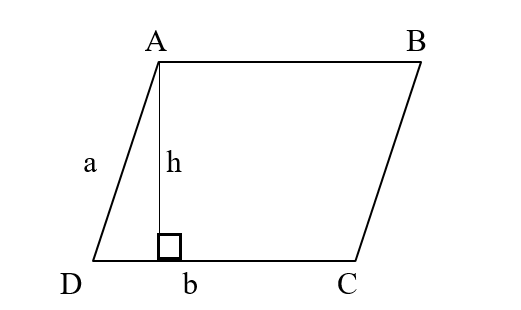
ABCD is a parallelogram.
\[\begin{gathered}
AB = CD \\
AD = BC \\
\end{gathered} \]
Sum of adjacent angles are 1800
\[\begin{gathered}
\angle D + \angle C = {180^o} \\
\angle A + \angle B = {180^o} \\
\end{gathered} \]
h is perpendicular to the base (DC) which is known as height of the parallelogram.
Area of parallelogram is given by,
\[\dfrac{1}{2}Base \times height\]
Complete step-by-step answer:
*In rhombus all the sides are equal and opposite sides are parallel to each other. Thus rhombus is an example of parallelogram. The figure of rhombus is given below.
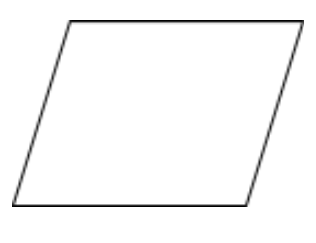
In the above figure all the sides are equal.
*In square also all the sides are equal and opposite sides are parallel to each other. Hence square is also a parallelogram. The figure of a square is given below.
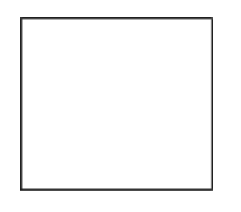
In the above figure all the sides are equal.
*In the rectangle opposite sides are parallel to each other but all the sides are not equal. Hence the rectangle is a parallelogram but all sides are not equal. The figure of a rectangle is given below.
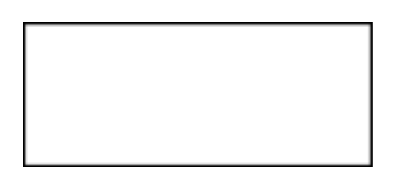
In the above figure only opposite sides are equal.
Hence the answer of the question is option (A) and option (B).
Note: Square and rectangle are called a special type of rectangle as all the interior angles of the quadrilateral are 900. Also the diagonals are also equal in length.
ABCD is a parallelogram.
\[\begin{gathered}
AB = CD \\
AD = BC \\
\end{gathered} \]
Sum of adjacent angles are 1800
\[\begin{gathered}
\angle D + \angle C = {180^o} \\
\angle A + \angle B = {180^o} \\
\end{gathered} \]
h is perpendicular to the base (DC) which is known as height of the parallelogram.
Area of parallelogram is given by,
\[\dfrac{1}{2}Base \times height\]
Complete step-by-step answer:
*In rhombus all the sides are equal and opposite sides are parallel to each other. Thus rhombus is an example of parallelogram. The figure of rhombus is given below.
In the above figure all the sides are equal.
*In square also all the sides are equal and opposite sides are parallel to each other. Hence square is also a parallelogram. The figure of a square is given below.
In the above figure all the sides are equal.
*In the rectangle opposite sides are parallel to each other but all the sides are not equal. Hence the rectangle is a parallelogram but all sides are not equal. The figure of a rectangle is given below.
In the above figure only opposite sides are equal.
Hence the answer of the question is option (A) and option (B).
Note: Square and rectangle are called a special type of rectangle as all the interior angles of the quadrilateral are 900. Also the diagonals are also equal in length.

Recently Updated Pages
Master Class 11 Social Science: Engaging Questions & Answers for Success

Master Class 11 Chemistry: Engaging Questions & Answers for Success
Master Class 12 Business Studies: Engaging Questions & Answers for Success
Master Class 12 Chemistry: Engaging Questions & Answers for Success
Master Class 12 Biology: Engaging Questions & Answers for Success
Class 12 Question and Answer - Your Ultimate Solutions Guide
Trending doubts
Give 10 examples for herbs , shrubs , climbers , creepers
How many millions make a billion class 6 maths CBSE
Why is the Earth called a unique planet class 6 social science CBSE
What is the shape of Earth A Circle B Square C Sphere class 6 social science CBSE
The planet nearest to earth is A Mercury B Venus C class 6 social science CBSE
Why is democracy considered as the best form of go class 6 social science CBSE