




A parallel beam of light is incident on the system of two convex lenses of focal lengths ${{f}_{1}}$=20 cm and ${{f}_{2}}$ =10 cm. What should be the distance between the two lenses so that rays after refraction from both the lenses pass undeviated.
A. 60cm
B. 30cm
C. 90cm
D. 40cm
Answer
 Verified
614.7k+ views
Hint: As the ray after refraction passes undeviated after refraction from both the lenses hence the distance between the lenses must be equal to the sum of the focal lengths of the lenses.
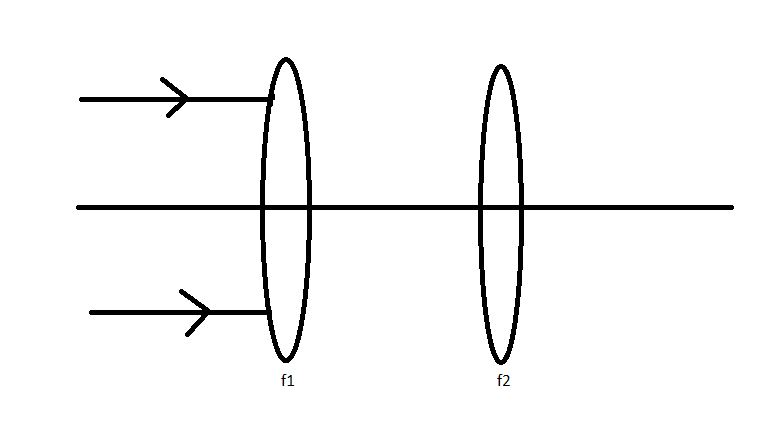
Complete step-by-step answer:
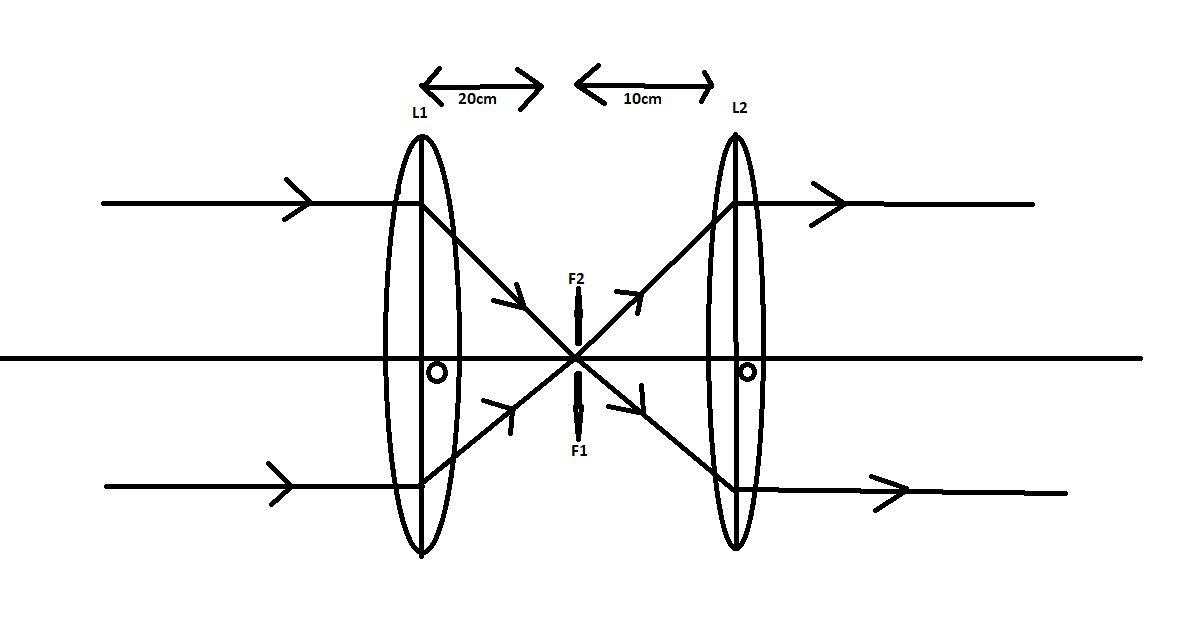
We know that,
${{f}_{1}}=20cm$
${{f}_{2}}=10cm$
As the rays passes undeviated the image formed by the first lens must be at the focal length of the 2$^{nd}$ lens, that means that the distance from the point of formation of image and 2$^{nd}$lens is 10cm as focal length of the 2$^{nd}$lens is 10 cm.
Therefore, the total distance between the two lenses is,
$d={{f}_{1}}+{{f}_{2}}$
d = (20+10) cm
d=30cm
Therefore Option(B) 30cm is the correct option.
Note: As both are convex lens we can figure out that two rays coming from infinity will pass through the focus of the first lens, and as the rays are undeviated it is a must that they fall on the focal length of the 2$^{nd}$ lens then only it can pass undeviated. We know that to form an image minimum of 2 light rays must fall on the lens so that one passes from the focus and another through the optical center forming the image on the other side where both the rays merge.
Complete step-by-step answer:
We know that,
${{f}_{1}}=20cm$
${{f}_{2}}=10cm$
As the rays passes undeviated the image formed by the first lens must be at the focal length of the 2$^{nd}$ lens, that means that the distance from the point of formation of image and 2$^{nd}$lens is 10cm as focal length of the 2$^{nd}$lens is 10 cm.
Therefore, the total distance between the two lenses is,
$d={{f}_{1}}+{{f}_{2}}$
d = (20+10) cm
d=30cm
Therefore Option(B) 30cm is the correct option.
Note: As both are convex lens we can figure out that two rays coming from infinity will pass through the focus of the first lens, and as the rays are undeviated it is a must that they fall on the focal length of the 2$^{nd}$ lens then only it can pass undeviated. We know that to form an image minimum of 2 light rays must fall on the lens so that one passes from the focus and another through the optical center forming the image on the other side where both the rays merge.
Recently Updated Pages
Master Class 12 Social Science: Engaging Questions & Answers for Success

Master Class 12 Physics: Engaging Questions & Answers for Success
Master Class 12 Maths: Engaging Questions & Answers for Success
Master Class 12 Economics: Engaging Questions & Answers for Success
Master Class 12 Chemistry: Engaging Questions & Answers for Success
Master Class 12 Business Studies: Engaging Questions & Answers for Success
Trending doubts
Draw a labelled sketch of the human eye class 12 physics CBSE
What are the major means of transport Explain each class 12 social science CBSE
How many 176Omega resistors in parallel are required class 12 physics CBSE
What are the advantages of vegetative propagation class 12 biology CBSE
What is corrosion Explain its advantages and disad class 12 chemistry CBSE
When was the first election held in India a 194748 class 12 sst CBSE