




A parachutist is descending vertically. At a certain height, his angle of elevation from a point on the ground is 60° and when he has descended 300 m further, the angle of elevation becomes 45° from the same point of observation. Find the distance of the point of observation from the place where the parachutist lands.
Answer
 Verified
638.4k+ views
Hint: We will first draw the figure to get a clear image of what the question is about. Then, we will operate the trigonometric tangent function on the angles of elevation individually in the obtained triangles to calculate the value of the distance of point of observation from the place where the parachutist lands using the formula: $\tan \theta = \dfrac{{{\text{perpendicular}}}}{{{\text{base}}}}$ .
Complete step-by-step answer:
We are given a parachutist who is descending vertically.
At a certain point, say A, the angle of elevation of the parachutist on a point on the ground, say B, is 60°.
Afterwards, when he has descended 300 m down. Let us say he is now at a point P, the angle of elevation of the parachutist from the same point B is 45° now.
We are required to calculate the distance of the point of observation B from the place where the parachutist lands, say C. Let us assume the distance is x metres.
Let us draw the figure of this arrangement:
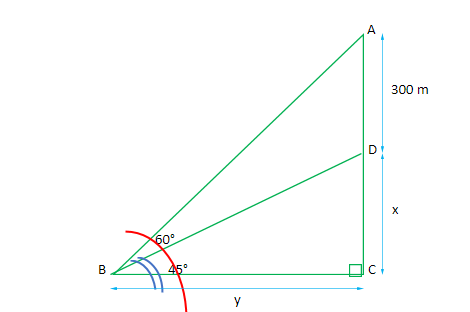
From the figure, in the right angled triangle DBC, we can say that
$\tan \theta = \dfrac{{{\text{perpendicular}}}}{{{\text{base}}}}$
Using the formula, we get
$ \Rightarrow \tan {45^ \circ } = \dfrac{{DC}}{{BC}}$
On substituting the values of DC and BC, we get
$
\Rightarrow \tan {45^ \circ } = \dfrac{x}{y} \\
\Rightarrow 1 = \dfrac{x}{y} \\
$
$ \Rightarrow x = y$ equation (1)
Now, in the right angled triangle ABC, using tan 60°, we get
$ \Rightarrow \tan 60^\circ = \dfrac{{AC}}{{BC}}$
Substituting the values of AC and BC, we get
$
\Rightarrow \tan 60^\circ = \dfrac{{300 + x}}{y} \\
\Rightarrow \sqrt 3 = \dfrac{{300 + x}}{y} \\
\Rightarrow \sqrt 3 y = 300 + x \\
$
Using equation (1), we get
$ \Rightarrow \sqrt 3 y = 300 + y$
Now, solving it for the value of y, we get
$
\Rightarrow \sqrt 3 y - y = 300 \\
\Rightarrow \left( {\sqrt 3 - 1} \right)y = 300 \\
\Rightarrow \left( {1.732 - 1} \right)y = 300 \\
$ (using $\sqrt 3 $= 1.732)
$
\Rightarrow \left( {0.732} \right)y = 300 \\
\Rightarrow y = 409.83 \simeq 410{\text{m}} \\
$
Therefore, the distance between the point of the landing of the parachutist and the point of the observation is found to be 410 metres.
Note: You may get confused while drawing the figure using the word problem given because you are required to draw the descending parachutist from the same point of observation at two distant points. Be careful while solving the tangent of the angle ABC as you are required to use the relation when x = y to calculate the value of the distance of the point of observation and landing point of the parachutist.
Complete step-by-step answer:
We are given a parachutist who is descending vertically.
At a certain point, say A, the angle of elevation of the parachutist on a point on the ground, say B, is 60°.
Afterwards, when he has descended 300 m down. Let us say he is now at a point P, the angle of elevation of the parachutist from the same point B is 45° now.
We are required to calculate the distance of the point of observation B from the place where the parachutist lands, say C. Let us assume the distance is x metres.
Let us draw the figure of this arrangement:
From the figure, in the right angled triangle DBC, we can say that
$\tan \theta = \dfrac{{{\text{perpendicular}}}}{{{\text{base}}}}$
Using the formula, we get
$ \Rightarrow \tan {45^ \circ } = \dfrac{{DC}}{{BC}}$
On substituting the values of DC and BC, we get
$
\Rightarrow \tan {45^ \circ } = \dfrac{x}{y} \\
\Rightarrow 1 = \dfrac{x}{y} \\
$
$ \Rightarrow x = y$ equation (1)
Now, in the right angled triangle ABC, using tan 60°, we get
$ \Rightarrow \tan 60^\circ = \dfrac{{AC}}{{BC}}$
Substituting the values of AC and BC, we get
$
\Rightarrow \tan 60^\circ = \dfrac{{300 + x}}{y} \\
\Rightarrow \sqrt 3 = \dfrac{{300 + x}}{y} \\
\Rightarrow \sqrt 3 y = 300 + x \\
$
Using equation (1), we get
$ \Rightarrow \sqrt 3 y = 300 + y$
Now, solving it for the value of y, we get
$
\Rightarrow \sqrt 3 y - y = 300 \\
\Rightarrow \left( {\sqrt 3 - 1} \right)y = 300 \\
\Rightarrow \left( {1.732 - 1} \right)y = 300 \\
$ (using $\sqrt 3 $= 1.732)
$
\Rightarrow \left( {0.732} \right)y = 300 \\
\Rightarrow y = 409.83 \simeq 410{\text{m}} \\
$
Therefore, the distance between the point of the landing of the parachutist and the point of the observation is found to be 410 metres.
Note: You may get confused while drawing the figure using the word problem given because you are required to draw the descending parachutist from the same point of observation at two distant points. Be careful while solving the tangent of the angle ABC as you are required to use the relation when x = y to calculate the value of the distance of the point of observation and landing point of the parachutist.
Recently Updated Pages
Basicity of sulphurous acid and sulphuric acid are

Master Class 11 English: Engaging Questions & Answers for Success
Master Class 11 Physics: Engaging Questions & Answers for Success
Master Class 11 Computer Science: Engaging Questions & Answers for Success
Master Class 11 Chemistry: Engaging Questions & Answers for Success
Master Class 11 Social Science: Engaging Questions & Answers for Success
Trending doubts
Difference Between Prokaryotic Cells and Eukaryotic Cells
Two of the body parts which do not appear in MRI are class 11 biology CBSE
One Metric ton is equal to kg A 10000 B 1000 C 100 class 11 physics CBSE
10 examples of friction in our daily life
Draw a diagram of nephron and explain its structur class 11 biology CBSE
What will happen if the mucus is not secreted by the class 11 biology CBSE