




A parachutist is descending vertically and makes angles of elevation of \[{{45}^{\circ }}\] and \[{{60}^{\circ }}\] at two observing points 100 m apart from each other on the left side of himself. Find the maximum height from which he falls and the distance of the point where he falls on the ground from the just observation points.
Answer
 Verified
668.7k+ views
Hint: consider the maximum height as AB and draw the angle of elevations at two different points and apply \[\tan \theta \]to the two right angled triangles and we will get two equations and then we have to compute the maximum height from which he falls.
Complete step-by-step answer:
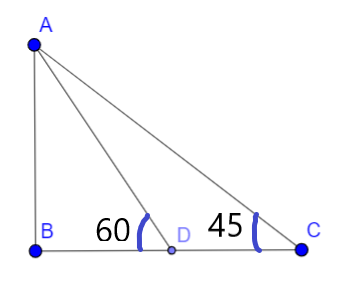
Given, the angle of elevations are \[{{45}^{\circ }}\]and\[{{60}^{\circ }}\]at two observing points 100m apart from each other on the left side of himself.
Let the maximum height be AB and BD be x.
In the right angled triangle ABC
\[\tan {{45}^{\circ }}=\dfrac{h}{x+100}\]. . . . . . . . . . . . . . . . . . . (1)
\[h=x+100\]. . . . . . . . . . . . . . . . . . . . . . . . (2)
In the right angled triangle ABD
\[\tan {{60}^{\circ }}=\dfrac{h}{x}\]. . . . . . . . . . . . . . . . . . . . . . (3)
\[x=\dfrac{h}{\sqrt{3}}\]. . . . . . . . . . . . . . . . . . . . . . . . . (4)
Substitute \[x=\dfrac{h}{\sqrt{3}}\]in equation (2)
\[h=\dfrac{h}{\sqrt{3}}+100\]
\[h\left( 1-\dfrac{1}{\sqrt{3}} \right)=100\]
\[0.423h=100\]
\[h=236.4m\]
So, the maximum height from which he falls is AB=\[h=236.4m\]
Note: The angle of elevation is the angle between the horizontal line from the observer and the line of sight to an object that is above the horizontal line. As the person moves from one point to another angle of elevation varies. If we move closer to the object the angle of elevation increases and vice versa.
Complete step-by-step answer:
Given, the angle of elevations are \[{{45}^{\circ }}\]and\[{{60}^{\circ }}\]at two observing points 100m apart from each other on the left side of himself.
Let the maximum height be AB and BD be x.
In the right angled triangle ABC
\[\tan {{45}^{\circ }}=\dfrac{h}{x+100}\]. . . . . . . . . . . . . . . . . . . (1)
\[h=x+100\]. . . . . . . . . . . . . . . . . . . . . . . . (2)
In the right angled triangle ABD
\[\tan {{60}^{\circ }}=\dfrac{h}{x}\]. . . . . . . . . . . . . . . . . . . . . . (3)
\[x=\dfrac{h}{\sqrt{3}}\]. . . . . . . . . . . . . . . . . . . . . . . . . (4)
Substitute \[x=\dfrac{h}{\sqrt{3}}\]in equation (2)
\[h=\dfrac{h}{\sqrt{3}}+100\]
\[h\left( 1-\dfrac{1}{\sqrt{3}} \right)=100\]
\[0.423h=100\]
\[h=236.4m\]
So, the maximum height from which he falls is AB=\[h=236.4m\]
Note: The angle of elevation is the angle between the horizontal line from the observer and the line of sight to an object that is above the horizontal line. As the person moves from one point to another angle of elevation varies. If we move closer to the object the angle of elevation increases and vice versa.
Recently Updated Pages
Class 10 Question and Answer - Your Ultimate Solutions Guide

Master Class 10 Computer Science: Engaging Questions & Answers for Success
Master Class 10 General Knowledge: Engaging Questions & Answers for Success
Master Class 12 Economics: Engaging Questions & Answers for Success
Master Class 12 Social Science: Engaging Questions & Answers for Success
Master Class 12 English: Engaging Questions & Answers for Success
Trending doubts
Explain the Treaty of Vienna of 1815 class 10 social science CBSE
The slogan Jai Hind was given by A Lal Bahadur Shastri class 10 social science CBSE
10 examples of evaporation in daily life with explanations
What is the full form of POSCO class 10 social science CBSE
Five things I will do to build a great India class 10 english CBSE
Identify the feminine form of noun nephew a shenephew class 10 english CBSE