




A normal is drawn to a parabola ${{y}^{2}}$= 4ax at any point other than the vertex. Prove that it cuts the parabola again at a point whose distance from the vertex is not less than 4$\sqrt{6}a$.
Answer
 Verified
614.1k+ views
Hint: First of all, we will find any general point on the standard parabola ${{y}^{2}}$= 4ax. Then we will find the equation of the normal to parabola from that point. After that, we will find the point at which this normal intersects the parabola again, and to get the distance, we will apply the distance formula between the origin and the point at which the normal intersects the parabola again and prove that it is not less than 4$\sqrt{6}a$.
Complete step-by-step solution
The figure will be as follows:
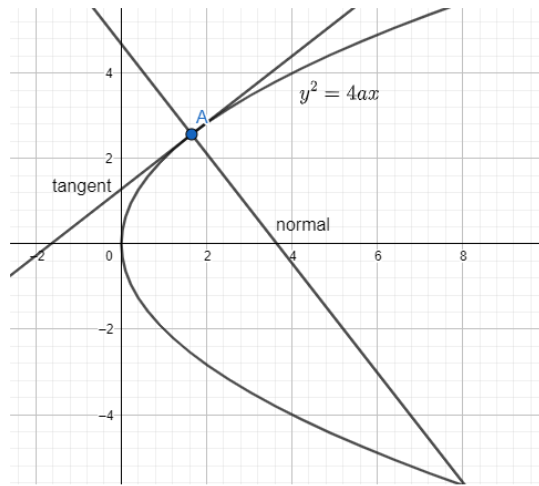
The standard equation of the parabola with the vertex at the origin (0, 0) is ${{y}^{2}}$= 4ax, and any point on this parabola can be expressed as (a${{t}^{2}}$, 2at).
This point satisfies the standard equation of parabola for any point of t.
To find the slope of the tangent to the parabola at point $\left( {{x}_{1}},{{y}_{1}} \right)$, we have to differentiate the equation of the parabola with respect to x at point $\left( {{x}_{1}},{{y}_{1}} \right)$.
\[\begin{align}
& \Rightarrow 2y\dfrac{dy}{dx}=4a \\
& \Rightarrow {{\left. \dfrac{dy}{dx} \right|}_{\left( {{x}_{1}},{{y}_{1}} \right)}}=\dfrac{2a}{{{y}_{1}}} \\
\end{align}\]
Thus, slope of the normal at point $\left( {{x}_{1}},{{y}_{1}} \right)$ will be $-\dfrac{{{y}_{1}}}{2a}$.
Therefore, the equation of the normal passing through the point (a${{t}^{2}}$, 2at) will be $\begin{align}
& \Rightarrow y-2at=-\dfrac{2at}{2a}\left( x-a{{t}^{2}} \right) \\
& \Rightarrow y-2at=-t\left( x-a{{t}^{2}} \right) \\
& \Rightarrow y=2at-t\left( x-a{{t}^{2}} \right) \\
\end{align}$
Where the slope of the normal is $-t$.
Consider a point $\left( at{{'}^{2}},2at' \right)$ on the parabola at which the normal intersects the parabola again.
Therefore, the slope of the normal with the points $\left( a{{t}^{2}},2at \right)$ and $\left( at{{'}^{2}},2at' \right)$ is given as:
$\begin{align}
& m=\dfrac{2at'-2at}{at{{'}^{2}}-a{{t}^{2}}} \\
& m=\dfrac{2\left( t'-t \right)}{\left( t'-t \right)\left( t'+t \right)} \\
& m=\dfrac{2}{t'+t} \\
\end{align}$
This slope must be equal to the slope of the normal given as $-t$.
$\begin{align}
& \Rightarrow -t=\dfrac{2}{t'+t} \\
& \Rightarrow \dfrac{-2}{t}=t'+t \\
& \Rightarrow t'=-\left( t+\dfrac{2}{t} \right) \\
\end{align}$
Hence, the point at which the normal intersects the parabola again is $\left\{ a{{\left( t+\dfrac{2}{t} \right)}^{2}},-2a\left( t+\dfrac{2}{t} \right) \right\}$
Now, we will find the distance between the origin, i.e. vertex of parabola and the point $\left\{ a{{\left( t+\dfrac{2}{t} \right)}^{2}},-2a\left( t+\dfrac{2}{t} \right) \right\}$ using distance formula $\sqrt{{{\left( {{x}_{2}}-{{x}_{1}} \right)}^{2}}+{{\left( {{y}_{2}}-{{y}_{1}} \right)}^{2}}}$, where $\left( {{x}_{1}},{{y}_{1}} \right)$ and $\left( {{x}_{2}},{{y}_{2}} \right)$ are the two points between which distance has to be found.
$\begin{align}
& \Rightarrow \sqrt{{{\left( a{{\left( t+\dfrac{2}{t} \right)}^{2}}-0 \right)}^{2}}+{{\left( -2a\left( t+\dfrac{2}{t} \right)-0 \right)}^{2}}} \\
& \Rightarrow a\left( t+\dfrac{2}{t} \right)\sqrt{{{\left( t+\dfrac{2}{t} \right)}^{2}}+4} \\
\end{align}$
For this to be minimum, $t+\dfrac{2}{t}$ must be minimum.
We know that AM $\ge $ GM
$\begin{align}
& \Rightarrow \dfrac{t+\dfrac{2}{t}}{2}\ge \sqrt{t\times \dfrac{2}{t}} \\
& \Rightarrow t+\dfrac{2}{t}\ge 2\sqrt{2} \\
\end{align}$
Thus, minimum value of $t+\dfrac{2}{t}$ is $2\sqrt{2}$.
Therefore, distance between the second intersecting point and the origin will be:
$\begin{align}
& \Rightarrow a2\sqrt{2}\sqrt{{{\left( 2\sqrt{2} \right)}^{2}}+4} \\
& \Rightarrow 2\sqrt{2}a\sqrt{12} \\
& \Rightarrow 2a\sqrt{2\times 4\times 3} \\
& \Rightarrow 4a\sqrt{6} \\
\end{align}$
Thus, the distance can’t be less than $4\sqrt{6}a$. Hence, proved.
Note: Students can directly remember that if the point on a parabola is (a${{t}^{2}}$, 2at) and we draw a normal through this point, the value of t changes to $-t-\dfrac{2}{t}$ and so the point is$\left\{ a{{\left( t+\dfrac{2}{t} \right)}^{2}},-2a\left( t+\dfrac{2}{t} \right) \right\}$. This is true for all points on the parabola ${{y}^{2}}$= 4ax.
Complete step-by-step solution
The figure will be as follows:
The standard equation of the parabola with the vertex at the origin (0, 0) is ${{y}^{2}}$= 4ax, and any point on this parabola can be expressed as (a${{t}^{2}}$, 2at).
This point satisfies the standard equation of parabola for any point of t.
To find the slope of the tangent to the parabola at point $\left( {{x}_{1}},{{y}_{1}} \right)$, we have to differentiate the equation of the parabola with respect to x at point $\left( {{x}_{1}},{{y}_{1}} \right)$.
\[\begin{align}
& \Rightarrow 2y\dfrac{dy}{dx}=4a \\
& \Rightarrow {{\left. \dfrac{dy}{dx} \right|}_{\left( {{x}_{1}},{{y}_{1}} \right)}}=\dfrac{2a}{{{y}_{1}}} \\
\end{align}\]
Thus, slope of the normal at point $\left( {{x}_{1}},{{y}_{1}} \right)$ will be $-\dfrac{{{y}_{1}}}{2a}$.
Therefore, the equation of the normal passing through the point (a${{t}^{2}}$, 2at) will be $\begin{align}
& \Rightarrow y-2at=-\dfrac{2at}{2a}\left( x-a{{t}^{2}} \right) \\
& \Rightarrow y-2at=-t\left( x-a{{t}^{2}} \right) \\
& \Rightarrow y=2at-t\left( x-a{{t}^{2}} \right) \\
\end{align}$
Where the slope of the normal is $-t$.
Consider a point $\left( at{{'}^{2}},2at' \right)$ on the parabola at which the normal intersects the parabola again.
Therefore, the slope of the normal with the points $\left( a{{t}^{2}},2at \right)$ and $\left( at{{'}^{2}},2at' \right)$ is given as:
$\begin{align}
& m=\dfrac{2at'-2at}{at{{'}^{2}}-a{{t}^{2}}} \\
& m=\dfrac{2\left( t'-t \right)}{\left( t'-t \right)\left( t'+t \right)} \\
& m=\dfrac{2}{t'+t} \\
\end{align}$
This slope must be equal to the slope of the normal given as $-t$.
$\begin{align}
& \Rightarrow -t=\dfrac{2}{t'+t} \\
& \Rightarrow \dfrac{-2}{t}=t'+t \\
& \Rightarrow t'=-\left( t+\dfrac{2}{t} \right) \\
\end{align}$
Hence, the point at which the normal intersects the parabola again is $\left\{ a{{\left( t+\dfrac{2}{t} \right)}^{2}},-2a\left( t+\dfrac{2}{t} \right) \right\}$
Now, we will find the distance between the origin, i.e. vertex of parabola and the point $\left\{ a{{\left( t+\dfrac{2}{t} \right)}^{2}},-2a\left( t+\dfrac{2}{t} \right) \right\}$ using distance formula $\sqrt{{{\left( {{x}_{2}}-{{x}_{1}} \right)}^{2}}+{{\left( {{y}_{2}}-{{y}_{1}} \right)}^{2}}}$, where $\left( {{x}_{1}},{{y}_{1}} \right)$ and $\left( {{x}_{2}},{{y}_{2}} \right)$ are the two points between which distance has to be found.
$\begin{align}
& \Rightarrow \sqrt{{{\left( a{{\left( t+\dfrac{2}{t} \right)}^{2}}-0 \right)}^{2}}+{{\left( -2a\left( t+\dfrac{2}{t} \right)-0 \right)}^{2}}} \\
& \Rightarrow a\left( t+\dfrac{2}{t} \right)\sqrt{{{\left( t+\dfrac{2}{t} \right)}^{2}}+4} \\
\end{align}$
For this to be minimum, $t+\dfrac{2}{t}$ must be minimum.
We know that AM $\ge $ GM
$\begin{align}
& \Rightarrow \dfrac{t+\dfrac{2}{t}}{2}\ge \sqrt{t\times \dfrac{2}{t}} \\
& \Rightarrow t+\dfrac{2}{t}\ge 2\sqrt{2} \\
\end{align}$
Thus, minimum value of $t+\dfrac{2}{t}$ is $2\sqrt{2}$.
Therefore, distance between the second intersecting point and the origin will be:
$\begin{align}
& \Rightarrow a2\sqrt{2}\sqrt{{{\left( 2\sqrt{2} \right)}^{2}}+4} \\
& \Rightarrow 2\sqrt{2}a\sqrt{12} \\
& \Rightarrow 2a\sqrt{2\times 4\times 3} \\
& \Rightarrow 4a\sqrt{6} \\
\end{align}$
Thus, the distance can’t be less than $4\sqrt{6}a$. Hence, proved.
Note: Students can directly remember that if the point on a parabola is (a${{t}^{2}}$, 2at) and we draw a normal through this point, the value of t changes to $-t-\dfrac{2}{t}$ and so the point is$\left\{ a{{\left( t+\dfrac{2}{t} \right)}^{2}},-2a\left( t+\dfrac{2}{t} \right) \right\}$. This is true for all points on the parabola ${{y}^{2}}$= 4ax.
Recently Updated Pages
Master Class 12 Economics: Engaging Questions & Answers for Success

Master Class 12 English: Engaging Questions & Answers for Success
Master Class 12 Social Science: Engaging Questions & Answers for Success
Master Class 12 Maths: Engaging Questions & Answers for Success
Master Class 12 Physics: Engaging Questions & Answers for Success
Master Class 11 Social Science: Engaging Questions & Answers for Success
Trending doubts
One Metric ton is equal to kg A 10000 B 1000 C 100 class 11 physics CBSE
Difference Between Prokaryotic Cells and Eukaryotic Cells
Find the value of the expression given below sin 30circ class 11 maths CBSE
1 ton equals to A 100 kg B 1000 kg C 10 kg D 10000 class 11 physics CBSE
Two of the body parts which do not appear in MRI are class 11 biology CBSE
Draw a diagram of nephron and explain its structur class 11 biology CBSE