




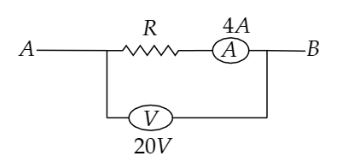
A non-ideal voltmeter and a non-ideal ammeter are connected as shown in the figure. The reading of the voltmeter of the voltmeter is $20V$ and that of the ammeter is $4A$. The value of $R$ is:
A. $5\Omega $
B. Less than $5\Omega $
C. Greater than $5\Omega $
D. May be less than $5\Omega $
Answer
 Verified
519.9k+ views
Hint: A voltmeter is a device used to measure the potential difference across a resistor. It is connected in parallel to the resistor. An ammeter is a device used to measure the electric current flowing through a resistor. It is always connected in series to the resistor. Use Ohm’s law to determine the resistor in the circuit. It states that the voltage $\left( V \right)$ across a resistor is directly proportional to the amount of electric current $\left( I \right)$ flowing through the resistor. $V = IR$, where $R$ is the resistance of the resistor.
Complete step by step answer:
It is given that the reading of voltmeter and ammeter is $20V$ and $4A$ respectively. Voltage across the resistor $R$ is $20V$. And current through the resistor $R$ is $4A$. It is required to find the resistance of the resistor in the given circuit.Now apply the Ohm’s law, the value of resistance is,
$R = \dfrac{V}{I}$.
$ \Rightarrow R = \dfrac{{20}}{4}\Omega $
$ \therefore R = 5\Omega $
Hence the correct option is (A).
Note: In real life, an ideal voltmeter and an ideal ammeter do not exist. An ideal voltmeter is one whose resistance is infinite so that no current passes through it and measures only voltage across a load. Non-ideal voltmeter means it has a finite resistance (very high compared to load) and hence a small or negligible current passes through it. An ideal ammeter is one whose resistance is zero so that all the current passes through it. A non-ideal ammeter has small resistance and hence there will be a small or negligible change in reading.
Complete step by step answer:
It is given that the reading of voltmeter and ammeter is $20V$ and $4A$ respectively. Voltage across the resistor $R$ is $20V$. And current through the resistor $R$ is $4A$. It is required to find the resistance of the resistor in the given circuit.Now apply the Ohm’s law, the value of resistance is,
$R = \dfrac{V}{I}$.
$ \Rightarrow R = \dfrac{{20}}{4}\Omega $
$ \therefore R = 5\Omega $
Hence the correct option is (A).
Note: In real life, an ideal voltmeter and an ideal ammeter do not exist. An ideal voltmeter is one whose resistance is infinite so that no current passes through it and measures only voltage across a load. Non-ideal voltmeter means it has a finite resistance (very high compared to load) and hence a small or negligible current passes through it. An ideal ammeter is one whose resistance is zero so that all the current passes through it. A non-ideal ammeter has small resistance and hence there will be a small or negligible change in reading.
Recently Updated Pages
Master Class 11 English: Engaging Questions & Answers for Success

Master Class 11 Social Science: Engaging Questions & Answers for Success
Master Class 11 Maths: Engaging Questions & Answers for Success
Master Class 11 Biology: Engaging Questions & Answers for Success
Master Class 11 Physics: Engaging Questions & Answers for Success
Master Class 11 Chemistry: Engaging Questions & Answers for Success
Trending doubts
Explain the Treaty of Vienna of 1815 class 10 social science CBSE
What is the Total Duration of Football Match?
First Cotton Mill of India
In which year voting age was reduced from 21 to 18?
10 examples of evaporation in daily life with explanations
What planets have no moons Which one has only one moon class 10 physics CBSE