




What is a node? What is an antinode?
Answer
 Verified
584.1k+ views
Hint: A standing wave pattern is an interference phenomenon. It's formed because of the superbly timed interference of two waves passing through identical mediums. A stationary wave pattern is not actually a wave but rather it's the pattern that is originated or formed when two waves of identical frequency and directions within a similar medium interfere with each other.
Complete step by step answer:
One of the most important and noticeable properties of stationary wave patterns is that there are points within the medium that appear to be at rest or standing still. These points, sometimes described as points of no displacement, are mentioned as nodes.
There are other points along the medium that undergo vibrations between an oversized positive and huge negative displacement. These points are the opposite of nodes, then they're called antinodes.
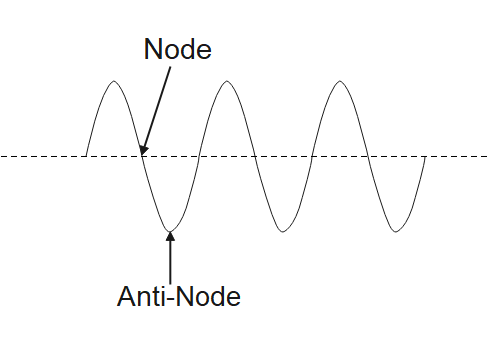
When a standing wave pattern is established during a medium, the nodes and therefore the antinodes are always located at identical positions along the medium; they're standing still. It's this characteristic that has earned the pattern the name standing wave.
The positioning of the nodes and antinodes during a standing wave pattern are often explained by focusing on the interference of the 2 waves. The nodes are produced at locations where destructive interference occurs. as an example, nodes form at locations where a crest of 1 wave meets a trough of a second wave; or a half-crest of 1 wave meets a half-trough of a second wave; or a quarter-crest of 1 wave meets a quarter-trough of a second wave; etc. Antinodes, on the opposite hand, are produced at locations where constructive interference occurs. For instance, if a crest of 1 wave meets a crest of a second wave, some extent of huge positive displacement results.
Note: Nodes and antinodes shouldn't be confused with crests and troughs. When the motion of a wave is discussed, it's customary to refer to some extent of huge maximum displacement as a crest and some extent of huge negative displacement as a trough. These represent points of the disturbance that travel from one location to a different through the medium. An antinode on the opposite hand is a point on the medium that's staying within the same location.
Complete step by step answer:
One of the most important and noticeable properties of stationary wave patterns is that there are points within the medium that appear to be at rest or standing still. These points, sometimes described as points of no displacement, are mentioned as nodes.
There are other points along the medium that undergo vibrations between an oversized positive and huge negative displacement. These points are the opposite of nodes, then they're called antinodes.
When a standing wave pattern is established during a medium, the nodes and therefore the antinodes are always located at identical positions along the medium; they're standing still. It's this characteristic that has earned the pattern the name standing wave.
The positioning of the nodes and antinodes during a standing wave pattern are often explained by focusing on the interference of the 2 waves. The nodes are produced at locations where destructive interference occurs. as an example, nodes form at locations where a crest of 1 wave meets a trough of a second wave; or a half-crest of 1 wave meets a half-trough of a second wave; or a quarter-crest of 1 wave meets a quarter-trough of a second wave; etc. Antinodes, on the opposite hand, are produced at locations where constructive interference occurs. For instance, if a crest of 1 wave meets a crest of a second wave, some extent of huge positive displacement results.
Note: Nodes and antinodes shouldn't be confused with crests and troughs. When the motion of a wave is discussed, it's customary to refer to some extent of huge maximum displacement as a crest and some extent of huge negative displacement as a trough. These represent points of the disturbance that travel from one location to a different through the medium. An antinode on the opposite hand is a point on the medium that's staying within the same location.
Recently Updated Pages
The given figure shows two endocrine glands marked class 11 biology NEET_UG

Match columnI with columnII and select the correct class 11 biology NEET
Match column I with column II and select the correct class 11 biology NEET_UG
Which floral family has left 9 right + 1 arrangement class 11 biology NEET_UG
Which is not a variety of sheep A Lohi B Beetal C Nellore class 11 biology NEET_UG
Match column I with column II and select the correct class 11 biology NEET_UG
Trending doubts
Draw a diagram of a plant cell and label at least eight class 11 biology CBSE
Difference Between Prokaryotic Cells and Eukaryotic Cells
One Metric ton is equal to kg A 10000 B 1000 C 100 class 11 physics CBSE
Two of the body parts which do not appear in MRI are class 11 biology CBSE
10 examples of friction in our daily life
Draw a diagram of nephron and explain its structur class 11 biology CBSE