




A motor car is going due north at a speed of 50 km/hr. It makes a ${90^0}$left turn without changing the speed. The change in the velocity of the car is about
$
(a){\text{ 50}}\sqrt 2 {\text{ km/hr}} \\
(b){\text{ 70 km/hr}} \\
(c){\text{ 80 km/hr}} \\
(d){\text{ zero}} \\
$
Answer
 Verified
536.6k+ views
Hint: Speed is a scalar quantity as it only has magnitude whereas velocity has both the magnitude as well as direction thus it is a vector. As the car has made a left turn this means the velocity gets changed and this change in velocity is the difference between the final and the initial velocity.
Complete step-by-step answer:
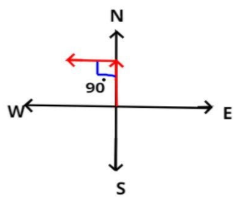
It is given that the motor car is going north at a speed of 50 km/hr. as shown in figure.
So the initial velocity (v) of the car is = $50\hat i$ km/hr, as $\left( {\hat i} \right)$ denotes the north direction.
Now the motor car makes a 90 degree left turn as shown in figure so the direction of the motor car is changed to west as shown in figure but it is given that the speed of motor car remains same, so the final velocity (u) of motor car is equal to $50\hat j$ km/hr, as $\left( {\hat j} \right)$ denotes the west direction.
Now we have to find out the change in velocity.
So as we know change in velocity is the subtraction of initial velocity (v) to the final velocity (u).
Therefore change in velocity (Vc) = initial velocity – final velocity.
$ \Rightarrow {V_c} = v - u$
$ \Rightarrow {V_c} = $ $50\hat i$ km/hr – $50\hat j$ km/hr $ = \left( {50\hat i - 50\hat j} \right)$ km/hr.
So we have to calculate the magnitude of this change in velocity.
$ \Rightarrow \left| {{V_c}} \right| = \left| {50\hat i - 50\hat j} \right| = \sqrt {{{\left( {50} \right)}^2} + {{\left( {50} \right)}^2}} = 50\sqrt 2 $
So this is the required change in velocity.
Hence option (a) is correct.
Note: Whenever we face such types of problems it is advised to make a simple diagrammatic plot of the directions in which the car moves as it helps understanding the concept of velocity. Sometimes in more complex problems the component of vectors of velocity helps solve the problems.
Complete step-by-step answer:
It is given that the motor car is going north at a speed of 50 km/hr. as shown in figure.
So the initial velocity (v) of the car is = $50\hat i$ km/hr, as $\left( {\hat i} \right)$ denotes the north direction.
Now the motor car makes a 90 degree left turn as shown in figure so the direction of the motor car is changed to west as shown in figure but it is given that the speed of motor car remains same, so the final velocity (u) of motor car is equal to $50\hat j$ km/hr, as $\left( {\hat j} \right)$ denotes the west direction.
Now we have to find out the change in velocity.
So as we know change in velocity is the subtraction of initial velocity (v) to the final velocity (u).
Therefore change in velocity (Vc) = initial velocity – final velocity.
$ \Rightarrow {V_c} = v - u$
$ \Rightarrow {V_c} = $ $50\hat i$ km/hr – $50\hat j$ km/hr $ = \left( {50\hat i - 50\hat j} \right)$ km/hr.
So we have to calculate the magnitude of this change in velocity.
$ \Rightarrow \left| {{V_c}} \right| = \left| {50\hat i - 50\hat j} \right| = \sqrt {{{\left( {50} \right)}^2} + {{\left( {50} \right)}^2}} = 50\sqrt 2 $
So this is the required change in velocity.
Hence option (a) is correct.
Note: Whenever we face such types of problems it is advised to make a simple diagrammatic plot of the directions in which the car moves as it helps understanding the concept of velocity. Sometimes in more complex problems the component of vectors of velocity helps solve the problems.
Recently Updated Pages
Basicity of sulphurous acid and sulphuric acid are

Master Class 12 English: Engaging Questions & Answers for Success
Master Class 12 Social Science: Engaging Questions & Answers for Success
Master Class 12 Maths: Engaging Questions & Answers for Success
Master Class 12 Economics: Engaging Questions & Answers for Success
Master Class 12 Physics: Engaging Questions & Answers for Success
Trending doubts
Which are the Top 10 Largest Countries of the World?
Draw a labelled sketch of the human eye class 12 physics CBSE
Draw ray diagrams each showing i myopic eye and ii class 12 physics CBSE
Giving reasons state the signs positive or negative class 12 physics CBSE
Explain esterification reaction with the help of a class 12 chemistry CBSE
What is defined as a solenoid Depict a diagram with class 12 physics CBSE