




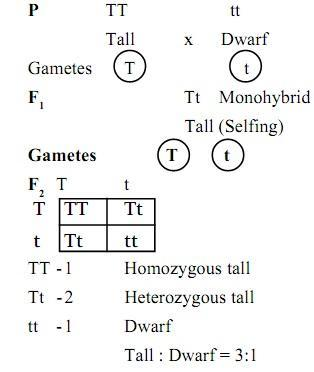
What is a monohybrid cross? What is the ratio of tall and dwarf plants obtained in \[F2\] generation? Represent the same with the help of a checkerboard.
Answer
 Verified
544.2k+ views
Hint: Genetics is an area of biology concerned with the study of heredity, its biological processes, genes, genomes, cell cycles, heredity, inherited genes, and a variety of other topics.
Heredity is constructed on the foundation of inheritance. The process of passing down attributes from one generation to the next is characterised as it. Gregor Johann Mendel is known as the "Father of Modern Genetics" for his discoveries on the fundamental principles of heredity.
Complete answer:
Part A-
A monohybrid cross is a cross between two people with homozygous genotypes that have the phenotype for a certain genetic trait that is the polar opposite.”
“A Monohybrid Cross is a cross between two monohybrid characteristics (TT and tt).”
A monohybrid cross is responsible for passing down one gene. It's simple to demonstrate using a Punnett Square.
Geneticists employ the monohybrid cross to see how homozygous offspring express heterozygous genes passed down from their parents.
Example- A monohybrid cross is created by crossing a long-stemmed pea plant with a short-stemmed pea plant. Heterozygous offspring result from a cross between the two.
Part B-
To evaluate the dominance relationship between two alleles, the monohybrid cross is commonly used. The parental generation is the starting point for the cross. One parent is homozygous for one allele while the other is homozygous for the other. The first filial (\[F1\]) generation is made up of the offspring. Every member of the \[F1\] generation is heterozygous for the dominant trait, and the \[F1\] generation's phenotype reflects this. The second filial (\[F2\]) generation is created by crossing two members of the \[F1\] generation. According to probability theory, the dominant allele's phenotype will be present in three-quarters of the \[F2\] generation. Mendelian inheritance is assumed in this expected \[3:1\] phenotypic ratio.
Part C-
Phenotypic ratio\[ = \] \[3:1\] ( \[3\] tall and \[1\]dwarf)
Genotypic ratio\[ = \] \[1:2:1\] ( \[1\] pure tall, \[2\] tall and \[1\] pure dwarf)
Note:
Laws of mendel-
Law of segregation: Every parent's pair of genes, or alleles, divides according to the law of segregation, and a single gene goes from each parent to their offspring. It's totally up to chance which gene in a pair passes on.
Law of independent assortment: Discrete pairs of alleles pass on to children without being dependent on one another, according to the law of Independent Assortment. As a result, the inheritance of genes in one section of a genome has no bearing on the inheritance of genes in another region.
Law of dominance: Recessive alleles are always disguised by dominant alleles, according to the law of dominance. As a result, a homozygous recessive and homozygous dominant hybrid produces the dominant phenotype despite the heterozygous genotype. The monohybrid cross experiment could explain this law.
Heredity is constructed on the foundation of inheritance. The process of passing down attributes from one generation to the next is characterised as it. Gregor Johann Mendel is known as the "Father of Modern Genetics" for his discoveries on the fundamental principles of heredity.
Complete answer:
Part A-
A monohybrid cross is a cross between two people with homozygous genotypes that have the phenotype for a certain genetic trait that is the polar opposite.”
“A Monohybrid Cross is a cross between two monohybrid characteristics (TT and tt).”
A monohybrid cross is responsible for passing down one gene. It's simple to demonstrate using a Punnett Square.
Geneticists employ the monohybrid cross to see how homozygous offspring express heterozygous genes passed down from their parents.
Example- A monohybrid cross is created by crossing a long-stemmed pea plant with a short-stemmed pea plant. Heterozygous offspring result from a cross between the two.
Part B-
To evaluate the dominance relationship between two alleles, the monohybrid cross is commonly used. The parental generation is the starting point for the cross. One parent is homozygous for one allele while the other is homozygous for the other. The first filial (\[F1\]) generation is made up of the offspring. Every member of the \[F1\] generation is heterozygous for the dominant trait, and the \[F1\] generation's phenotype reflects this. The second filial (\[F2\]) generation is created by crossing two members of the \[F1\] generation. According to probability theory, the dominant allele's phenotype will be present in three-quarters of the \[F2\] generation. Mendelian inheritance is assumed in this expected \[3:1\] phenotypic ratio.
Part C-
Phenotypic ratio\[ = \] \[3:1\] ( \[3\] tall and \[1\]dwarf)
Genotypic ratio\[ = \] \[1:2:1\] ( \[1\] pure tall, \[2\] tall and \[1\] pure dwarf)
Note:
Laws of mendel-
Law of segregation: Every parent's pair of genes, or alleles, divides according to the law of segregation, and a single gene goes from each parent to their offspring. It's totally up to chance which gene in a pair passes on.
Law of independent assortment: Discrete pairs of alleles pass on to children without being dependent on one another, according to the law of Independent Assortment. As a result, the inheritance of genes in one section of a genome has no bearing on the inheritance of genes in another region.
Law of dominance: Recessive alleles are always disguised by dominant alleles, according to the law of dominance. As a result, a homozygous recessive and homozygous dominant hybrid produces the dominant phenotype despite the heterozygous genotype. The monohybrid cross experiment could explain this law.
Recently Updated Pages
Master Class 12 Business Studies: Engaging Questions & Answers for Success

Master Class 12 Chemistry: Engaging Questions & Answers for Success
Master Class 12 Biology: Engaging Questions & Answers for Success
Class 12 Question and Answer - Your Ultimate Solutions Guide
Master Class 11 English: Engaging Questions & Answers for Success
Master Class 11 Social Science: Engaging Questions & Answers for Success
Trending doubts
Differentiate between Pyramid of energy and pyramid class 12 biology CBSE
Antibodies present in colostrum which protect the new class 12 biology CBSE
How many pollen sacs theca are present in each lobe class 12 biology CBSE
Bolting ie internode elongation just prior to flowering class 12 biology CBSE
Australian marsupials and placental mammals are suitable class 12 biology CBSE
Draw the diagram of the pyramid of energy Explain In class 12 biology CBSE