




A mirage occurs because
A. The refractive index of atmosphere increases with height
B. The refractive index of atmosphere decrease with height
C. The host ground acts like a mirror
D. Refractive index remains constant with height
Answer
 Verified
652.8k+ views
Hint: The light rays coming from a distant object appear to be coming from the image of the object inside the ground and this is called a mirage. We know that light rays coming from a particular distance or distant object, all travel through nearly the same air layers. All are bent over about the same amount. The rays which are coming from the top of the object will arrive lower. Using these concepts, we can determine the reason behind the mirage occurrence.
Complete answer:
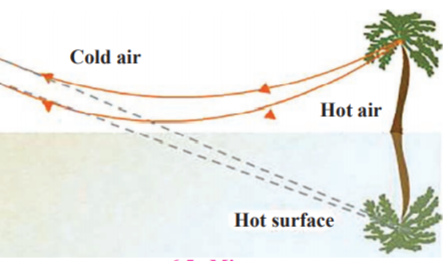
Have you seen a mirage which is an illusion of the appearance of water in a desert or on a hot road? Or have you seen that objects beyond and above a holy fire appear to be shaking? Why does this happen?
As hot air rises above, cold air descends, so as we move upward the refractive index also decreases.
Local atmospheric conditions affect the refraction of light to some extent. In both the examples above, the air near the hot road or desert surface and near the holy flames is hot and hence rarer than the air above it. The refractive index of air keeps increasing as we go to increasing heights. In the first case above, the direction of light rays, coming from a distance, keeps changing according to the laws of refraction.
The light rays coming from a distant object appear to be coming from the image of the object inside the ground as shown in the figure. This is called a mirage.
In the second example, the direction of light rays coming from objects beyond the holy fire changes due to changing refractive index above the fire. Thus, the objects appear to be moving.
Light rays coming from a particular distance or distant object, all travel through nearly the same air layers and all are bent over about the same amount by virtue of total internal reflection as the light is moving from a denser medium that is cold to a rarer medium that is hot air. Therefore, rays coming from the top of the object will arrive lower than those from the bottom or vice versa. The image usually is upside down by enhancing the illusion that the sky image seen in the distance is really an oil puddle of water acting as a mirror.
Hence a mirage occurs because the refractive index of the atmosphere increases with height.
So, the correct answer is “Option A”.
Note:
The real object in an inferior mirage is the sky (blue) or any distant (therefore bluish) object in that same direction. The mirage causes the observer to see a bright and bluish patch on the ground at some distance. The effect of atmospheric conditions on the refraction of light can be seen in the twinkling of the stars.
Complete answer:
Have you seen a mirage which is an illusion of the appearance of water in a desert or on a hot road? Or have you seen that objects beyond and above a holy fire appear to be shaking? Why does this happen?
As hot air rises above, cold air descends, so as we move upward the refractive index also decreases.
Local atmospheric conditions affect the refraction of light to some extent. In both the examples above, the air near the hot road or desert surface and near the holy flames is hot and hence rarer than the air above it. The refractive index of air keeps increasing as we go to increasing heights. In the first case above, the direction of light rays, coming from a distance, keeps changing according to the laws of refraction.
The light rays coming from a distant object appear to be coming from the image of the object inside the ground as shown in the figure. This is called a mirage.
In the second example, the direction of light rays coming from objects beyond the holy fire changes due to changing refractive index above the fire. Thus, the objects appear to be moving.
Light rays coming from a particular distance or distant object, all travel through nearly the same air layers and all are bent over about the same amount by virtue of total internal reflection as the light is moving from a denser medium that is cold to a rarer medium that is hot air. Therefore, rays coming from the top of the object will arrive lower than those from the bottom or vice versa. The image usually is upside down by enhancing the illusion that the sky image seen in the distance is really an oil puddle of water acting as a mirror.
Hence a mirage occurs because the refractive index of the atmosphere increases with height.
So, the correct answer is “Option A”.
Note:
The real object in an inferior mirage is the sky (blue) or any distant (therefore bluish) object in that same direction. The mirage causes the observer to see a bright and bluish patch on the ground at some distance. The effect of atmospheric conditions on the refraction of light can be seen in the twinkling of the stars.
Recently Updated Pages
Write any three differences between metals and nonmetals class 10 social science CBSE

Amit standing on a horizontal plane finds a bird flying class 10 maths CBSE
Two circles of radii 5 cm and 3 cm intersect at two class 10 maths CBSE
Solve the following i John and Jivanti together have class 10 maths CBSE
What is the relation between orthocenter circumcentre class 10 maths CBSE
Two plane mirrors are inclined at 70circ A ray incident class 10 physics CBSE
Trending doubts
Explain the Treaty of Vienna of 1815 class 10 social science CBSE
Which country is known as "The land of Fire and Ice"?
1 GB equals how many MB?
10 examples of evaporation in daily life with explanations
What is the full form of POSCO class 10 social science CBSE
Make a sketch of the human nerve cell What function class 10 biology CBSE