




A millimeter of 25 millivolt range is to be converted into an ammeter of 25-ampere range. The value (in ohm) of necessary shunt will be:
A. 1
B. 0.05
C. 0.001
D. 0.01
Answer
 Verified
582k+ views
Hint: A millimeter can be converted to an ammeter by connecting a very small shunt resistance in parallel with the galvanometer. This causes an increase in the current range of the whole setup as a lot of current passes through the shunt resistance. Find the potential difference across the multimeter and the shunt resistance. Equate these two equations for potential difference and then obtain an expression for shunt resistance. Substitute the values in the formula and find the value of shunt resistance.
Complete solution step-by-step:
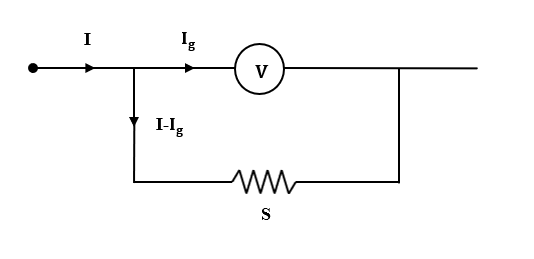
Let the resistance of millimeter be G and current flowing through it be ${I}_{g}$. The shunt resistance be S.
Given: $
V= 25 mV= 25 \times {10}^{-3}V$
I= 25 A
From the above figure, potential difference across millimeter is given by,
$V= {I}_{g}G$ …(1)
Similarly, potential difference across the shunt resistance is given by,
${V}_{s}=\left(I-{I}_{g}\right)S$ …(2)
We know the potential difference across the millimeter is the same as the potential difference across shunt resistance.
$\therefore V={V}_{s}$
Substituting values in above equation we get,
${I}_{g}G=\left(I-{I}_{g}\right)S$
$\Rightarrow S= \dfrac {{I}_{g}G}{I-{I}_{g}}$
Substituting equation. (1) back in above equation we get,
$ S= \dfrac {V}{I-{I}_{g}}$ …(3)
Now, we know, for an ideal millimeter, resistance is infinity. Also, current is inversely proportional to resistance. Thus, the current through the voltmeter will be zero.
$\therefore {I}_{g}=0$
Substituting values in the equation. (3) we get,
$S= \dfrac {25 \times {10}^{-3}}{25-0}$
$\Rightarrow S= \dfrac {25 \times {10}^{-3}}{25}$
$\Rightarrow S= {10}^{-3}\Omega$
$\Rightarrow S= 0.001 \Omega$
Thus, the value (in ohm) of necessary shunt will be $0.001 \Omega$.
So, the correct answer is option C is 0.001.
Note:
Students must remember how to convert a millimeter or galvanometer into an ammeter or a voltmeter. To convert a galvanometer into an ammeter, a very small shunt resistance has to be connected in parallel always. While to convert a galvanometer into a voltmeter, a large resistance has to be connected in series. The galvanometer resistance is considered as a simple resistance which is in series with an ideal galvanometer. An ideal galvanometer or a millimeter has zero resistance.
Complete solution step-by-step:
Let the resistance of millimeter be G and current flowing through it be ${I}_{g}$. The shunt resistance be S.
Given: $
V= 25 mV= 25 \times {10}^{-3}V$
I= 25 A
From the above figure, potential difference across millimeter is given by,
$V= {I}_{g}G$ …(1)
Similarly, potential difference across the shunt resistance is given by,
${V}_{s}=\left(I-{I}_{g}\right)S$ …(2)
We know the potential difference across the millimeter is the same as the potential difference across shunt resistance.
$\therefore V={V}_{s}$
Substituting values in above equation we get,
${I}_{g}G=\left(I-{I}_{g}\right)S$
$\Rightarrow S= \dfrac {{I}_{g}G}{I-{I}_{g}}$
Substituting equation. (1) back in above equation we get,
$ S= \dfrac {V}{I-{I}_{g}}$ …(3)
Now, we know, for an ideal millimeter, resistance is infinity. Also, current is inversely proportional to resistance. Thus, the current through the voltmeter will be zero.
$\therefore {I}_{g}=0$
Substituting values in the equation. (3) we get,
$S= \dfrac {25 \times {10}^{-3}}{25-0}$
$\Rightarrow S= \dfrac {25 \times {10}^{-3}}{25}$
$\Rightarrow S= {10}^{-3}\Omega$
$\Rightarrow S= 0.001 \Omega$
Thus, the value (in ohm) of necessary shunt will be $0.001 \Omega$.
So, the correct answer is option C is 0.001.
Note:
Students must remember how to convert a millimeter or galvanometer into an ammeter or a voltmeter. To convert a galvanometer into an ammeter, a very small shunt resistance has to be connected in parallel always. While to convert a galvanometer into a voltmeter, a large resistance has to be connected in series. The galvanometer resistance is considered as a simple resistance which is in series with an ideal galvanometer. An ideal galvanometer or a millimeter has zero resistance.
Recently Updated Pages
Master Class 12 Social Science: Engaging Questions & Answers for Success

Master Class 12 Physics: Engaging Questions & Answers for Success
Master Class 12 Maths: Engaging Questions & Answers for Success
Master Class 12 Economics: Engaging Questions & Answers for Success
Master Class 12 Chemistry: Engaging Questions & Answers for Success
Master Class 12 Business Studies: Engaging Questions & Answers for Success
Trending doubts
Which are the Top 10 Largest Countries of the World?
Draw a labelled sketch of the human eye class 12 physics CBSE
Explain the structure of megasporangium class 12 biology CBSE
What are the major means of transport Explain each class 12 social science CBSE
How many chromosomes are found in human ovum a 46 b class 12 biology CBSE
The diagram of the section of a maize grain is given class 12 biology CBSE