




A metallic sphere of radius 10.5cm is melted and thus recast into small cones, each of radius 3.5cm and height 3cm. Find how many cones are obtained.
Answer
 Verified
566.3k+ views
Hint: The volume of a metallic sphere of radius \[R\] is given by \[{V_s} = \dfrac{4}{3}\pi {R^3}\]. The volume of a cone with radius ‘\[r\]’ and height ‘\[h\]’ is given by \[{V_c} = \dfrac{1}{3}\pi {r^2}h\]. So, use this concept to reach the solution of the given problem.
Complete step-by-step answer:
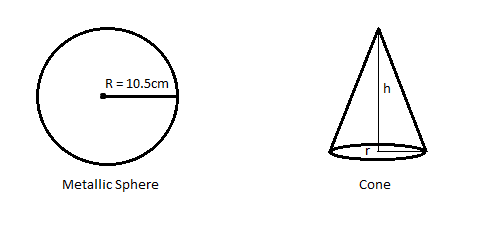
The diagram of given metallic sphere and cone is as given below:
Given, radius of metallic sphere \[R = 10.5cm\]
We know that the volume of a metallic sphere of radius \[R\] is given by \[{V_s} = \dfrac{4}{3}\pi {R^3}\].
So, volume of the metallic sphere with radius \[R = 10.5cm\] is
\[
\Rightarrow {V_s} = \dfrac{4}{3}\pi {\left( {10.5} \right)^3} \\
\Rightarrow {V_s} = \dfrac{\pi }{3} \times 4 \times 10.5 \times 10.5 \times 10.5 \\
\Rightarrow {V_s} = \dfrac{\pi }{3}\left( {4630.5} \right) \\
\therefore {V_s} = \dfrac{\pi }{3}\left( {4630.5} \right)c{m^3} \\
\]
Given radius of the cone is \[r = 3.5cm\] and height of the cone is \[h = 3cm\]
We know that the volume of a cone with radius ‘\[r\]’ and height ‘\[h\]’ is given by \[{V_c} = \dfrac{1}{3}\pi {r^2}h\]
\[
\Rightarrow {V_c} = \dfrac{1}{3}\pi {\left( {3.5} \right)^2}\left( 3 \right) \\
\Rightarrow {V_c} = \dfrac{\pi }{3} \times 3.5 \times 3.5 \times 3 \\
\Rightarrow {V_c} = \dfrac{\pi }{3}\left( {36.75} \right) \\
\therefore {V_c} = \dfrac{\pi }{3}\left( {36.75} \right)c{m^3} \\
\]
Number of cones obtained \[n = \dfrac{{{\text{Volume of the sphere }}\left( {{V_s}} \right)}}{{{\text{Volume of the cone }}\left( {{V_c}} \right)}}\]
\[
\Rightarrow n = \dfrac{{\dfrac{\pi }{3}\left( {4630.5} \right)c{m^3}}}{{\dfrac{\pi }{3}\left( {36.75} \right)c{m^3}}} \\
\Rightarrow n = \dfrac{{4630.5}}{{36.75}} \\
\therefore n = 126 \\
\]
Therefore, the number of cones obtained is 126.
Note: Here the volume of the metallic sphere and the total volume formed by the number of cones are equal. So, the number of cones formed can be found by the volume of the metallic sphere divided by the volume of one cone.
Complete step-by-step answer:
The diagram of given metallic sphere and cone is as given below:
Given, radius of metallic sphere \[R = 10.5cm\]
We know that the volume of a metallic sphere of radius \[R\] is given by \[{V_s} = \dfrac{4}{3}\pi {R^3}\].
So, volume of the metallic sphere with radius \[R = 10.5cm\] is
\[
\Rightarrow {V_s} = \dfrac{4}{3}\pi {\left( {10.5} \right)^3} \\
\Rightarrow {V_s} = \dfrac{\pi }{3} \times 4 \times 10.5 \times 10.5 \times 10.5 \\
\Rightarrow {V_s} = \dfrac{\pi }{3}\left( {4630.5} \right) \\
\therefore {V_s} = \dfrac{\pi }{3}\left( {4630.5} \right)c{m^3} \\
\]
Given radius of the cone is \[r = 3.5cm\] and height of the cone is \[h = 3cm\]
We know that the volume of a cone with radius ‘\[r\]’ and height ‘\[h\]’ is given by \[{V_c} = \dfrac{1}{3}\pi {r^2}h\]
\[
\Rightarrow {V_c} = \dfrac{1}{3}\pi {\left( {3.5} \right)^2}\left( 3 \right) \\
\Rightarrow {V_c} = \dfrac{\pi }{3} \times 3.5 \times 3.5 \times 3 \\
\Rightarrow {V_c} = \dfrac{\pi }{3}\left( {36.75} \right) \\
\therefore {V_c} = \dfrac{\pi }{3}\left( {36.75} \right)c{m^3} \\
\]
Number of cones obtained \[n = \dfrac{{{\text{Volume of the sphere }}\left( {{V_s}} \right)}}{{{\text{Volume of the cone }}\left( {{V_c}} \right)}}\]
\[
\Rightarrow n = \dfrac{{\dfrac{\pi }{3}\left( {4630.5} \right)c{m^3}}}{{\dfrac{\pi }{3}\left( {36.75} \right)c{m^3}}} \\
\Rightarrow n = \dfrac{{4630.5}}{{36.75}} \\
\therefore n = 126 \\
\]
Therefore, the number of cones obtained is 126.
Note: Here the volume of the metallic sphere and the total volume formed by the number of cones are equal. So, the number of cones formed can be found by the volume of the metallic sphere divided by the volume of one cone.
Recently Updated Pages
Master Class 11 English: Engaging Questions & Answers for Success

Master Class 11 Social Science: Engaging Questions & Answers for Success
Master Class 11 Maths: Engaging Questions & Answers for Success
Master Class 11 Chemistry: Engaging Questions & Answers for Success
Master Class 11 Biology: Engaging Questions & Answers for Success
Master Class 11 Physics: Engaging Questions & Answers for Success
Trending doubts
Why is it 530 pm in india when it is 1200 afternoon class 10 social science CBSE
What is the full form of CNG A Complete Natural Gas class 10 social science CBSE
Which Country Has the Largest Border with India?
Choose the feminine form of the given noun Fox AFoxess class 10 english CBSE
Fill the blanks with proper collective nouns 1 A of class 10 english CBSE
The term Eelam means A Country B State C Nation D class 10 social science CBSE