




A metallic solid of volume 1,500 $c{{m}^{3}}$ melted and drawn into the form of a wire of height 14 cm. Find the radius of the wire. (Use $\pi =\dfrac{22}{7}$)
(a) $2\sqrt{5}cm$
(b) $4\sqrt{5}cm$
(c) $5.83cm$
(d) $3\sqrt{5}cm$
Answer
 Verified
611.7k+ views
Hint: Whenever a metallic solid is converted from one shape to another, the volume of the metal used remains the same. This is also known as conservation of volume. Also, there are some formulas that will be used to solve this question. The volume of the cylinder is given by the formula $\pi {{r}^{2}}h$.
Complete step-by-step answer:
Before proceeding the question, we must know all the concepts and the formula that will be required to solve this question.
By the conservation of volume, if a metallic solid is converted from one shape to another, the volume of the metal in both the shapes remains the same.
The volume of a cylinder having radius r and height h is given by the formula,
$V=\pi {{r}^{2}}h...........\left( 1 \right)$
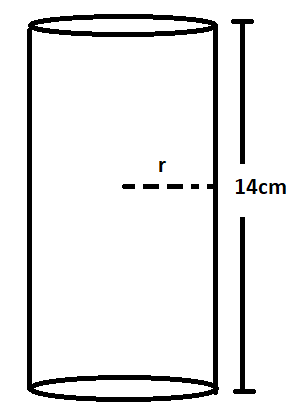
In the question, it is given that a metallic solid of volume 1,500 $c{{m}^{3}}$ melted and drawn into the form of a wire of height 14 cm. and required to find the radius of the cylindrical wire that is formed.
Let us assume a variable r which represents the radius of the cylindrical wire formed.
From formula $\left( 1 \right)$, the volume of cylinder having radius r and height h = 14cm is,
$V=\pi {{r}^{2}}\left( 14 \right)$
Substituting $\pi =\dfrac{22}{7}$ in the above equation, we get,
$\begin{align}
& V=\dfrac{22}{7}{{r}^{2}}\left( 14 \right) \\
& \Rightarrow V=44{{r}^{2}} \\
\end{align}$
From the concept of conservation of volume, we can say that this volume is equal to the volume of the solid from which the cylinder is formed. In the question, the volume of the sphere is given as 1,500 $c{{m}^{3}}$. Equating the above obtained volume to 1500, we get,
$\begin{align}
& 44{{r}^{2}}=1500 \\
& \Rightarrow {{r}^{2}}=\dfrac{1500}{44} \\
& \Rightarrow {{r}^{2}}=\dfrac{750}{22} \\
& \Rightarrow {{r}^{2}}=34.09 \\
& \Rightarrow r=5.83cm \\
\end{align}$
The answer is option (c).
Note: There is a possibility that one may commit a mistake while applying the formula of the cylinder. It is a very common mistake that students forget to write units of radius and this mistake may lead us to an incorrect answer.
Complete step-by-step answer:
Before proceeding the question, we must know all the concepts and the formula that will be required to solve this question.
By the conservation of volume, if a metallic solid is converted from one shape to another, the volume of the metal in both the shapes remains the same.
The volume of a cylinder having radius r and height h is given by the formula,
$V=\pi {{r}^{2}}h...........\left( 1 \right)$
In the question, it is given that a metallic solid of volume 1,500 $c{{m}^{3}}$ melted and drawn into the form of a wire of height 14 cm. and required to find the radius of the cylindrical wire that is formed.
Let us assume a variable r which represents the radius of the cylindrical wire formed.
From formula $\left( 1 \right)$, the volume of cylinder having radius r and height h = 14cm is,
$V=\pi {{r}^{2}}\left( 14 \right)$
Substituting $\pi =\dfrac{22}{7}$ in the above equation, we get,
$\begin{align}
& V=\dfrac{22}{7}{{r}^{2}}\left( 14 \right) \\
& \Rightarrow V=44{{r}^{2}} \\
\end{align}$
From the concept of conservation of volume, we can say that this volume is equal to the volume of the solid from which the cylinder is formed. In the question, the volume of the sphere is given as 1,500 $c{{m}^{3}}$. Equating the above obtained volume to 1500, we get,
$\begin{align}
& 44{{r}^{2}}=1500 \\
& \Rightarrow {{r}^{2}}=\dfrac{1500}{44} \\
& \Rightarrow {{r}^{2}}=\dfrac{750}{22} \\
& \Rightarrow {{r}^{2}}=34.09 \\
& \Rightarrow r=5.83cm \\
\end{align}$
The answer is option (c).
Note: There is a possibility that one may commit a mistake while applying the formula of the cylinder. It is a very common mistake that students forget to write units of radius and this mistake may lead us to an incorrect answer.
Recently Updated Pages
Master Class 10 Computer Science: Engaging Questions & Answers for Success

Master Class 10 General Knowledge: Engaging Questions & Answers for Success
Master Class 10 English: Engaging Questions & Answers for Success
Master Class 10 Social Science: Engaging Questions & Answers for Success
Master Class 10 Maths: Engaging Questions & Answers for Success
Master Class 10 Science: Engaging Questions & Answers for Success
Trending doubts
What is the median of the first 10 natural numbers class 10 maths CBSE
Which women's tennis player has 24 Grand Slam singles titles?
Who is the Brand Ambassador of Incredible India?
Why is there a time difference of about 5 hours between class 10 social science CBSE
Write a letter to the principal requesting him to grant class 10 english CBSE
State and prove converse of BPT Basic Proportionality class 10 maths CBSE