




A metallic right circular cone 20cm high and whose vertical angle is 60° is cut into two parts at the middle of its height by a plane parallel to its base. If the frustum so obtained be drawn into a wire of diameter $\dfrac{1}{{16}}$cm, find the length of the wire.
Answer
 Verified
627.6k+ views
Hint – In order to find the length of the wire, we draw an appropriate figure with the given data in the question, then with the help of the angle inside the figure we use the tan function to find the other sides and then use the formula of volume of frustum to find the answer.
Complete step-by-step answer:
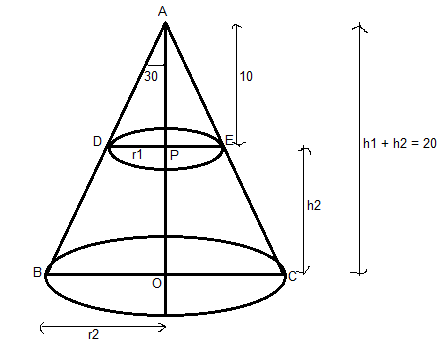
Let ABC is the metallic cone and DECB is the required frustum.
Let the radii of the frustum are${{\text{r}}_1}{\text{ and }}{{\text{r}}_2}$, i.e. DP = ${{\text{r}}_1}$ and BO =${{\text{r}}_2}$.
Now from ∆ABO,
$
{{\text{r}}_2}{\text{ = }}{{\text{h}}_1}{\text{ }} \times {\text{ tan30}}^\circ \\
\Rightarrow {{\text{r}}_2}{\text{ = 10 }} \times {\text{ }}\dfrac{1}{{\sqrt 3 }} \\
\Rightarrow {{\text{r}}_2} = {\text{ }}\dfrac{{10}}{{\sqrt 3 }} \\
$
Now from ∆ADP,
$
{{\text{r}}_1}{\text{ = }}\left( {{{\text{h}}_1}{\text{ + }}{{\text{h}}_2}} \right){\text{ }} \times {\text{ tan30}}^\circ \\
\Rightarrow {{\text{r}}_1}{\text{ = 20 }} \times {\text{ }}\dfrac{1}{{\sqrt 3 }} \\
\Rightarrow {{\text{r}}_1} = {\text{ }}\dfrac{{20}}{{\sqrt 3 }} \\
$
We know volume of the frustum can be given as = $\dfrac{1}{3}\pi {\text{h}}\left( {{{\text{r}}_1}^2 + {\text{r}}_2^2 + {{\text{r}}_1}{{\text{r}}_2}} \right)$
Therefore volume of frustum DECB is,
h = 10, ${{\text{r}}_1} = {\text{ }}\dfrac{{20}}{{\sqrt 3 }}$and ${{\text{r}}_2} = {\text{ }}\dfrac{{10}}{{\sqrt 3 }}$
$
\Rightarrow {\text{V = }}\dfrac{{\pi \times 10}}{3}\left( {{{\left( {\dfrac{{20}}{{\sqrt 3 }}} \right)}^2} + {{\left( {\dfrac{{10}}{{\sqrt 3 }}} \right)}^2} + \dfrac{{20}}{{\sqrt 3 }} \times \dfrac{{10}}{{\sqrt 3 }}} \right) \\
\Rightarrow {\text{V = }}\dfrac{{10\pi }}{3}\left( {\dfrac{{400}}{3} + \dfrac{{100}}{3} + \dfrac{{200}}{3}} \right) \\
\Rightarrow {\text{V = }}\dfrac{{7000\pi }}{9} \\
$
Now let l is the length of the wire.
Given diameter of the wire d is = $\dfrac{1}{{16}}$cm
So the radius of the wire is = $\dfrac{{\text{d}}}{2} = \dfrac{1}{{2 \times 16}} = \dfrac{1}{{32}}{\text{cm}}$
We know the volume of the wire V = $\pi {{\text{r}}^2}{\text{l}}$
Given volume of the frustum = volume of the wire drawn from it
$
\Rightarrow \dfrac{{7000\pi }}{9} = \pi {{\text{r}}^2}{\text{l}} \\
\Rightarrow {\text{l = }}\dfrac{{7000\pi }}{{\pi {{\left( {\dfrac{1}{{32}}} \right)}^2}}} \\
$
$
\Rightarrow {\text{l = }}\dfrac{{796444.444}}{{100}}{\text{m - - - - - }}\left( {100{\text{cm = 1m}}} \right) \\
\therefore {\text{l = 7964}}{\text{.444m}} \\
$
Hence the length of the wire = 7964.444 m
Note – In order to solve this type of question the key is to understand the concepts of frustum and its volume. In geometry, a frustum is the portion of a solid that lies between one or two parallel planes cutting it. Equating the volume of the frustum to the volume of the wire is the next vital step in order to find the answer.
Complete step-by-step answer:
Let ABC is the metallic cone and DECB is the required frustum.
Let the radii of the frustum are${{\text{r}}_1}{\text{ and }}{{\text{r}}_2}$, i.e. DP = ${{\text{r}}_1}$ and BO =${{\text{r}}_2}$.
Now from ∆ABO,
$
{{\text{r}}_2}{\text{ = }}{{\text{h}}_1}{\text{ }} \times {\text{ tan30}}^\circ \\
\Rightarrow {{\text{r}}_2}{\text{ = 10 }} \times {\text{ }}\dfrac{1}{{\sqrt 3 }} \\
\Rightarrow {{\text{r}}_2} = {\text{ }}\dfrac{{10}}{{\sqrt 3 }} \\
$
Now from ∆ADP,
$
{{\text{r}}_1}{\text{ = }}\left( {{{\text{h}}_1}{\text{ + }}{{\text{h}}_2}} \right){\text{ }} \times {\text{ tan30}}^\circ \\
\Rightarrow {{\text{r}}_1}{\text{ = 20 }} \times {\text{ }}\dfrac{1}{{\sqrt 3 }} \\
\Rightarrow {{\text{r}}_1} = {\text{ }}\dfrac{{20}}{{\sqrt 3 }} \\
$
We know volume of the frustum can be given as = $\dfrac{1}{3}\pi {\text{h}}\left( {{{\text{r}}_1}^2 + {\text{r}}_2^2 + {{\text{r}}_1}{{\text{r}}_2}} \right)$
Therefore volume of frustum DECB is,
h = 10, ${{\text{r}}_1} = {\text{ }}\dfrac{{20}}{{\sqrt 3 }}$and ${{\text{r}}_2} = {\text{ }}\dfrac{{10}}{{\sqrt 3 }}$
$
\Rightarrow {\text{V = }}\dfrac{{\pi \times 10}}{3}\left( {{{\left( {\dfrac{{20}}{{\sqrt 3 }}} \right)}^2} + {{\left( {\dfrac{{10}}{{\sqrt 3 }}} \right)}^2} + \dfrac{{20}}{{\sqrt 3 }} \times \dfrac{{10}}{{\sqrt 3 }}} \right) \\
\Rightarrow {\text{V = }}\dfrac{{10\pi }}{3}\left( {\dfrac{{400}}{3} + \dfrac{{100}}{3} + \dfrac{{200}}{3}} \right) \\
\Rightarrow {\text{V = }}\dfrac{{7000\pi }}{9} \\
$
Now let l is the length of the wire.
Given diameter of the wire d is = $\dfrac{1}{{16}}$cm
So the radius of the wire is = $\dfrac{{\text{d}}}{2} = \dfrac{1}{{2 \times 16}} = \dfrac{1}{{32}}{\text{cm}}$
We know the volume of the wire V = $\pi {{\text{r}}^2}{\text{l}}$
Given volume of the frustum = volume of the wire drawn from it
$
\Rightarrow \dfrac{{7000\pi }}{9} = \pi {{\text{r}}^2}{\text{l}} \\
\Rightarrow {\text{l = }}\dfrac{{7000\pi }}{{\pi {{\left( {\dfrac{1}{{32}}} \right)}^2}}} \\
$
$
\Rightarrow {\text{l = }}\dfrac{{796444.444}}{{100}}{\text{m - - - - - }}\left( {100{\text{cm = 1m}}} \right) \\
\therefore {\text{l = 7964}}{\text{.444m}} \\
$
Hence the length of the wire = 7964.444 m
Note – In order to solve this type of question the key is to understand the concepts of frustum and its volume. In geometry, a frustum is the portion of a solid that lies between one or two parallel planes cutting it. Equating the volume of the frustum to the volume of the wire is the next vital step in order to find the answer.
Recently Updated Pages
Basicity of sulphurous acid and sulphuric acid are

Master Class 10 English: Engaging Questions & Answers for Success
Master Class 10 Social Science: Engaging Questions & Answers for Success
Master Class 10 Computer Science: Engaging Questions & Answers for Success
Class 10 Question and Answer - Your Ultimate Solutions Guide
Master Class 10 General Knowledge: Engaging Questions & Answers for Success
Trending doubts
Which country won the ICC Men's ODI World Cup in 2023?
In cricket, how many legal balls are there in a standard over?
Explain the Treaty of Vienna of 1815 class 10 social science CBSE
A boat goes 24 km upstream and 28 km downstream in class 10 maths CBSE
What does "powerplay" mean in limited-overs cricket?
What is the "Powerplay" in T20 cricket?