




A metallic bucket, open at the top, of height 24cm is in the form of the frustum of a cone, the radii of whose lower and upper circular ends are 7cm and 14 cm respectively. Find:
i) the volume of water which can completely fill the bucket.
ii) the area of metal sheet used to make the bucket. $\left[ use\text{ }\pi =\dfrac{22}{7} \right]$
Answer
 Verified
609.6k+ views
Hint: In the above question first of all we will calculate the slant height of the frustum and then we will calculate the volume and curved surface area of the frustum by using their formulae as shown belows:
Let the slant height of the frustum of the cone be “l” and the radius of the upper end be “R” and the radius of the lower end be “r” respectively. Therefore,
\[\begin{align}
& l=\sqrt{{{{(R-r)}^{2}}}+{{h}^{2}}} \\
& volume=\dfrac{1}{3}\pi h({{R}^{2}}+{{r}^{2}}+R\times r) \\
& \text{curved surface area = }\pi \times l\times (R+r) \\
\end{align}\]
Complete step-by-step answer:
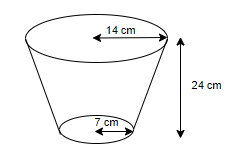
Now, we have been given h =24cm, R= 14cm and r=7cm. Therefore,
\[\begin{align}
& l=\sqrt{{{(14-7)}^{2}}+{{24}^{2}}} \\
& l=\sqrt{49+576} \\
& l=\sqrt{625} \\
& l=25cm \\
& \text{so, slant height is 25cm}\text{. } \\
& \text{volume=}\dfrac{1}{3}\times \pi \times 24({{14}^{2}}+{{7}^{2}}+14\times 7) \\
& \text{ }=\dfrac{1}{3}\times \dfrac{22}{7}\times 24(196+49+98) \\
& \text{ =}\dfrac{181104}{21} \\
& \text{ =8624c}{{\text{m}}^{3}} \\
& \text{curved surface area=}\dfrac{22}{7}\times 25\times (14+7) \\
& \text{ =}\dfrac{11550}{21} \\
& \text{ =1650c}{{\text{m}}^{2}} \\
& \text{Area of the base(lower end) of the bucket = }\pi {{\text{r}}^{2}} \\
& \text{ =}\dfrac{22}{7}\times 7\times 7 \\
& \text{ =154c}{{\text{m}}^{2}} \\
\end{align}\]
Area of the metal sheet used to make the bucket
= curved surface area + Area of the base (lower end)
= 1650 +154
=1804\[c{{m}^{2}}\]
Therefore, the volume of the water which can completely fill the bucket is 8624\[c{{m}^{3}}\] and the area of the metal sheet used to make the bucket is 1804\[c{{m}^{2}}\].
NOTE: Be careful while doing calculation as there is a chance that you might make a mistake and you will get the incorrect answer. The most common mistake that is possible is using the wrong formula for the volume of frustum as \[\dfrac{1}{3}\pi h\left( {{R}^{2}}+{{r}^{2}} \right)\] instead of \[\dfrac{1}{3}\pi h\left( {{R}^{2}}+{{r}^{2}}+R\times r \right)\].
Let the slant height of the frustum of the cone be “l” and the radius of the upper end be “R” and the radius of the lower end be “r” respectively. Therefore,
\[\begin{align}
& l=\sqrt{{{{(R-r)}^{2}}}+{{h}^{2}}} \\
& volume=\dfrac{1}{3}\pi h({{R}^{2}}+{{r}^{2}}+R\times r) \\
& \text{curved surface area = }\pi \times l\times (R+r) \\
\end{align}\]
Complete step-by-step answer:
Now, we have been given h =24cm, R= 14cm and r=7cm. Therefore,
\[\begin{align}
& l=\sqrt{{{(14-7)}^{2}}+{{24}^{2}}} \\
& l=\sqrt{49+576} \\
& l=\sqrt{625} \\
& l=25cm \\
& \text{so, slant height is 25cm}\text{. } \\
& \text{volume=}\dfrac{1}{3}\times \pi \times 24({{14}^{2}}+{{7}^{2}}+14\times 7) \\
& \text{ }=\dfrac{1}{3}\times \dfrac{22}{7}\times 24(196+49+98) \\
& \text{ =}\dfrac{181104}{21} \\
& \text{ =8624c}{{\text{m}}^{3}} \\
& \text{curved surface area=}\dfrac{22}{7}\times 25\times (14+7) \\
& \text{ =}\dfrac{11550}{21} \\
& \text{ =1650c}{{\text{m}}^{2}} \\
& \text{Area of the base(lower end) of the bucket = }\pi {{\text{r}}^{2}} \\
& \text{ =}\dfrac{22}{7}\times 7\times 7 \\
& \text{ =154c}{{\text{m}}^{2}} \\
\end{align}\]
Area of the metal sheet used to make the bucket
= curved surface area + Area of the base (lower end)
= 1650 +154
=1804\[c{{m}^{2}}\]
Therefore, the volume of the water which can completely fill the bucket is 8624\[c{{m}^{3}}\] and the area of the metal sheet used to make the bucket is 1804\[c{{m}^{2}}\].
NOTE: Be careful while doing calculation as there is a chance that you might make a mistake and you will get the incorrect answer. The most common mistake that is possible is using the wrong formula for the volume of frustum as \[\dfrac{1}{3}\pi h\left( {{R}^{2}}+{{r}^{2}} \right)\] instead of \[\dfrac{1}{3}\pi h\left( {{R}^{2}}+{{r}^{2}}+R\times r \right)\].
Recently Updated Pages
Master Class 10 Computer Science: Engaging Questions & Answers for Success

Master Class 10 General Knowledge: Engaging Questions & Answers for Success
Master Class 10 English: Engaging Questions & Answers for Success
Master Class 10 Social Science: Engaging Questions & Answers for Success
Master Class 10 Maths: Engaging Questions & Answers for Success
Master Class 10 Science: Engaging Questions & Answers for Success
Trending doubts
What is the median of the first 10 natural numbers class 10 maths CBSE
Which women's tennis player has 24 Grand Slam singles titles?
Who is the Brand Ambassador of Incredible India?
Why is there a time difference of about 5 hours between class 10 social science CBSE
Write a letter to the principal requesting him to grant class 10 english CBSE
State and prove converse of BPT Basic Proportionality class 10 maths CBSE