




A metallic bucket, open at the top, of height 24cm is in the form of the frustum old a cone, the radii of whose lower and upper circular ends are 7cm and 14 cm respectively. Find
$(a)$ The volume of water which can completely fill the bucket.
$(b)$ The area of the metal sheet used to make the bucket.
Answer
 Verified
669k+ views
Hint: In order to calculate the volume of the bucket directly use the formula for volume of frustum as the bucket is in shape of frustum. For the area of metal sheet used to make this bucket, find the curved surface area bucket shaped in the form of frustum but don’t forget to add the area of lower circular region.
Complete step-by-step answer:
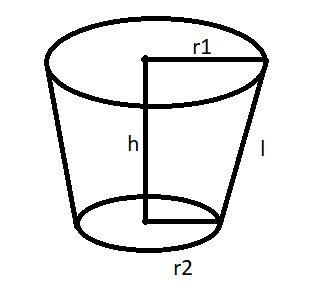
The diagram of the bucket is shown above where (r1 and r2) are the radii of upper and lower circular parts respectively and (h) is height of the frustum of a cone (i.e. metallic bucket).
Now it is given that,
${r_1} = 14{\text{ cm, }}{r_2} = 7{\text{ cm, }}h = 24{\text{ cm}}$.
Now as we know that the volume (V) of the frustum is
$ \Rightarrow V = \dfrac{1}{3}\pi h\left( {{r_1}^2 + {r_2}^2 + {r_1}{r_2}} \right)$.
Now substitute the values in the above equation we have,
$ \Rightarrow V = \dfrac{1}{3}\left( {\dfrac{{22}}{7}} \right)\left( {24} \right)\left( {{{\left( {14} \right)}^2} + {7^2} + \left( {14} \right)\left( 7 \right)} \right)$, $\left[ {\because \pi = \dfrac{{22}}{7}} \right]$
Now simplify the above equation we have,
$ \Rightarrow V = \left( {\dfrac{{22}}{7}} \right)\left( 8 \right)\left( {196 + 49 + 98} \right) = \dfrac{{22}}{7}\left( 8 \right)\left( {343} \right) = 22\left( 8 \right)\left( {49} \right) = 8624{\text{ c}}{{\text{m}}^3}$.
Now as the bucket is open at the top therefore the total area (A) of the metal sheet used to make a bucket is the sum of curved surface area (C.S.A) of the bucket and the lower circular part area (A1).
$ \Rightarrow A = C.S.A + {A_1}$………………. (1)
So first calculate the area of the lower circular part.
As we know that the area of the circle is$\pi {r^2}$.
So the area of the lower circular part is$\pi {r_2}^2$.
$ \Rightarrow {A_1} = \pi {r_2}^2 = \dfrac{{22}}{7}{\left( 7 \right)^2} = 22\left( 7 \right) = 154{\text{ c}}{{\text{m}}^2}$.
Now calculate the curved surface area of the bucket.
The formula for the curved surface area (C.S.A) of the bucket is $\pi l\left( {{r_1} + {r_2}} \right)$………………. (2)
Where l is the slant height of the bucket as shown in figure.
And the formula for slant height of the frustum is given as
$l = \sqrt {{{\left( {{r_1} - {r_2}} \right)}^2} + {h^2}} $
So substitute the values in the above formula we have,
$ \Rightarrow l = \sqrt {{{\left( {14 - 7} \right)}^2} + {{24}^2}} = \sqrt {49 + 576} = \sqrt {625} = 25{\text{ cm}}$
Now from equation (2) we have,
$ \Rightarrow C.S.A = \dfrac{{22}}{7}\left( {25} \right)\left( {14 + 7} \right) = 22\left( {25} \right)\left( 3 \right) = 1650{\text{ c}}{{\text{m}}^2}$
So the total area of the metallic bucket is from equation (1) we have,
$ \Rightarrow A = C.S.A + {A_1}$
$ \Rightarrow A = 1650 + 154 = 1804{\text{ c}}{{\text{m}}^2}$
So the volume of the water which can fill the bucket completely is 8264 cubic centimeter and the area of the metal sheet used to make the bucket is 1804 square centimeter.
So this is the required answer.
Note: Whenever we face such types of problems the key concept is simply to have the gist of direct formula for volume and curved surface area of basic conic sections like frustum, cone, sphere, hemisphere etc. Draw the diagram which will help us visualize easily and according to the questions proceed further to get answers.
Complete step-by-step answer:
The diagram of the bucket is shown above where (r1 and r2) are the radii of upper and lower circular parts respectively and (h) is height of the frustum of a cone (i.e. metallic bucket).
Now it is given that,
${r_1} = 14{\text{ cm, }}{r_2} = 7{\text{ cm, }}h = 24{\text{ cm}}$.
Now as we know that the volume (V) of the frustum is
$ \Rightarrow V = \dfrac{1}{3}\pi h\left( {{r_1}^2 + {r_2}^2 + {r_1}{r_2}} \right)$.
Now substitute the values in the above equation we have,
$ \Rightarrow V = \dfrac{1}{3}\left( {\dfrac{{22}}{7}} \right)\left( {24} \right)\left( {{{\left( {14} \right)}^2} + {7^2} + \left( {14} \right)\left( 7 \right)} \right)$, $\left[ {\because \pi = \dfrac{{22}}{7}} \right]$
Now simplify the above equation we have,
$ \Rightarrow V = \left( {\dfrac{{22}}{7}} \right)\left( 8 \right)\left( {196 + 49 + 98} \right) = \dfrac{{22}}{7}\left( 8 \right)\left( {343} \right) = 22\left( 8 \right)\left( {49} \right) = 8624{\text{ c}}{{\text{m}}^3}$.
Now as the bucket is open at the top therefore the total area (A) of the metal sheet used to make a bucket is the sum of curved surface area (C.S.A) of the bucket and the lower circular part area (A1).
$ \Rightarrow A = C.S.A + {A_1}$………………. (1)
So first calculate the area of the lower circular part.
As we know that the area of the circle is$\pi {r^2}$.
So the area of the lower circular part is$\pi {r_2}^2$.
$ \Rightarrow {A_1} = \pi {r_2}^2 = \dfrac{{22}}{7}{\left( 7 \right)^2} = 22\left( 7 \right) = 154{\text{ c}}{{\text{m}}^2}$.
Now calculate the curved surface area of the bucket.
The formula for the curved surface area (C.S.A) of the bucket is $\pi l\left( {{r_1} + {r_2}} \right)$………………. (2)
Where l is the slant height of the bucket as shown in figure.
And the formula for slant height of the frustum is given as
$l = \sqrt {{{\left( {{r_1} - {r_2}} \right)}^2} + {h^2}} $
So substitute the values in the above formula we have,
$ \Rightarrow l = \sqrt {{{\left( {14 - 7} \right)}^2} + {{24}^2}} = \sqrt {49 + 576} = \sqrt {625} = 25{\text{ cm}}$
Now from equation (2) we have,
$ \Rightarrow C.S.A = \dfrac{{22}}{7}\left( {25} \right)\left( {14 + 7} \right) = 22\left( {25} \right)\left( 3 \right) = 1650{\text{ c}}{{\text{m}}^2}$
So the total area of the metallic bucket is from equation (1) we have,
$ \Rightarrow A = C.S.A + {A_1}$
$ \Rightarrow A = 1650 + 154 = 1804{\text{ c}}{{\text{m}}^2}$
So the volume of the water which can fill the bucket completely is 8264 cubic centimeter and the area of the metal sheet used to make the bucket is 1804 square centimeter.
So this is the required answer.
Note: Whenever we face such types of problems the key concept is simply to have the gist of direct formula for volume and curved surface area of basic conic sections like frustum, cone, sphere, hemisphere etc. Draw the diagram which will help us visualize easily and according to the questions proceed further to get answers.
Recently Updated Pages
Basicity of sulphurous acid and sulphuric acid are

Master Class 12 Economics: Engaging Questions & Answers for Success
Master Class 12 Biology: Engaging Questions & Answers for Success
Master Class 11 English: Engaging Questions & Answers for Success
Master Class 11 Physics: Engaging Questions & Answers for Success
Master Class 11 Computer Science: Engaging Questions & Answers for Success
Trending doubts
What is the Total Duration of Football Match?
Explain the Treaty of Vienna of 1815 class 10 social science CBSE
In football, which nation is called "La Roja"?
Why is there a time difference of about 5 hours between class 10 social science CBSE
10 examples of evaporation in daily life with explanations
What is the full form of POSCO class 10 social science CBSE