




A manufacturer produces nuts and bolts. It takes 1 hour of work on machine A and 3 hours on machine B to produce a package of nuts. It takes 3 hours on machine A and 1 hour on machine B to produce a package of bolts. He earns a profit of Rs 17.50 per package on nuts and Rs 7 per package of bolts. How many packages of each should be produced each day so as to maximize his profits if he operates his machines for at the most 12 hours a day?
$
{\text{A}}{\text{. 1}} \\
{\text{B}}{\text{. 2}} \\
{\text{C}}{\text{. 3}} \\
{\text{D}}{\text{. 4}} \\
$
Answer
 Verified
638.1k+ views
Hint: Here, we will proceed by making the linear inequalities according to the problem statement and then obtaining the feasible solution which will satisfy all the linear inequalities and then finding the value of the function (which needs to be maximized) corresponding to all the corner points of the feasible point.
Complete step-by-step answer:
Let x be the number of packages of nuts produced each day and y be the number of packages of bolts produced each day.
According to the problem statement,
In order to produce 1 package of nuts, 1 hour of work on machine A and 3 hours of work on machine B is required.
In order to produce 1 package of bolts, 3 hours of work on machine A and 1 hour of work on machine B is required.
Also, machines A and B operate for a maximum of 12 hours a day.
$
x + 3y \leqslant 12{\text{ }} \to {\text{(1)}} \\
3x + y \leqslant 12{\text{ }} \to {\text{(2)}} \\
$
Since, the number of packages can never be negative.
$
x \geqslant 0{\text{ }} \to {\text{(3)}} \\
y \geqslant 0{\text{ }} \to {\text{(4)}} \\
$
Profit function is given by
\[z = 17.5x + 7y{\text{ }} \to {\text{(5)}}\]
Here, we need to maximize the profit function i.e., z
Consider the straight line $x + 3y = 12{\text{ }} \to {\text{(6)}}$
Put x = 0 in equation (6), we get
$
\Rightarrow 0 + 3y = 12 \\
\Rightarrow y = 4 \\
$
Put y = 0 in equation (6), we get
$
\Rightarrow x + \left( {3 \times 0} \right) = 12 \\
\Rightarrow x = 12 \\
$
So, the passing points of the straight line given by equation (6) are (0,4) and (12,0).
Consider the straight line $3x + y = 12{\text{ }} \to {\text{(7)}}$
Put x = 0 in equation (7), we get
\[
\Rightarrow \left( {3 \times 0} \right) + y = 12 \\
\Rightarrow y = 12 \\
\]
Put y = 0 in equation (7), we get
$
\Rightarrow 3x + 0 = 12 \\
\Rightarrow x = 4 \\
$
So, the passing points of the straight line given by equation (7) are (0,12) and (4,0).
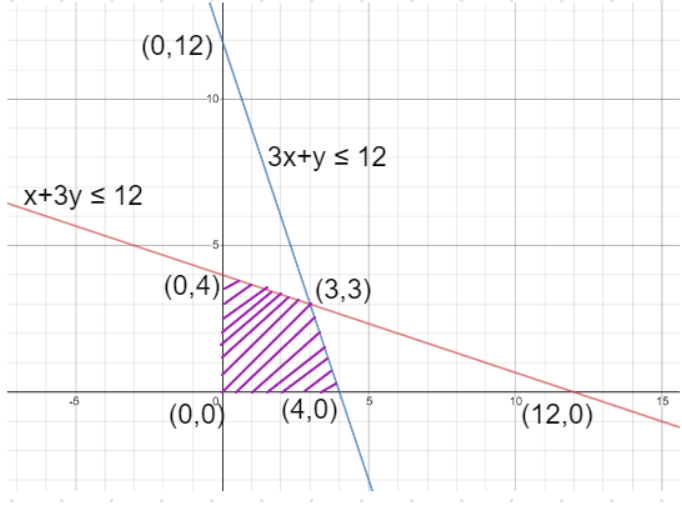
Let us plot both these straight lines given by equations (6) and (7) which are obtained by considering just the equality of the linear inequalities (1) and (2).
Since, the origin O(0,0) satisfies both the linear inequalities given by (1) and (2).
The linear inequalities given by (3) and (4) refer that only the first quadrant is feasible for the solution.
So, the feasible region which satisfies all the four linear inequalities is coloured violet as shown in the figure.
Equation (6) can be rewritten as
$ \Rightarrow x = 12 - 3y$
Put the value of x from the above equation in equation (7), we get
$
\Rightarrow 3\left( {12 - 3y} \right) + y = 12 \\
\Rightarrow 36 - 9y + y = 12 \\
\Rightarrow 8y = 24 \\
\Rightarrow y = 3 \\
$
Put y = 3 in the equation $x = 12 - 3y$, we have
$
\Rightarrow x = 12 - \left( {3 \times 3} \right) \\
\Rightarrow x = 12 - 9 \\
\Rightarrow x = 3 \\
$
The point where both the straight lines given by equations (6) and (7) will meet is (3,3)
Corner points of the feasible region (coloured at violet) are (0,0), (4,0), (3,3) and (0,4).
For point (0,0), \[
z = 17.5x + 7y \\
\Rightarrow z = \left( {17.5 \times 0} \right) + \left( {7 \times 0} \right) \\
\Rightarrow z = 0 \\
\]
For point (4,0), \[
z = 17.5x + 7y \\
\Rightarrow z = \left( {17.5 \times 4} \right) + \left( {7 \times 0} \right) \\
\Rightarrow z = 70 \\
\]
For point (3,3), \[
z = 17.5x + 7y \\
\Rightarrow z = \left( {17.5 \times 3} \right) + \left( {7 \times 3} \right) \\
\Rightarrow z = 73.5 \\
\]
For point (0,4), \[
z = 17.5x + 7y \\
\Rightarrow z = \left( {17.5 \times 0} \right) + \left( {7 \times 4} \right) \\
\Rightarrow z = 0 + 28 \\
\Rightarrow z = 28 \\
\]
Clearly, the maximum value of the profit function z is Rs 73.5.
Therefore, the number of packages of nuts produced each day is 3 and the number of packages of bolts produced each day is 3 i.e., 3 packages each.
Hence, option C is correct.
Note: In this particular problem, if we will put x = 0 and y = 0 in the linear inequalities $x + 3y \leqslant 12$ and $3x + y \leqslant 12$, we will get $0 \leqslant 12$ which is true. This means that origin (0,0) satisfies both the linear inequalities. In order to find the point corresponding to which the maximum or minimum value of the function occurs, we will find all the extremes points (i.e., corner points) of the feasible region.
Complete step-by-step answer:
Let x be the number of packages of nuts produced each day and y be the number of packages of bolts produced each day.
According to the problem statement,
In order to produce 1 package of nuts, 1 hour of work on machine A and 3 hours of work on machine B is required.
In order to produce 1 package of bolts, 3 hours of work on machine A and 1 hour of work on machine B is required.
Also, machines A and B operate for a maximum of 12 hours a day.
$
x + 3y \leqslant 12{\text{ }} \to {\text{(1)}} \\
3x + y \leqslant 12{\text{ }} \to {\text{(2)}} \\
$
Since, the number of packages can never be negative.
$
x \geqslant 0{\text{ }} \to {\text{(3)}} \\
y \geqslant 0{\text{ }} \to {\text{(4)}} \\
$
Profit function is given by
\[z = 17.5x + 7y{\text{ }} \to {\text{(5)}}\]
Here, we need to maximize the profit function i.e., z
Consider the straight line $x + 3y = 12{\text{ }} \to {\text{(6)}}$
Put x = 0 in equation (6), we get
$
\Rightarrow 0 + 3y = 12 \\
\Rightarrow y = 4 \\
$
Put y = 0 in equation (6), we get
$
\Rightarrow x + \left( {3 \times 0} \right) = 12 \\
\Rightarrow x = 12 \\
$
So, the passing points of the straight line given by equation (6) are (0,4) and (12,0).
Consider the straight line $3x + y = 12{\text{ }} \to {\text{(7)}}$
Put x = 0 in equation (7), we get
\[
\Rightarrow \left( {3 \times 0} \right) + y = 12 \\
\Rightarrow y = 12 \\
\]
Put y = 0 in equation (7), we get
$
\Rightarrow 3x + 0 = 12 \\
\Rightarrow x = 4 \\
$
So, the passing points of the straight line given by equation (7) are (0,12) and (4,0).
Let us plot both these straight lines given by equations (6) and (7) which are obtained by considering just the equality of the linear inequalities (1) and (2).
Since, the origin O(0,0) satisfies both the linear inequalities given by (1) and (2).
The linear inequalities given by (3) and (4) refer that only the first quadrant is feasible for the solution.
So, the feasible region which satisfies all the four linear inequalities is coloured violet as shown in the figure.
Equation (6) can be rewritten as
$ \Rightarrow x = 12 - 3y$
Put the value of x from the above equation in equation (7), we get
$
\Rightarrow 3\left( {12 - 3y} \right) + y = 12 \\
\Rightarrow 36 - 9y + y = 12 \\
\Rightarrow 8y = 24 \\
\Rightarrow y = 3 \\
$
Put y = 3 in the equation $x = 12 - 3y$, we have
$
\Rightarrow x = 12 - \left( {3 \times 3} \right) \\
\Rightarrow x = 12 - 9 \\
\Rightarrow x = 3 \\
$
The point where both the straight lines given by equations (6) and (7) will meet is (3,3)
Corner points of the feasible region (coloured at violet) are (0,0), (4,0), (3,3) and (0,4).
For point (0,0), \[
z = 17.5x + 7y \\
\Rightarrow z = \left( {17.5 \times 0} \right) + \left( {7 \times 0} \right) \\
\Rightarrow z = 0 \\
\]
For point (4,0), \[
z = 17.5x + 7y \\
\Rightarrow z = \left( {17.5 \times 4} \right) + \left( {7 \times 0} \right) \\
\Rightarrow z = 70 \\
\]
For point (3,3), \[
z = 17.5x + 7y \\
\Rightarrow z = \left( {17.5 \times 3} \right) + \left( {7 \times 3} \right) \\
\Rightarrow z = 73.5 \\
\]
For point (0,4), \[
z = 17.5x + 7y \\
\Rightarrow z = \left( {17.5 \times 0} \right) + \left( {7 \times 4} \right) \\
\Rightarrow z = 0 + 28 \\
\Rightarrow z = 28 \\
\]
Clearly, the maximum value of the profit function z is Rs 73.5.
Therefore, the number of packages of nuts produced each day is 3 and the number of packages of bolts produced each day is 3 i.e., 3 packages each.
Hence, option C is correct.
Note: In this particular problem, if we will put x = 0 and y = 0 in the linear inequalities $x + 3y \leqslant 12$ and $3x + y \leqslant 12$, we will get $0 \leqslant 12$ which is true. This means that origin (0,0) satisfies both the linear inequalities. In order to find the point corresponding to which the maximum or minimum value of the function occurs, we will find all the extremes points (i.e., corner points) of the feasible region.
Recently Updated Pages
Master Class 12 Business Studies: Engaging Questions & Answers for Success

Master Class 12 Biology: Engaging Questions & Answers for Success
Master Class 12 Chemistry: Engaging Questions & Answers for Success
Class 12 Question and Answer - Your Ultimate Solutions Guide
Master Class 11 Social Science: Engaging Questions & Answers for Success
Master Class 11 English: Engaging Questions & Answers for Success
Trending doubts
Explain the Treaty of Vienna of 1815 class 10 social science CBSE
Who Won 36 Oscar Awards? Record Holder Revealed
What is the median of the first 10 natural numbers class 10 maths CBSE
Why is it 530 pm in india when it is 1200 afternoon class 10 social science CBSE
Why is there a time difference of about 5 hours between class 10 social science CBSE
What is the full form of POSCO class 10 social science CBSE