




A man on the top of a cliff 100 m high, observe the angles of depression of two points on the opposite sides of the cliff as \[{{30}^{\circ }}\] and \[{{60}^{\circ }}\] respectively. Then, the distance between the two points is equal to
(a)$400\sqrt{3}m$
(b)$\dfrac{400}{\sqrt{3}}m$
(c)$\dfrac{100}{\sqrt{3}}m$
(d)$200\sqrt{3}$
Answer
 Verified
623.1k+ views
Hint: For solving this problem, we consider two triangles ABD and ADC having respective bases as a and b in metres. Now, by applying the trigonometric ratio of $\tan \theta $ in both the triangles, we obtain the respective bases individually as height is already given in the problem statement. By adding both the bases of the triangle, we get the final answer.
Complete step-by-step answer:
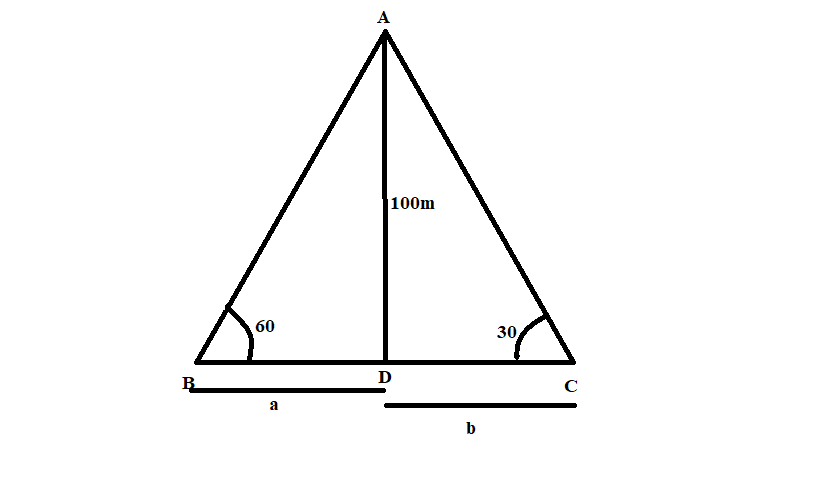
Let, the base of triangle ABD be ‘a’ meters and base of triangle ADC be ‘b’ meters.
According to the problem statement, the height of the cliff is 100m, $\angle ABD={{60}^{\circ }}$ and $\angle ACD={{30}^{\circ }}$.
One useful trigonometric ratio involved in this problem is tan which can be expressed as:
$\tan \theta =\dfrac{perpendicular}{base}$
In $\Delta ABD$, applying tan${{60}^{\circ }}$, we get
$\tan {{60}^{\circ }}=\dfrac{AD}{BD}$
As we know that the value of $\tan {{60}^{\circ }}=\sqrt{3}$, AD =100m and BD = a meter. Therefore, to evaluate a we put the values in the above ratio.
$\begin{align}
& \sqrt{3}=\dfrac{100}{a} \\
& a=\dfrac{100}{\sqrt{3}}m \\
\end{align}$
The length of BD is $\dfrac{100}{\sqrt{3}}m$.
In $\Delta ADC$, applying $\tan {{30}^{\circ }}$, we get
$\tan {{30}^{\circ }}=\dfrac{AD}{DC}$
As we know that the value of tan${{30}^{\circ }}=\dfrac{1}{\sqrt{3}}$, AD = 100 m and DC = b meter.
$\begin{align}
& \dfrac{1}{\sqrt{3}}=\dfrac{100}{b} \\
& b=100\sqrt{3}m \\
\end{align}$
The value of DC is $100\sqrt{3}m$,
Adding both the value of BD and DC with each other, we get
$\begin{align}
& a+b=\dfrac{100}{\sqrt{3}}+100\sqrt{3} \\
& a+b=\dfrac{400}{\sqrt{3}}m \\
\end{align}$
Hence, the distance between two points is $\dfrac{400}{\sqrt{3}}m$.
Therefore, option (b) is correct.
Note: The key concept involved in solving this problem is the knowledge of trigonometric ratio in the form of triangles. Once we know the value of angle subtended, we can easily find the ratio between the length by using tan operation.
Complete step-by-step answer:
Let, the base of triangle ABD be ‘a’ meters and base of triangle ADC be ‘b’ meters.
According to the problem statement, the height of the cliff is 100m, $\angle ABD={{60}^{\circ }}$ and $\angle ACD={{30}^{\circ }}$.
One useful trigonometric ratio involved in this problem is tan which can be expressed as:
$\tan \theta =\dfrac{perpendicular}{base}$
In $\Delta ABD$, applying tan${{60}^{\circ }}$, we get
$\tan {{60}^{\circ }}=\dfrac{AD}{BD}$
As we know that the value of $\tan {{60}^{\circ }}=\sqrt{3}$, AD =100m and BD = a meter. Therefore, to evaluate a we put the values in the above ratio.
$\begin{align}
& \sqrt{3}=\dfrac{100}{a} \\
& a=\dfrac{100}{\sqrt{3}}m \\
\end{align}$
The length of BD is $\dfrac{100}{\sqrt{3}}m$.
In $\Delta ADC$, applying $\tan {{30}^{\circ }}$, we get
$\tan {{30}^{\circ }}=\dfrac{AD}{DC}$
As we know that the value of tan${{30}^{\circ }}=\dfrac{1}{\sqrt{3}}$, AD = 100 m and DC = b meter.
$\begin{align}
& \dfrac{1}{\sqrt{3}}=\dfrac{100}{b} \\
& b=100\sqrt{3}m \\
\end{align}$
The value of DC is $100\sqrt{3}m$,
Adding both the value of BD and DC with each other, we get
$\begin{align}
& a+b=\dfrac{100}{\sqrt{3}}+100\sqrt{3} \\
& a+b=\dfrac{400}{\sqrt{3}}m \\
\end{align}$
Hence, the distance between two points is $\dfrac{400}{\sqrt{3}}m$.
Therefore, option (b) is correct.
Note: The key concept involved in solving this problem is the knowledge of trigonometric ratio in the form of triangles. Once we know the value of angle subtended, we can easily find the ratio between the length by using tan operation.
Recently Updated Pages
Basicity of sulphurous acid and sulphuric acid are

Master Class 11 Business Studies: Engaging Questions & Answers for Success
Master Class 11 Computer Science: Engaging Questions & Answers for Success
Master Class 11 Economics: Engaging Questions & Answers for Success
Master Class 11 Social Science: Engaging Questions & Answers for Success
Master Class 11 English: Engaging Questions & Answers for Success
Trending doubts
One Metric ton is equal to kg A 10000 B 1000 C 100 class 11 physics CBSE
The largest wind power cluster is located in the state class 11 social science CBSE
Explain zero factorial class 11 maths CBSE
State and prove Bernoullis theorem class 11 physics CBSE
What steps did the French revolutionaries take to create class 11 social science CBSE
Which among the following are examples of coming together class 11 social science CBSE