




A man of mass 50 kg climbs up a ladder of height 10m. calculate the increase in his potential energy. ($g=9.8m{{s}^{-2}}$ )
a) 490J
b) 2450J
c) 4900J
d) 0J
Answer
 Verified
612.3k+ views
Hint: The increase in the potential energy of the man is basically the work done by him to overcome the Earth’s gravitational force. The work done on a body is mathematically defined as, $W=F.d$ where F is the force on the body and d is the displacement of the body along the action of force. Hence from the above equation we can calculate the increase in the potential energy i.e. work done in moving up to a height of 10m against the gravitational force on the man.
Complete step by step answer:
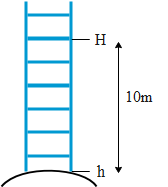
The force of gravity is equal to the, ${{F}_{g}}=mg$ where m is the mass of the object and g is the acceleration due to gravity. In the above question a man climbs a ladder and goes up to a height of H as shown in the diagram. Hence work done by him is equals to,
$\begin{align}
& W=F.d \\
& W=mgH \\
\end{align}$
Let us say the man goes from height h to a height H on the ladder. Hence its increase in potential energy (E)from the above equation we get,
$E=mgH-mgh$ Let us say the man started climbing from the ground i.e. h=0. Hence we get the increase in potential energy as,
$E=mgH$. The mass of the man is 50kg and climbs up to a height of 10m from the ground. Therefore the potential energy of the man is numerically equal to,
$\begin{align}
& E=mgH \\
& E=50\times 9.8\times 10 \\
& E=4900J \\
\end{align}$
Hence the correct answer to the above question is option C.
Note:
The expression we obtained for the increase in potential energy is valid up to a particular height. This is because the value of acceleration due to gravity changes with the altitude. It is also to be noted that the mass of the body has to be always expressed in terms of kg as it is the SI unit for mass.
Complete step by step answer:
The force of gravity is equal to the, ${{F}_{g}}=mg$ where m is the mass of the object and g is the acceleration due to gravity. In the above question a man climbs a ladder and goes up to a height of H as shown in the diagram. Hence work done by him is equals to,
$\begin{align}
& W=F.d \\
& W=mgH \\
\end{align}$
Let us say the man goes from height h to a height H on the ladder. Hence its increase in potential energy (E)from the above equation we get,
$E=mgH-mgh$ Let us say the man started climbing from the ground i.e. h=0. Hence we get the increase in potential energy as,
$E=mgH$. The mass of the man is 50kg and climbs up to a height of 10m from the ground. Therefore the potential energy of the man is numerically equal to,
$\begin{align}
& E=mgH \\
& E=50\times 9.8\times 10 \\
& E=4900J \\
\end{align}$
Hence the correct answer to the above question is option C.
Note:
The expression we obtained for the increase in potential energy is valid up to a particular height. This is because the value of acceleration due to gravity changes with the altitude. It is also to be noted that the mass of the body has to be always expressed in terms of kg as it is the SI unit for mass.
Recently Updated Pages
Master Class 12 Business Studies: Engaging Questions & Answers for Success

Master Class 12 Biology: Engaging Questions & Answers for Success
Master Class 12 Chemistry: Engaging Questions & Answers for Success
Class 12 Question and Answer - Your Ultimate Solutions Guide
Master Class 11 Social Science: Engaging Questions & Answers for Success
Master Class 11 English: Engaging Questions & Answers for Success
Trending doubts
Which are the Top 10 Largest Countries of the World?
Draw a labelled sketch of the human eye class 12 physics CBSE
Name the crygenes that control cotton bollworm and class 12 biology CBSE
Differentiate between homogeneous and heterogeneous class 12 chemistry CBSE
Ribosomal RNA is actively synthesised in A Nucleoplasm class 12 biology CBSE
How many molecules of ATP and NADPH are required information class 12 biology CBSE