




A man of height 6 ft. observes the top of a tower and the foot of the tower at angles of \[45^\circ \] and \[30^\circ \] of elevation and depression respectively. Assuming the man to stand on the level ground, the height of the tower is:
A) \[6\left( {\sqrt 3 - 1} \right)\] ft.
B) \[6\left( {\sqrt 3 + 1} \right)\] ft.
C) \[6\left( {\sqrt 2 - 1} \right)\] ft.
D) None of these
Answer
 Verified
628.5k+ views
Hint: Use trigonometry ratio \[\tan \theta = \dfrac{{{\text{Perpendicular}}}}{{{\text{Base}}}}\] in the triangle making \[30^\circ \] and find the base from this then use this trigonometry ratio in the triangle making \[45^\circ \] and use the obtained base value into this.
Complete Step-by-Step solution:
First, we will draw the figure,
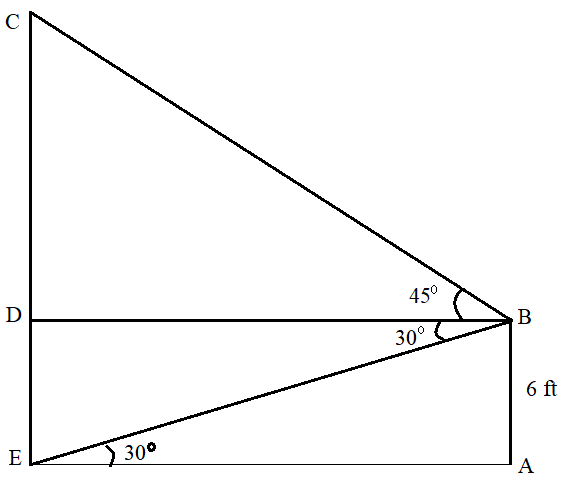
Angle DEB is given in the question.
As we know that alternate interior angles are equal, so angle BCE will be the same as angle DEB that is .
In the triangle BAE, angle E is known and the perpendicular AB is known and we want to compute base AE so, we can use \[\tan \theta = \dfrac{{{\text{Perpendicular}}}}{{{\text{Base}}}}\].
Now we are applying this trigonometric ratio into the triangle BAE and substituting the values into trigonometric ratio,
\[
\tan 30^\circ = \dfrac{{AB}}{{EA}} \\
\tan 30^\circ = \dfrac{6}{{EA}} \\
\]
As we know \[\tan 30^\circ = \dfrac{{\text{1}}}{{\sqrt 3 }}\] substituting this value and solve for EA,
\[
\dfrac{1}{{\sqrt 3 }} = \dfrac{6}{{EA}} \\
EA = 6\sqrt 3 \\
\]
Side EA is equivalent to side DB.
Thus, \[DB = EA = 6\sqrt 3 \]
Now we are applying trigonometric ratio \[\tan \theta = \dfrac{{{\text{Perpendicular}}}}{{{\text{Base}}}}\] into the triangle DBC and substituting the values into trigonometric ratio,
\[\tan 45^\circ = \dfrac{{DC}}{{DB}}\]
As we know \[\tan 45^\circ = 1\] and we have \[DB = EA = 6\sqrt 3 \], substituting these values and solving,
\[
1 = \dfrac{{DC}}{{6\sqrt 3 }} \\
DC = 6\sqrt 3 \\
\]
From the figure, it is seen that the height of the building is the sum of ED and DC.
Now we have the value of ED and DC. So, we will add these to find the height of the building,
\[
ED + DC = 6 + 6\sqrt 3 \\
= 6\left( {1 + \sqrt 3 } \right) \\
\]
Thus, the height of the building is \[6\left( {1 + \sqrt 3 } \right)\] ft.
Hence option B is correct.
Note:
Any of the trigonometric functions can be used to find the answer but while solving these types of questions we have to first focus on “what we have to find” and then on “what data we have” so make our calculation shorter.
Complete Step-by-Step solution:
First, we will draw the figure,
Angle DEB is given in the question.
As we know that alternate interior angles are equal, so angle BCE will be the same as angle DEB that is .
In the triangle BAE, angle E is known and the perpendicular AB is known and we want to compute base AE so, we can use \[\tan \theta = \dfrac{{{\text{Perpendicular}}}}{{{\text{Base}}}}\].
Now we are applying this trigonometric ratio into the triangle BAE and substituting the values into trigonometric ratio,
\[
\tan 30^\circ = \dfrac{{AB}}{{EA}} \\
\tan 30^\circ = \dfrac{6}{{EA}} \\
\]
As we know \[\tan 30^\circ = \dfrac{{\text{1}}}{{\sqrt 3 }}\] substituting this value and solve for EA,
\[
\dfrac{1}{{\sqrt 3 }} = \dfrac{6}{{EA}} \\
EA = 6\sqrt 3 \\
\]
Side EA is equivalent to side DB.
Thus, \[DB = EA = 6\sqrt 3 \]
Now we are applying trigonometric ratio \[\tan \theta = \dfrac{{{\text{Perpendicular}}}}{{{\text{Base}}}}\] into the triangle DBC and substituting the values into trigonometric ratio,
\[\tan 45^\circ = \dfrac{{DC}}{{DB}}\]
As we know \[\tan 45^\circ = 1\] and we have \[DB = EA = 6\sqrt 3 \], substituting these values and solving,
\[
1 = \dfrac{{DC}}{{6\sqrt 3 }} \\
DC = 6\sqrt 3 \\
\]
From the figure, it is seen that the height of the building is the sum of ED and DC.
Now we have the value of ED and DC. So, we will add these to find the height of the building,
\[
ED + DC = 6 + 6\sqrt 3 \\
= 6\left( {1 + \sqrt 3 } \right) \\
\]
Thus, the height of the building is \[6\left( {1 + \sqrt 3 } \right)\] ft.
Hence option B is correct.
Note:
Any of the trigonometric functions can be used to find the answer but while solving these types of questions we have to first focus on “what we have to find” and then on “what data we have” so make our calculation shorter.
Recently Updated Pages
Master Class 12 Economics: Engaging Questions & Answers for Success

Master Class 12 English: Engaging Questions & Answers for Success
Master Class 12 Social Science: Engaging Questions & Answers for Success
Master Class 12 Maths: Engaging Questions & Answers for Success
Master Class 12 Physics: Engaging Questions & Answers for Success
Master Class 10 English: Engaging Questions & Answers for Success
Trending doubts
Explain the Treaty of Vienna of 1815 class 10 social science CBSE
Why is it 530 pm in india when it is 1200 afternoon class 10 social science CBSE
What is the full form of POSCO class 10 social science CBSE
Define Potential, Developed, Stock and Reserved resources
Which Country Has the Largest Border with India?
Complete the sentence with the most appropriate word class 10 english CBSE