




A man of 72kg weight is standing on a board inclined at ${{20}^{\circ }}$ with the horizontal find the components of man weight (i) perpendicular to the board (ii) parallel to the plane of time board
Answer
 Verified
608.4k+ views
Hint: First draw body diagram of the man inclined on the board at 20 degree. That is, a free body diagram is a schematic diagram representing the information of forces acting on the body including the magnitude and direction of the forces. From that find the parallel and perpendicular components acting on the body. The weight of the body is the product of mass and acceleration due to gravity which acts downwards. Then find the parallel and perpendicular forces acting on that man. Thus we get the components of man weight in perpendicular and parallel to the board.
Complete answer:
Given that the weight of man is,
m= 72kg
And the standing board inclines at $\theta ={{20}^{\circ }}$ with the horizontal.
The free body diagram for the given data can be shown as,
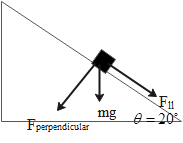
From the figure,
Thus the component of man’s weight perpendicular to the board is,
${{F}_{\bot }}=mg\cos \theta $
$\Rightarrow {{F}_{\bot }}=72\cos ({{20}^{\circ }})$ $=67.66N$
Then the component of man’s weight parallel to board is,
${{F}_{ll}}=mg\sin \theta $
$\Rightarrow {{F}_{ll}}=72\sin \left( {{20}^{\circ }} \right)$
$\Rightarrow {{F}_{ll}}=24.63N$
Note:
To handle a typical problem in mechanics a schematic diagram should be drawn showing various parts of the body and forces acting on it. This schematic diagram is known as the free body diagram. In a free body diagram, we should include information about forces, that is their magnitude as well as direction.
Complete answer:
Given that the weight of man is,
m= 72kg
And the standing board inclines at $\theta ={{20}^{\circ }}$ with the horizontal.
The free body diagram for the given data can be shown as,
From the figure,
Thus the component of man’s weight perpendicular to the board is,
${{F}_{\bot }}=mg\cos \theta $
$\Rightarrow {{F}_{\bot }}=72\cos ({{20}^{\circ }})$ $=67.66N$
Then the component of man’s weight parallel to board is,
${{F}_{ll}}=mg\sin \theta $
$\Rightarrow {{F}_{ll}}=72\sin \left( {{20}^{\circ }} \right)$
$\Rightarrow {{F}_{ll}}=24.63N$
Note:
To handle a typical problem in mechanics a schematic diagram should be drawn showing various parts of the body and forces acting on it. This schematic diagram is known as the free body diagram. In a free body diagram, we should include information about forces, that is their magnitude as well as direction.
Recently Updated Pages
Master Class 11 Social Science: Engaging Questions & Answers for Success

Master Class 11 Chemistry: Engaging Questions & Answers for Success
Master Class 12 Business Studies: Engaging Questions & Answers for Success
Master Class 12 Chemistry: Engaging Questions & Answers for Success
Master Class 12 Biology: Engaging Questions & Answers for Success
Class 12 Question and Answer - Your Ultimate Solutions Guide
Trending doubts
One Metric ton is equal to kg A 10000 B 1000 C 100 class 11 physics CBSE
Difference Between Prokaryotic Cells and Eukaryotic Cells
How many of the following diseases can be studied with class 11 biology CBSE
Two of the body parts which do not appear in MRI are class 11 biology CBSE
Which of the following enzymes is used for carboxylation class 11 biology CBSE
Explain zero factorial class 11 maths CBSE