




A line segment has endpoints at \[\left( {2,7} \right)\] and $\left( {5,4} \right)$. The line segment is dilated by a factor of $2$ around $\left( {4,3} \right)$. What are the new endpoints and length of the line segment?
Answer
 Verified
505.5k+ views
Hint: Here, in the given question we are given, a line segment has endpoints at \[\left( {2,7} \right)\] and $\left( {5,4} \right)$ and this line segment is dilated by a factor of $2$ around $\left( {4,3} \right)$ and we need to find the new points and length of the line segment. Dilation is a transformation, which is used to resize the object. Dilation is used to make the objects larger or smaller. At first we will find the new endpoints using the dilution factor. If a point $A$ of coordinate $\left( {a,b} \right)$ be dilated by a factor $n$ around the point of coordinate $\left( {h,k} \right)$, then after dilation the new position will be $A' = \left( {n\left( {a - h} \right) + h,n\left( {b - k} \right) + k} \right)$. After this, we will find the length of line segment of new end points using distance formula, $D = \sqrt {{{\left( {{x_2} - {x_1}} \right)}^2} + {{\left( {{y_2} - {y_1}} \right)}^2}} $.
Complete step by step answer:
Let $\overline {PQ} $ be a line segment on the coordinate plane with endpoints at \[\left( {2,7} \right)\] and $\left( {5,4} \right)$.
The absolute value of the scale factor $\left( n \right)$, with the constraint $0 < n < 1$, reduces the line segment $\overline {PQ} $, enlarges if otherwise.
The scale factor of dilation is $2$.
Now, let us find the new endpoints using $A' = \left( {n\left( {a - h} \right) + h,n\left( {b - k} \right) + k} \right)$
Given, endpoints \[P\left( {2,7} \right)\] and $Q\left( {5,4} \right)$.
For point \[P\left( {2,7} \right)\], we have $n = 2$ and $\left( {h,k} \right) = \left( {4,3} \right)$. So, new endpoint will be:
$ \Rightarrow P' = \left( {2\left( {2 - 4} \right) + 4,2\left( {7 - 3} \right) + 3} \right)$
On subtraction of terms, we get
$ \Rightarrow P' = \left( {2\left( { - 2} \right) + 4,2\left( 4 \right) + 3} \right)$
On multiplication of terms, we get
$ \Rightarrow P' = \left( { - 4 + 4,8 + 3} \right)$
$ \Rightarrow P' = \left( {0,11} \right)$
For point \[Q\left( {5,4} \right)\], We have $n = 2$ and $\left( {h,k} \right) = \left( {4,3} \right)$. So, new endpoint will be:
$ \Rightarrow Q' = \left( {2\left( {5 - 4} \right) + 4,2\left( {4 - 3} \right) + 3} \right)$
On subtraction of terms, we get
$ \Rightarrow Q' = \left( {2\left( 1 \right) + 4,2\left( 1 \right) + 3} \right)$
On multiplication of terms, we get
$ \Rightarrow Q' = \left( {2 + 4,2 + 3} \right)$
$ \Rightarrow Q' = \left( {6,5} \right)$
New end-points: $P'\left( {0,11} \right)$ and $Q'\left( {6,5} \right)$.
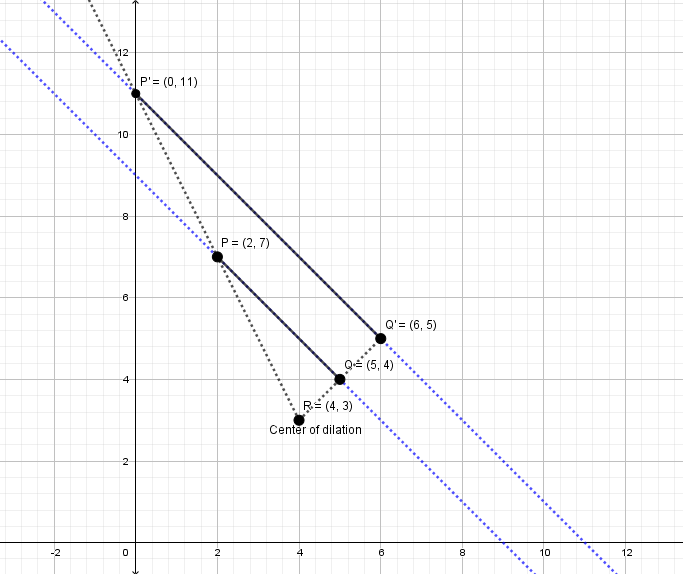
Here $\overline {PQ} $ is the pre-image and after dilation, $\overline {P'Q'} $ is called the image. Note that the pre-image and the image are parallel.
Observe that the points (center of dilation $R$, $P$ and $P'$) are collinear.
And, the points (center of dilation $R$, $Q$ and $Q'$) are collinear.
$\overline {PQ} \parallel \overline {P'Q'} $, since we have congruent corresponding angles.
Also, from $R\left( {4,3} \right)$, move up $4units$ on the $y - axis$, and $2units$ left on the $x - axis$ to reach the endpoint $P\left( {2,7} \right)$.
Move $\left( {4 \times 2 = 8units} \right)$ up on the $y - axis$, and $\left( {2 \times 2 = 4units} \right)$ left on the $x - axis$, to reach the point $P'\left( {0,11} \right)$.
From $R\left( {4,3} \right)$, move up $1unit$ on the $y - axis$, and $1unit$ right on the $x - axis$ to reach the endpoint $Q\left( {5,4} \right)$.
Move $\left( {1 \times 2 = 2units} \right)$ up on the $y - axis$, and $\left( {1 \times 2 = 2units} \right)$ to the right on the $x - axis$, to reach the point $Q'\left( {6,5} \right)$.
Now, we will find the length of the line segment or length of the image $\overline {P'Q'} $.
Distance formula: $D = \sqrt {{{\left( {{x_2} - {x_1}} \right)}^2} + {{\left( {{y_2} - {y_1}} \right)}^2}} $, let $\left( {{x_1},{y_1}} \right)$ be $\left( {6,5} \right)$ and $\left( {{x_2},{y_2}} \right)$ be $\left( {0,11} \right)$. Therefore, on substituting the values, we get
$ \Rightarrow D = \sqrt {{{\left( {0 - 6} \right)}^2} + {{\left( {11 - 5} \right)}^2}} $
On subtraction of terms, we get
$ \Rightarrow D = \sqrt {{{\left( 6 \right)}^2} + {{\left( 6 \right)}^2}} $
$ \Rightarrow D = \sqrt {36 + 36} $
On addition of terms, we get
$ \Rightarrow D = \sqrt {72} $
$ \Rightarrow D = 8.48$
Thus, length of line segment $\overline {P'Q'} = 8.48units$.
Therefore, the new endpoints are $P'\left( {0,11} \right)$ and $Q'\left( {6,5} \right)$ and length of line segment is $8.48units$.
Note: Remember that dilation is not an isometry. It creates similar figures only and dilation preserves the angle of measure. Remember that a scale factor of $n = 1$ means that the segment and its image are equal. The dilation does not enlarge or shrink the image of the figure; it remains unchanged. Also, when the scale factor $n > 1$, a dilation is an enlargement. When $0 < n < 1$, a dilation is a reduction.
Complete step by step answer:
Let $\overline {PQ} $ be a line segment on the coordinate plane with endpoints at \[\left( {2,7} \right)\] and $\left( {5,4} \right)$.
The absolute value of the scale factor $\left( n \right)$, with the constraint $0 < n < 1$, reduces the line segment $\overline {PQ} $, enlarges if otherwise.
The scale factor of dilation is $2$.
Now, let us find the new endpoints using $A' = \left( {n\left( {a - h} \right) + h,n\left( {b - k} \right) + k} \right)$
Given, endpoints \[P\left( {2,7} \right)\] and $Q\left( {5,4} \right)$.
For point \[P\left( {2,7} \right)\], we have $n = 2$ and $\left( {h,k} \right) = \left( {4,3} \right)$. So, new endpoint will be:
$ \Rightarrow P' = \left( {2\left( {2 - 4} \right) + 4,2\left( {7 - 3} \right) + 3} \right)$
On subtraction of terms, we get
$ \Rightarrow P' = \left( {2\left( { - 2} \right) + 4,2\left( 4 \right) + 3} \right)$
On multiplication of terms, we get
$ \Rightarrow P' = \left( { - 4 + 4,8 + 3} \right)$
$ \Rightarrow P' = \left( {0,11} \right)$
For point \[Q\left( {5,4} \right)\], We have $n = 2$ and $\left( {h,k} \right) = \left( {4,3} \right)$. So, new endpoint will be:
$ \Rightarrow Q' = \left( {2\left( {5 - 4} \right) + 4,2\left( {4 - 3} \right) + 3} \right)$
On subtraction of terms, we get
$ \Rightarrow Q' = \left( {2\left( 1 \right) + 4,2\left( 1 \right) + 3} \right)$
On multiplication of terms, we get
$ \Rightarrow Q' = \left( {2 + 4,2 + 3} \right)$
$ \Rightarrow Q' = \left( {6,5} \right)$
New end-points: $P'\left( {0,11} \right)$ and $Q'\left( {6,5} \right)$.
Here $\overline {PQ} $ is the pre-image and after dilation, $\overline {P'Q'} $ is called the image. Note that the pre-image and the image are parallel.
Observe that the points (center of dilation $R$, $P$ and $P'$) are collinear.
And, the points (center of dilation $R$, $Q$ and $Q'$) are collinear.
$\overline {PQ} \parallel \overline {P'Q'} $, since we have congruent corresponding angles.
Also, from $R\left( {4,3} \right)$, move up $4units$ on the $y - axis$, and $2units$ left on the $x - axis$ to reach the endpoint $P\left( {2,7} \right)$.
Move $\left( {4 \times 2 = 8units} \right)$ up on the $y - axis$, and $\left( {2 \times 2 = 4units} \right)$ left on the $x - axis$, to reach the point $P'\left( {0,11} \right)$.
From $R\left( {4,3} \right)$, move up $1unit$ on the $y - axis$, and $1unit$ right on the $x - axis$ to reach the endpoint $Q\left( {5,4} \right)$.
Move $\left( {1 \times 2 = 2units} \right)$ up on the $y - axis$, and $\left( {1 \times 2 = 2units} \right)$ to the right on the $x - axis$, to reach the point $Q'\left( {6,5} \right)$.
Now, we will find the length of the line segment or length of the image $\overline {P'Q'} $.
Distance formula: $D = \sqrt {{{\left( {{x_2} - {x_1}} \right)}^2} + {{\left( {{y_2} - {y_1}} \right)}^2}} $, let $\left( {{x_1},{y_1}} \right)$ be $\left( {6,5} \right)$ and $\left( {{x_2},{y_2}} \right)$ be $\left( {0,11} \right)$. Therefore, on substituting the values, we get
$ \Rightarrow D = \sqrt {{{\left( {0 - 6} \right)}^2} + {{\left( {11 - 5} \right)}^2}} $
On subtraction of terms, we get
$ \Rightarrow D = \sqrt {{{\left( 6 \right)}^2} + {{\left( 6 \right)}^2}} $
$ \Rightarrow D = \sqrt {36 + 36} $
On addition of terms, we get
$ \Rightarrow D = \sqrt {72} $
$ \Rightarrow D = 8.48$
Thus, length of line segment $\overline {P'Q'} = 8.48units$.
Therefore, the new endpoints are $P'\left( {0,11} \right)$ and $Q'\left( {6,5} \right)$ and length of line segment is $8.48units$.
Note: Remember that dilation is not an isometry. It creates similar figures only and dilation preserves the angle of measure. Remember that a scale factor of $n = 1$ means that the segment and its image are equal. The dilation does not enlarge or shrink the image of the figure; it remains unchanged. Also, when the scale factor $n > 1$, a dilation is an enlargement. When $0 < n < 1$, a dilation is a reduction.
Recently Updated Pages
Master Class 11 Social Science: Engaging Questions & Answers for Success

Master Class 11 Physics: Engaging Questions & Answers for Success
Master Class 11 Maths: Engaging Questions & Answers for Success
Master Class 11 Economics: Engaging Questions & Answers for Success
Master Class 11 Computer Science: Engaging Questions & Answers for Success
Master Class 11 Chemistry: Engaging Questions & Answers for Success
Trending doubts
One Metric ton is equal to kg A 10000 B 1000 C 100 class 11 physics CBSE
How many bones are in the spine class 11 biology CBSE
There are 720 permutations of the digits 1 2 3 4 5 class 11 maths CBSE
What is charge mass and charge to mass ratio of an class 11 chemistry CBSE
State and prove Bernoullis theorem class 11 physics CBSE
Difference Between Prokaryotic Cells and Eukaryotic Cells